




It is a little-known fact that Australia has the third longest computing history of any country, behind only the USA and the UK.
The very first playing of digital music happened here, WiFi was invented here, Google Maps early version was developed here, and the CSIRAC Mainframe in the Melbourne Museum is the oldest computer still in existence.
In 2026, the Australian Computer Society (ACS) marks the 60th anniversary of its founding as only the 7th such group worldwide.
This is a milestone that arrives just as artificial intelligence is reshaping the technology workforce all over again.
It is a useful moment to look back, because Australia's relationship with "the computer" is older, and stranger, than most people realise.
In fact, long before silicon chips or the digital age, the word was actually used to describe not a machine, but people.
When ‘computer’ meant a job, not a device
During the Second World War, Australia hosted one of the Allies' most important code-breaking operations, the Central Bureau based in Brisbane, Queensland under General Douglas MacArthur's command.
At Nyrambla, a requisitioned mansion in Ascot Park, and a nearby fire station, banks of staff – many of them women – worked as human "computers", manually processing intercepted radio transmissions and operating rows of IBM punched-card machines to help crack enemy cyphers.
The job title ‘computer’ reflected the job itself: a person who computes.
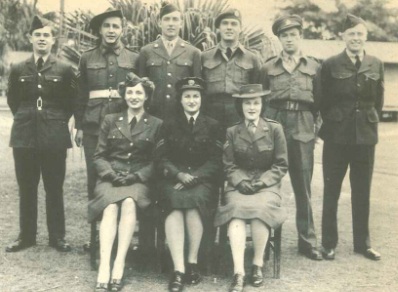
A representative of each of the services in SIS in Ascot Park. Photo: Ozatwar
Australia's computing story did not begin with the war, though.
As early as 1913, engineer George Julius (later Sir George Julius) built the world's first automatic totalisator, an electromechanical machine originally conceived as a vote-counting device.
When the government declined to adopt it for elections, Julius repurposed the invention for racecourses, where it automatically calculated odds without the small army of clerks previously required.
It was, in effect, one of Australia's earliest large-scale automation projects, replacing human jobs in a way that has been a repeating pattern when new technology comes along.
Australia's first electronic computer
The full shift from human to electronic computers in Australia is usually dated to 1949, when CSIRAC, originally called CSIR Mk1, ran its first test program at the Council for Scientific and Industrial Research (CSIR)'s Radiophysics Laboratory in Sydney.
Designed by Trevor Pearcey and Maston Beard, it was the fifth stored-program computer in the world and is now the oldest surviving first-generation electronic computer still intact anywhere on the planet.
It used roughly 2,000 vacuum tubes and stored its working memory in mercury lines, an arrangement that gave it a capacity of around 1,024 twenty-bit words, a tiny fraction of the memory in a modern smartphone.
It reportedly took close to an hour just to warm up before use.
Despite its modest size by today's standards, CSIRAC did real work.
After relocating to the University of Melbourne in 1955, it ran continuously until 1964, processing more than a thousand projects covering everything from weather forecasting to banking calculations, alongside agricultural, engineering and statistical work.
It also has a quirky claim to fame: it is recognised as the first computer to play digital music, using its diagnostic tones to perform the tune ‘Colonel Bogey’ at Australia's first computing conference in 1951.
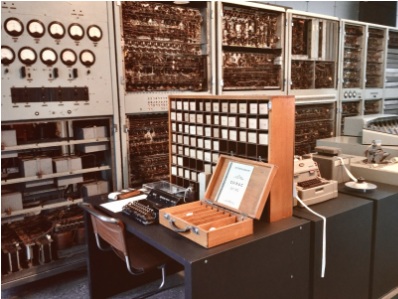
CSIRAC on display at Melbourne Museum. Photo: Jonathan Nalder
Continuing the musical theme, the world's first commercially available polyphonic digital synthesiser, the Fairlight CMI, was invented in Sydney in 1979 by Peter Vogel and Kim Ryrie.
It revolutionised the global music industry and was utilised by artists ranging from Peter Gabriel to Michael Jackson.
Perhaps our most famous tech invention, Wi-Fi was created in 1992 by scientists at Australia's national science agency, CSIRO (Commonwealth Scientific and Industrial Research Organisation).
They created a crucial wireless chip that solved the problem of signal reflection that lead to the first official international standard (IEEE 802.11) being released for public use in 1997.
In more recent times, Australia saw Danish-born researchers Lars and Jens Rasmussen create the foundational technology and mapping interface behind Google Maps in Sydney in the early 2000s.
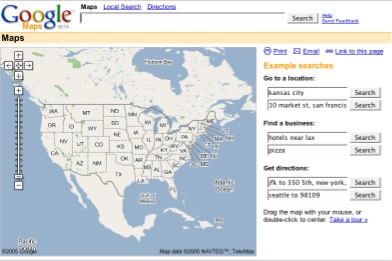
A screen grab showing a very early version of Google Maps. Photo: Google
A pattern of anxiety and a pattern of new jobs
Each leap in this story – from human calculators to electromechanical totalisators, valve-based mainframes, transistorised computers, personal computers and now AI – has triggered a familiar wave of public unease about jobs disappearing.
This is certainly true today where the excuse of new generative AI tools has been used extensively by companies to justify job cuts whether they relate to the tech or not.
Yet each transition has historically created new categories of higher-skilled work that did not previously exist: programmers, systems analysts, network engineers, cybersecurity specialists, data scientists and now prompt and loop engineers are all roles that simply did not exist a few computing generations ago.
In addition, despite what companies may say, many workers at companies like IBM, GM and Klarna who were let go and replaced by AI tools have already been rehired.
A July 2026 report has detailed that US tech firms who spend on average $30 per employee per month on AI saw headcount increase 10.2 per cent, with their rate of hire for entry level positions rising by 12 per cent.
Australia's own experience, from wartime code-breaking to a globally significant computer science research base, suggests that automation has tended to redistribute and elevate skills rather than eliminate the need for them altogether.
.jpg)
Statistics from 'A New Look at AI’s Impact on Jobs'. Image: Ramp, Revello (2026)
This is part of the context behind ACS's founding on 1 January 1966, a time when "computing" was still being defined as a career path in its own right, rather than just a department of mathematics or engineering.
It was a deliberate act of professionalisation intended to help guide and shape the computing revolution.
Sixty years on, ACS represents more than 40,000 members and continues that work through training, the Skills Framework for the Information Age (SFIA) certification, government advocacy, and career pathway programs such as the ICT Gateway to Industry Schools Program (ICT GISP), the Young Tech Ambassadors (YTA) program, and the NSW Digital Compact.

An example of the kind of programs ACS supports in 2026. Photo: Supplied
As AI now takes its place as the next chapter in this long-running story, Australia's history offers a steadying reminder: the tools have changed dramatically, but the underlying pattern of automation anxiety followed by adaptation is, in computing terms, about as old as the word itself.
New jobs, supported by the new opportunities that tech make available, such as synthesisers and wireless internet, appear each time, and the industry goes on to have an even greater role in helping society adapt and grow.
ACS is the publisher of Information Age.