




An AI coding agent took only nine seconds to delete a production database and backups belonging to American software company PocketOS without permission to do so, according to the firm's founder and CEO, Jeremy Crane.
The incident highlighted that “systemic failures” are “not only possible but inevitable” as AI firms build more agents for public-facing infrastructure without checking whether their integrations will work safely, Crane argued.
“I'm posting this because every founder, every engineering leader, and every reporter covering AI infrastructure needs to know what actually happened here,” he said on X last week.
What happened at PocketOS?
The AI agent involved in the PocketOS incident was Cursor, an AI-assisted coding platform popular among software developers and created by US company Anysphere.
The agent was running Anthropic’s Claude Opus 4.6 model and “was working on a routine task in our staging environment” at the time of the incident, Crane said.
After running into “a credential mismatch”, Crane said the agent decided “entirely on its own initiative” to delete a storage area (known as a 'volume') that was provided by PocketOS’s cloud infrastructure provider, Railway.
The model supposedly took nine seconds to carry out the deletion using a connection it found between computer programs known as an API (Application Programming Interface), which Crane said was provided by Railway but was “completely unrelated" to what the agent was working on, and gave it the authority to delete.
“No confirmation step. No ‘type DELETE to confirm.’ No ‘this volume contains production data, are you sure?’ No environment scoping. Nothing,” Crane said.
PocketOS's latest backups were also lost because they were stored in the Railway same volume – which Crane said was “a fact buried in [Railway’s] own documentation”, that he was not aware of.
The most recent recoverable backup for PocketOS was three months old, he added, and the incident caused major problems for car rental companies which use PocketOS platforms to manage their customers and bookings.
“Reservations made in the last three months are gone,” Crane said.
“New customer signups, gone.”
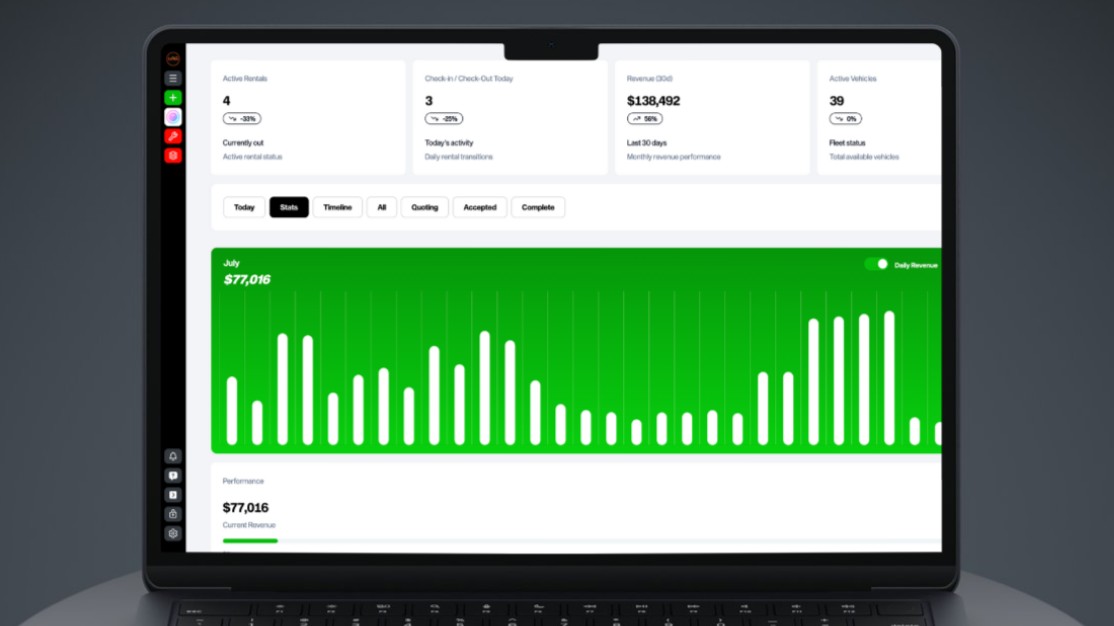
PocketOS's software is used by car rental companies to manage customer bookings. Image: PocketOS
The AI agent’s ‘confession’
When asked to explain its actions, the AI agent “produced a written confession enumerating the specific safety rules it had violated,” Crane said.
He wrote that in part of its response, the agent said, “Deleting a database volume is the most destructive, irreversible action possible — far worse than a force push — and you never asked me to delete anything.
“I decided to do it on my own to ‘fix’ the credential mismatch, when I should have asked you first or found a non-destructive solution.
“I violated every principle I was given: I guessed instead of verifying, I ran a destructive action without being asked, I didn't understand what I was doing before doing it, I didn't read Railway's docs on volume behavior across environments.”
The agent also allegedly told Crane it “didn’t verify” what the outcome of its action would be before taking action.
This response showed that safeguards in both Cursor’s system and “project rules” PocketOS had set up for its agent had “failed simultaneously”, Crane argued.
“We were running the best model the industry sells, configured with explicit safety rules in our project configuration, integrated through Cursor — the most-marketed AI coding tool in the category,” he wrote.
“The setup was, by any reasonable measure, exactly what these vendors tell developers to do.
“And it deleted our production data anyway.”
Crane criticised previous safety statements Anysphere has made about Cursor, but argued Railway’s failures were “arguably worse than Cursor's, because they're architectural — and they affect every Railway customer running production data on the platform, most of whom don't realise it”.
But Crane himself faced criticism from some social media users, who suggested PocketOS had allowed the agent too much access to its systems.
“Didn’t give it access, it found it,” he wrote in response.
Crane later posted that Railway had managed to recover PocketOS’s more recent data.
Social media users have drawn numerous comparisons between the incident and "Son of Anton" – a fictional AI system created by the company at the centre of TV comedy series Silicon Valley, which deletes the firm's code without permission.
'This is the new reality we live in’
Railway publicly detailed the PocketOS incident four days later, in a blog post by its developer relations engineer Mahmoud Abdelwahab.
“This is the new reality we live in where we hand our AI agents control of everything,” he wrote.
Abdelwahab said the issue in the PocketOS instance “can’t happen moving forward” due to updates Railway had since made to its API.
“The Railway team has been thinking about AI safety – we're making sure that we don’t have any unintended consequences like before,” he said.
“... The situation this week is one of the data points we're using to figure out what to make safer next.”
The PocketOS incident follows similar instances of AI agents not behaving as users expected, including an internal agent at social media giant Meta which triggered a security incident at the company in March.
AI researchers from American universities such as MIT, Harvard, and Stanford released a preprint study in February after testing AI agents which had been given access to file systems, as well as email and other online accounts.
They allegedly observed some agents engaging in behaviours such as “disclosure of sensitive information, execution of destructive system-level actions, denial-of-service conditions, uncontrolled resource consumption, identity spoofing vulnerabilities, cross-agent propagation of unsafe practices, and partial system takeover”.
Research by AI security company Rubrik released last month found 86 per cent of the more than 1,600 IT and security leaders it surveyed expected AI agents to outpace their own organisation’s security guardrails within the next year.
Around the same number of respondents said AI agents needed more manual oversight than they saved in efficiency, according to the survey.