

Pity the IT workers polishing their resume this week. New data shows work is harder than ever to find.
As the national unemployment rate leaps from 4.1 per cent in January to 4.3 per cent in February, the prospects for employment in the domains of technology and IT are dimming faster than the national average.
High-profile companies are laying off workers.
Atlassian just cut 10 per cent of its workers, for example.
That made headlines.
Sometimes headlines and the data can be in conflict, but not this time.
The most recent ABS data paints a picture of an industry where the growth has run out.
What was once a booming employment market is now relatively stagnant.
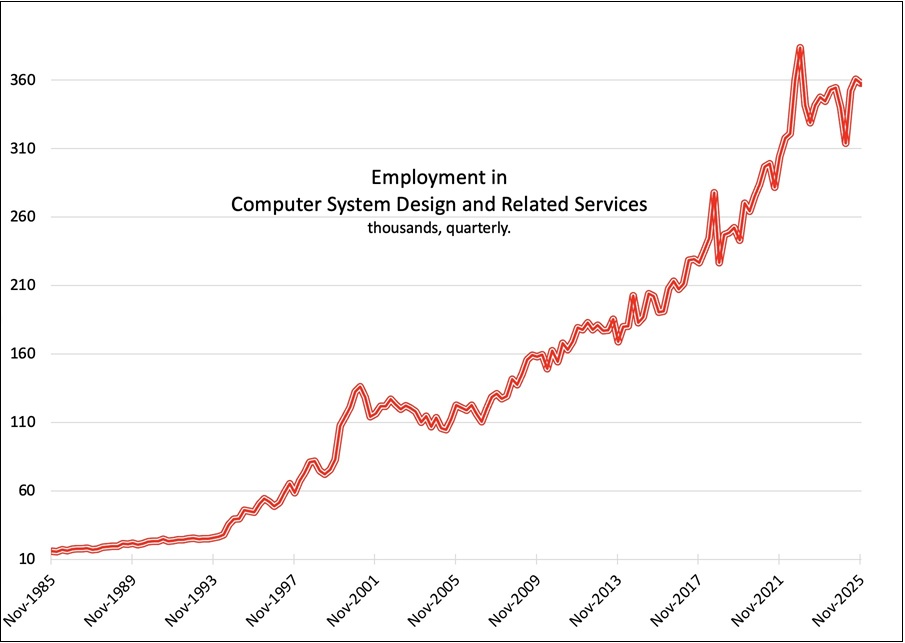
As the next chart shows, the number of people employed in ‘Computer System Design and Related Services’ raced to its 2022 peak with what looked like exponential growth and has been below its peak since.
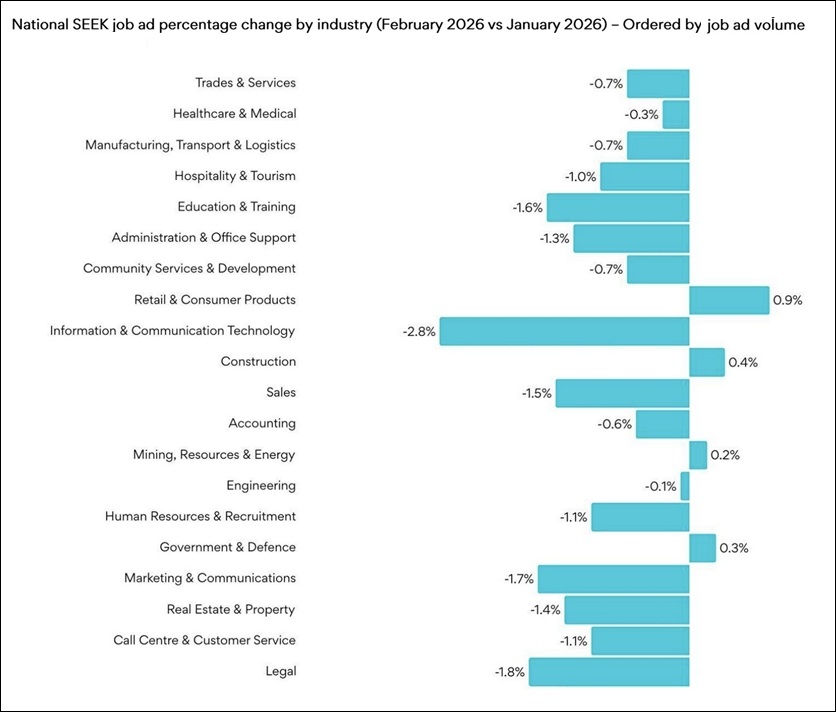
Employment data is necessarily backwards-looking. We can get a glimpse of the future by looking at job advertisements, however. Data from the recruitment platform SEEK has grim tidings.
The number of job ads is falling in most categories, but even amid widespread falls, the size of the slump in IT stands out. It is a tough market out there.
Atlassian’s boss, announcing his layoffs, waved vaguely in the direction of AI.
“It would be disingenuous to pretend AI doesn’t change the mix of skills we need or the number of roles required in certain areas. It does,” he said
However, that is just one company. SEEK’s experts believe the economy-wide decline does not yet capture the effect of AI.
“The trend decline in key industries such as Consulting & Strategy and Information & Communication Technology predates the dispersion of LLMs in the workplace, suggesting that it is not the result of automation,” said SEEK Chief Economist Dr Blair Chapman.
That is credible at a national level where adoption of tech is slow.
However, nobody whose works flows through a keyboard is unaware of the threat AI poses. It certainly it looks like physical jobs are still the safest.
As the next chart shows, jobs that cannot be automated are safer.
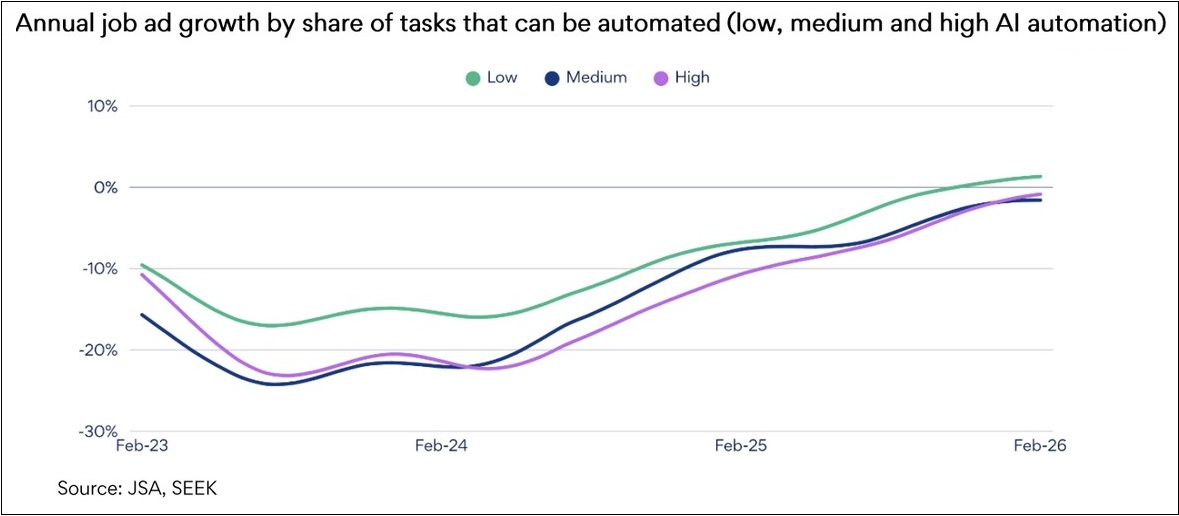
The construction industry is a great example. It is adding new workers, as the first chart showed.
The reason is the relentless spatial manoeuvring required in making a house. Computers are great at navigating abstract spaces (a chessboard), or highly controlled physical spaces (a lift-well, a production line), and not as good at handling dynamic 3-dimensional space. So they can’t make a house. Not yet.
While we still need construction workers, wages are rising in that sector. The wage price index for construction is up 3.5 per cent in the last year, compared to 3 per cent in information, media and telecommunication, and 2.7 per cent in financial and insurance services.
Moravec’s paradox observes that computers have become good at things people find hard before getting good at things people find easy.
That formulation is decades old, but the phenomenon is accelerated by AI. Coders, lawyers, accountants – these are the jobs smart people aspired to.
And they are the first to be taken by computers.
Meanwhile, birds build nests. Beavers build dams. The animal parts of our brains make navigating physical space easy and building things instinctive.
These tasks can probably eventually be outsourced to computers, but it may take them quite a while to be better than humans.
Until then, the people making out like bandits in the AI revolution will be the workers laying concrete slabs under the data centres, rather than the people racing to stay a step ahead of the models.
(This article was written by hand, without any AI.)