



If you sometimes wish there were two of you to get the work done, you may not have to wait long.
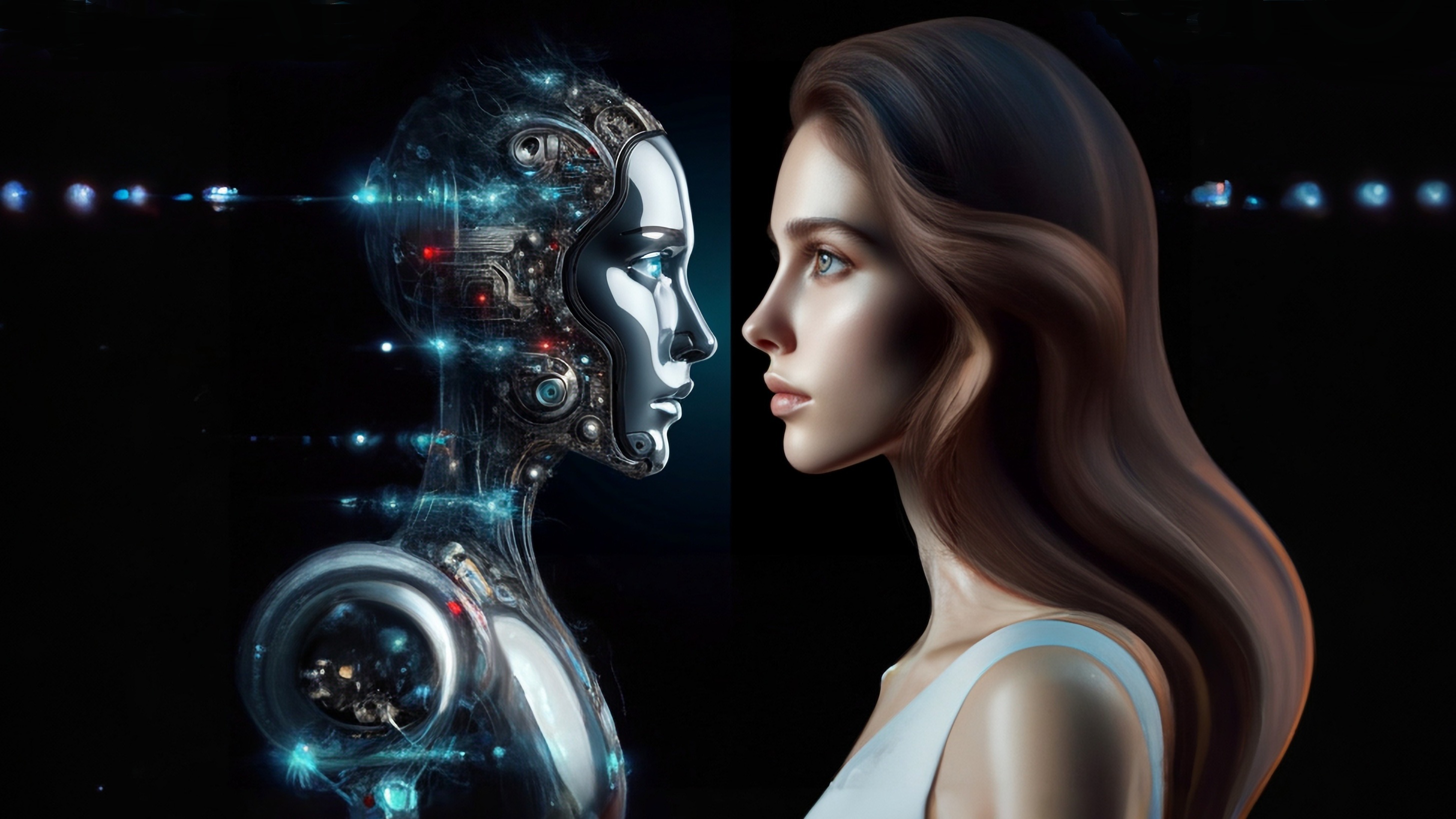
AI tools now allow executives, creators, and consultants to train chatbots and lifelike avatars on their own writing, interviews, and recorded speech, effectively turning years of accumulated experience into an on-demand adviser that can hold conversations, answer questions, and operate around the clock.
Jim Penman, founder and head of Jim's Group, which is the Southern Hemisphere's largest franchise network, has taken the first step in duplicating himself as CEO with an artificial intelligence version of himself.
“As CEO, I'm available by phone and email all the time, but I'm still just one person.
“I’m supported by an amazing team at the Jim's Group, but many people want to talk with me.
“We've created an AI avatar of me to ensure people can get guidance instantly, any time they need it," Penman says.
Joel Kleber, chief marketing officer at Jim’s Group, says the AI version was built using Delphi.ai software and is trained and filled with content on nearly a million words of Jim's books, podcasts, content books, interviews, and speeches.
“Prospects access Jim’s knowledge, and only his knowledge.”
Kleber adds that a lot of CEOs in Silicon Valley are making their own digital likeness.
“Jim is older now and has so much knowledge to pass on from his years in business. If staff have a question, they can ask this version if he isn’t around."
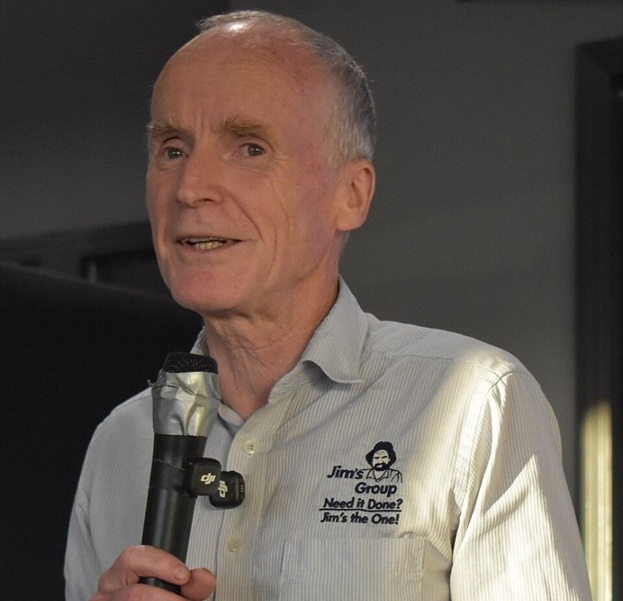
Jim Penman's avatar can answer questions just as well as Jim himself can. Photo: Wikipedia
He explains that the chat version works really well and is not the standard chat-box.
“We’re seeing franchises and prospects use it a lot. They not only given answers but a footnote of where the information came from, such as podcasts and videos.”
Initially there were some teething problems with the video, which is a live avatar.
So far, the AI Jim has been going for eight months, and Penman is happy with it.
“Since we began using it eight months ago, Jim tests it regularly and if it doesn’t get something right, he’ll let me know. We’ve refined it to a point where he is happy with it,” says Kleber.
Among the content, there are 10 pre-set questions, based on the common ones asked.
“To date, there has been more than 9,000 conversations, mostly extensive chats about the franchise system. Prospects have mentioned it in training, which is how we judge effectiveness,” he adds.
Penmen says the system is brilliant.
“It would be quite impossible for me to have anything close to this with so many conversations. I've tried it myself and the answers are very much what I would say. “
The next feature is a feedback system.
“The way the software works now, there isn’t feedback. We'd have to get email addresses in advance – which could put some people off. We're looking at a way to make this possible,” Penman says.
Human-made branding a premium
Research from printing and custom branding company VistaPrint reveals Aussie small and medium businesses (SMBs) are seeing human-made branding as a premium differentiator.
As AI and digital design tools continue to reshape how brands are built, the data suggests many small businesses see human input central to standing out and building trust, particularly as more brands enter the market and visual identities proliferate.
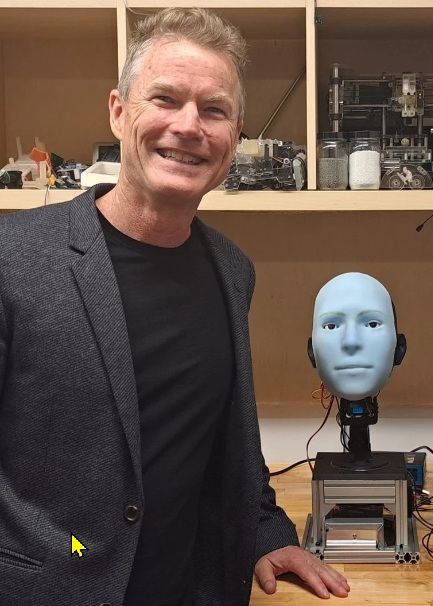
Futurist Bruce McCabe says we are grossly underestimating what's coming in AI. Photo: Supplied
Of the 300 SMBs surveyed, 63 per cent would pay more for branding that feels handcrafted, personal, and human-made likeness, highlighting a growing desire for creativity that feels expressive and authentic, rather than purely automated.
Although there is some concern – 68 per cent feel customers would trust them less if content is AI-generated.
While 70 per cent of small businesses say it is becoming easier for brands to look similar as more adopt digital design tools, many see that as a call to double down on their distinct story and personality, combining AI with human creativity to stand out.
Tip of the iceberg
Global futurist on technology Dr Bruce McCabe says avatars such as Jim Penman’s are the tip of the iceberg.
“Constantly and consistently across the globe, I see most people grossly underestimate what’s coming in all parts of AI,” he says.
“What we’re seeing today is nothing, compared to what’s coming even in the next few years.”
He adds AI is a massive force multiplier for many professions where it can replicate itself or aspects of itself in a manner that they, the customers, won’t be able to tell the difference. It will be revolutionary.
“What I’m talking about here, is more than simulating a personality; I’m talking about emotional learning model and fully engaging avatars that go far beyond conversation which also liaise with other AIs.”
McCabe says that absolutely every aspect of every function of every job across every industry will be changed.
“It’s as simple as that, and we’re at the beginning of this process, we’ve only seen a little of what’s about to hit us.”
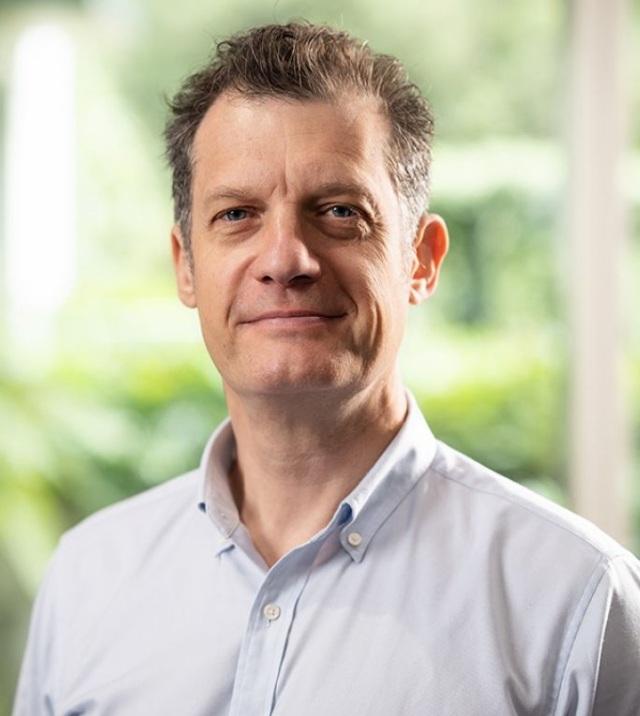
Professor Olivier Salvado believes most AI output will be driven by advertising. Photo: Supplied
A number of McCabe’s overseas clients have been using avatar technology.
“It’s utterly transformational in customer service. And it needn’t be visual, there are a lot of audio avatars operating, effectively and infinitely scalable.”
He gives an example of out-bound work in the health sector, where there are health avatars and products available online today for any hospital to use that can provide pre- and post-operative calls to patients.
“Instead of a text prior to a procedure, you’ll get a call from fully conversational avatar or video engaging in a fully flexible conversation to prepare for your op procedure.”
Globally, countries such as Saudi Arabia and the USA are working through how transformational this is and not just in terms of workflow but the dividend returns – which is in the trillions.
One issue McCabe wants people to understand is the issue of people fixated on whether AI will reach consciousness.
“This is a useless argument. We are moving into an age of equivalence. We don’t have to know whether machines are smarter. What we have to accept is that we won’t be able to tell the difference.”
This is happening now, with examples mentioned in customer service and the pre- and post-operative calls, or taking hotel bookings.
“You can slip in your AI tool, and the customer will not know the difference. We are in this age and one that is infinitely scalable,” says McCabe.
Danger of false sense of trust
Professor Olivier Salvado from Queensland University of Technology’s AI in Health Research Network says there is a danger in anthropomorphising AI.
“Take for example a coaching avatar – be aware that it is not just absorbing information about your circumstances and telling you what you need to hear.”
He says this can create a false sense of empathy and trust.
“[It will] produce what is the most likely response someone wants to hear. I am not sure there is any value in a machine telling what one wants to hear. “
He adds the input is undefined and coming from whatever the AI provider has decided or trained the AI for, which is “unlike a human coach who has a reputation and a background that you can check on and relate to.”
Furthermore, he says, one should be mindful that very likely most AI answers will be driven by advertising revenue.