
Telecommunications regulator ACMA is investigating an “incredibly concerning” claim by the Australian Communications Consumer Action Network (ACCAN) that 10 per cent of Australians couldn’t reach Triple Zero services due to a mobile outage in the past 12 months, which Telstra has called “misleading”.
In a media release before a 12 March hearing of an ongoing Senate inquiry into Triple Zero, ACCAN claimed “1 in 10 Australians (10%) reported that they or a member of their family were unable to reach Triple Zero from a mobile phone in the last 12 months due to a mobile outage.”
The claim – based on an Essential Research survey of 1,014 – triggered alarm at telco industry group the Australian Telecommunications Alliance (ATA), which started a heated email exchange with ACCAN in March, captured in newly tabled documents published by the Senate inquiry this week.
ACCAN CEO Carol Bennett used the data to approach Greens Senator Sarah Hanson-Young, chair of the Senate inquiry, the day before the 12 March hearing, saying “the data indicates significant consumer concern about the reliability of emergency access via mobile networks.”
The morning of the hearing, ATA CEO Luke Coleman wrote to Bennett requesting “full” access to the research, including details of the polling, sample size, and questions posed to respondents “so we can better understand the results in context.”
Bennett replied the next morning that “shooting the messenger is not part of [ATA's] work and doesn’t give anyone confidence that the industry acknowledges the problem and is working to address it.”
The media release, Coleman replied, “was designed to undermine confidence in Triple Zero, and the industry more broadly.”
“Industry has repeatedly and publicly acknowledged the problem and is working to address it [but] ACCAN appears more interested in scoring cheap shots in the media than in being part of the solution.”
‘On its face, that is absurd’
Clare Chapple, first assistant secretary of the government’s Triple Zero Custodian Division, called ACCAN’s figures “incredibly concerning”.
Having requested copies of the survey data – and allegedly been rebuffed by ACCAN – Chappell told the Senate inquiry that the organisation “was clear that the data represents one in 10 survey respondents, as opposed to extrapolating that out to one in 10 Australians.”
ACCAN’s press release, however, clearly makes claims about “1 in 10 Australians (10%)” – a representation that led Telstra group general counsel Lyndall Stoyles to write a scathing letter to ACCAN calling out the implications of this extrapolation and demanding a retraction.
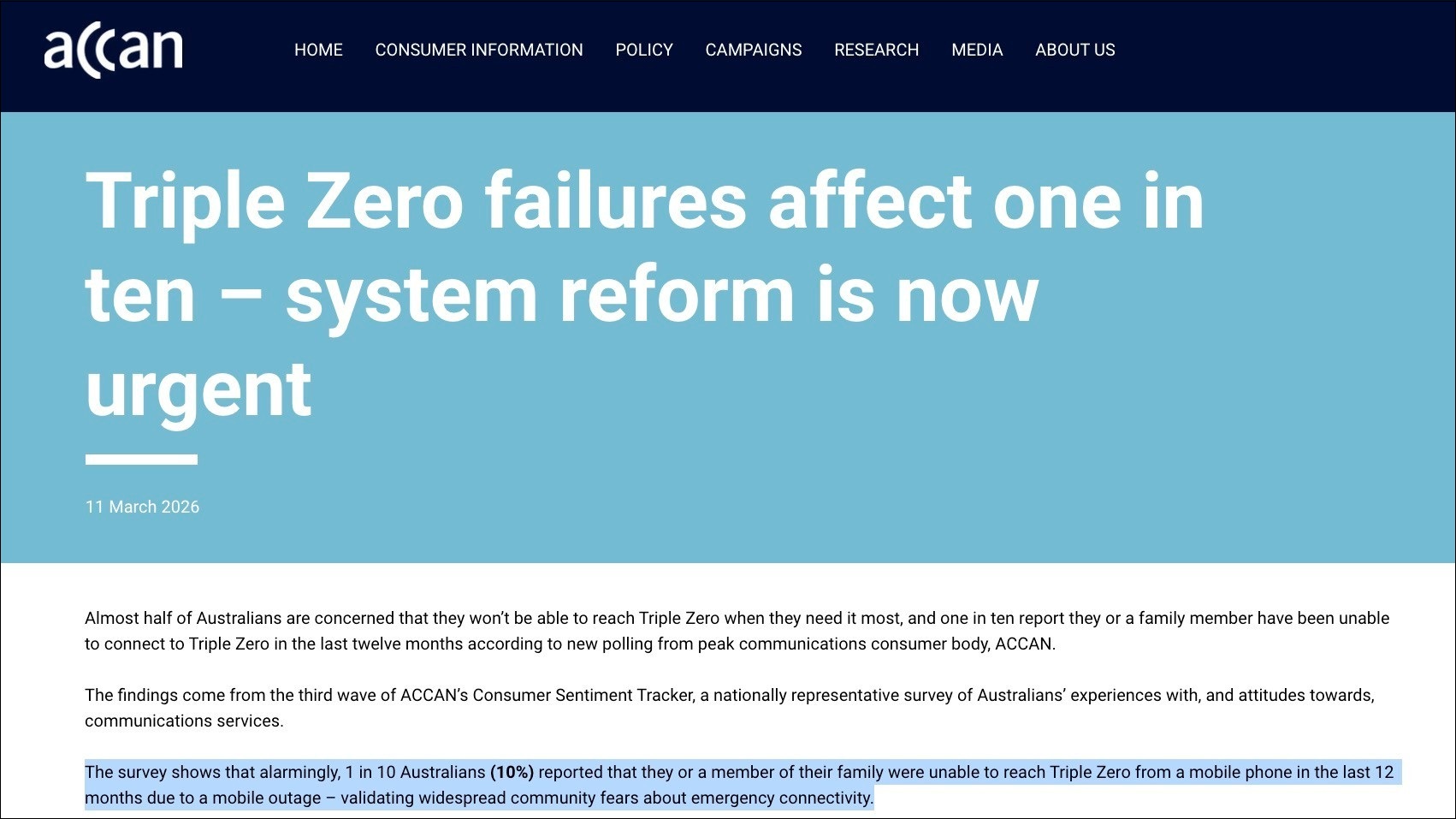
An excerpt of ACCAN's 11 March press release.
“By publishing these statements,” Stoyles wrote, “ACCAN has represented that 2.7 million Australians (10 per cent of the population) were affected by Triple Zero failures in 2025”, that “10 per cent of Triple Zero calls fail”, and that “10 per cent of Triple Zero calls fail due to a mobile outage.”
With around 65 million “successful” voice calls made every day on Telstra’s network, she continued, “ACCAN is representing that, at a minimum, 6 million calls fail per day due to outages.”
“On its face, that is absurd,” she wrote.
“While Telstra has not seen the underlying survey data,” Stoyles added, “as the designated Emergency Call Person and the largest telecommunications provider in Australia, we are confident that the above statements are unsupportable and demonstrably incorrect.”
Regulator investigates 'very serious claim'
The back-and-forth drew in regulator ACMA’s newly appointed chief AI officer Samantha Yorke, who called ACCAN’s survey “a very serious claim which warrants careful scrutiny, particularly given it has the potential to further damage public confidence in the Triple Zero service.”
Yorke also requested copies of the survey methodology, instrument, and “analytical approach taken to derive the headline findings,” calling it “a matter of priority… to ensure that discussions regarding emergency call access are appropriately informed by evidence.”
Stoyles made the same point in a 17 March reply to ACCAN’s CEO, in which she said she remained “seriously concerned that the media release and subsequent public commentary contains statements that are inaccurate, misleading, and inconsistent with the actual performance and reliability of the Triple Zero service.”
ACCAN, however, demurred, with Bennett making no reply other than pointing Yorke to the organisation’s site of commissioned research in a terse email on 19 March.
The ongoing tensions around ACCAN’s representation of its survey data have persisted, and on 14 April the Senate inquiry was granted an extension of its final report until 30 June, giving it 10 additional weeks to sort out the claims.
Coleman from the ATA, for one, told Information Age that “ACCAN's ‘consumer sentiment tracker’ report shows that the research does not support public statements made by ACCAN.”
“… ACCAN’s statements do not make it clear that the report reflects consumer perceptions, not actual experience – an important distinction.”
ACMA is continuing to investigate the claims, with a spokesperson telling Information Age “this data raised serious concerns which we sought to more fully understand”.
“The alarming level of failure to reach Triple Zero identified in the ACCAN research did not align with any data available to the ACMA, including reports to the Telecommunications Industry Ombudsman or from industry,” they said.
The dispute over the survey findings highlights ongoing sensitivities around Triple Zero coverage in the wake of a series of failures, and lagging consumer confidence that has spurred the government into a full review of the system.