


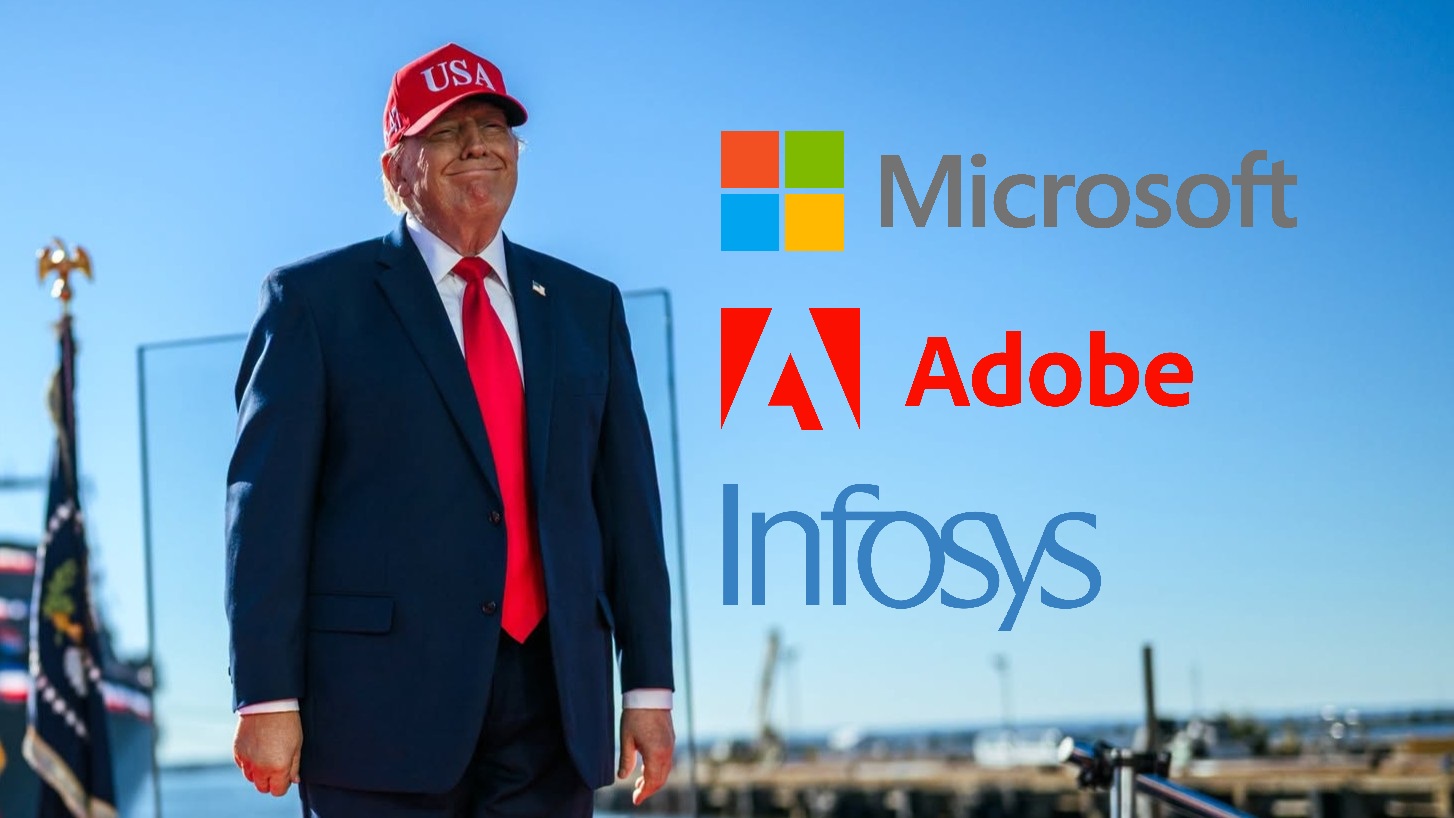

Technology giants Microsoft, Adobe, and Infosys are among eight tech companies which have been banned from accessing a popular permanent visa program after the US government accused them of fraud and using the scheme to replace American workers.
The H-1B program provides skilled foreign workers a path to permanent residency in the US, and is highly popular with American tech firms.
The scheme has been controversial within the Trump administration and its supporters, with debate raging over whether tech firms need to attract overseas talent or should support local jobs.
Most employment-based US green cards require this program, which involves companies showing that hiring a worker from overseas will not impact US jobs or wages.
The other banned companies are Cognizant, Tata, Wipro, HCL, and Capgemini.
Microsoft and Adobe are based in the US, while the other tech firms targeted were founded in India – except for Capgemini, which is French.
Under the suspension, the US government will not accept any new applications from the eight firms, or process any pending applications.
The US Department of Labor has claimed that it has uncovered $31 billion ($US22 billion) in visa fraud in this program.
“We are protecting something far more valuable than any dollar amount,” US Secretary of Labor Keith Sonderling said.
“We are protecting the American worker.”
The ban was unveiled just hours before US President Donald Trump presented Indian-born Microsoft CEO Satya Nadella with the National Medal of Technology and Innovation.
Thank you, @POTUS, for this incredible honor today. I'm humbled to stand alongside so many giants of American innovation and looking forward for what we can continue to do together to advance technology and drive American prosperity.
— Satya Nadella (@satyanadella) October 8, 2026
‘Foreign indentured servants’
US Vice President JD Vance accused Microsoft specifically of replacing American workers with “foreign indentured servants” via the H-1B scheme.
“Our message to Microsoft is: you’re a great American company, but you’ve got to hire great American workers,” Vance said.
He claimed that Microsoft had fired 6,000 American workers while at the same time obtaining 6,300 H-1B visas, and almost 3,000 permanent residencies.
“You cannot lay off American workers and replace them with foreign indentured servants,” Vance said.
“When someone comes in, they are completely subordinate to that company.
“If they lose that job, they have to leave the country.
“No company in the US has abused this system more than Microsoft.”
Microsoft rejected these accusations in a blog post last week, saying that 80 per cent of the visas cited were to extend or change the status of existing Microsoft employees, rather than bringing new arrivals to the US.
“The remaining filings for new employees were for individuals already legally in the United States who decided to come work for us, and they equal only 1 per cent of our US workforce,” the Microsoft blog post said.
“They are not new arrivals to our country.
“We believe in the strength and talent of the American workforce.
“That is why the vast majority of Microsoft employees in the United States are Americans.”
The company said that it only files for H-1B visas for individuals who meet the “rigorous standards” of this category, and they receive some of the highest compensation in the tech sector in America.
“Microsoft succeeds as a global technology leader by developing the world’s best technology workforce,” the company said.
“We do this by strengthening this country’s talent pipeline, hiring American workers, and attracting the best talent from around the world.”
Microsoft accounts for the fifth-most H-1B visas, with Amazon taking the most.
No 'material impact'?
Infosys, the second-biggest tech company in India, said in a statement to the market that it does not expect there to be a “material impact” of the suspension.
“We welcome the opportunity to work with the Department of Labor and related government agencies to answer any questions they may have,” a company statement said.
US President Donald Trump has planned to introduce a $150,000 application fee for these visas, which has so far been blocked by the courts amid a legal challenge which labelled the plan unconstitutional and unlawful.
The H-1B visa is not commonly used by Australian tech workers in the US, who tend to use E-3 visas, which allow companies to sponsor up to 10,500 Australians per year for work in a “speciality occupation” requiring a university degree and pay equal to or above normal wages.
Less than 500 Australians receive H-1B visas each year – in January 2025, just 60 Australians were approved for such a visa.