




Mobile carrier Vodafone contacted regulators more than 160 times to stop the use of its network to send tens of millions of cryptocurrency and other scam messages – which together comprised over 98 per cent of all scam calls to Vodafone customers.
Vodafone has accused telco Aussie Broadband, whose subsidiary Symbio sells wholesale voice and phone services to more than 500 corporate clients, of failing to address the deluge of scam calls made by customers of its clients, who onsell the numbers to thousands of others.
The mobile carrier’s analysis of 25 million scam calls, received by Vodafone customers between July 2025 and July 2026, found that over 24.8 million of them (98.35 per cent) came from Symbio’s voice network, including around 160,000 calls made to promote one Binance crypto scam.
The unknown scammers were also caught impersonating banks, police, government agencies, and technology companies – a modus operandi that has proven consistently effective despite concerted anti-spam efforts by Australian banks, telcos, and authorities.
Aussie Broadband has argued that Symbio – which it acquired in 2023 for $262 million – onsells the phone numbers and can’t control what its customers do with them, with CEO Brian Maher saying that “where we find a persistent bad actor, then we will disconnect them.”
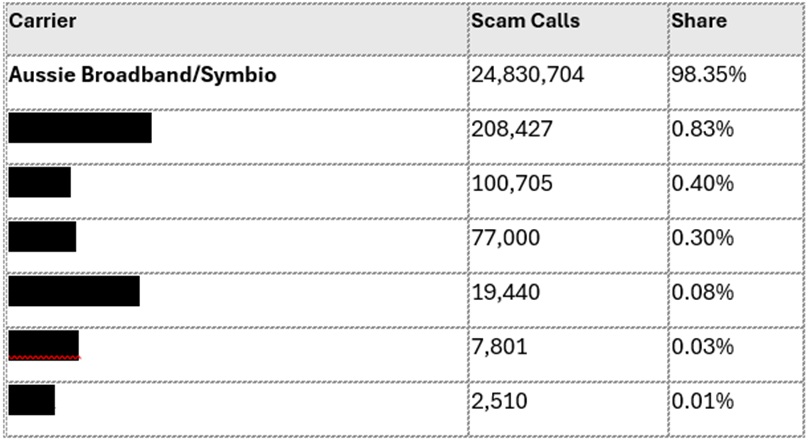
Vodafone's analysis of 25 million scam calls found that 98.35% came from customers of Aussie Broadband subsidiary Symbio – with other sources responsible for just a fraction of a percent. Source: Vodafone
Vodafone believes other telecommunications providers are experiencing similar problems with scammers using Symbio's services.
It argues the volume of calls also exposes broader weaknesses in Australia's anti-scam legislation and the industry's ability to identify and shut down scammers further up the supply chain.
A Vodafone spokesperson told Information Age, “If the bad actors responsible for the traffic were identified and shut down closer to the source, the overwhelming majority of scam calls we currently identify reaching Vodafone customers would disappear.”
“Australians are sick of scam calls [and] shouldn’t have to wait for a scammer pretending to be the police or their bank to reach their phone before somebody acts.”
Phone scams a persistent problem in Australia
More than 33,300 phone scams have already been reported to the Australian Competition and Consumer Commission’s (ACCC) Scamwatch service this year, with $61.1 million in reported losses – including $36.1 million lost to investment scams – and the traditionally scam-heavy holiday shopping season will likely ratchet up the pressure dramatically.
And while Australian telcos have been required to block SMS scams since last December, the persistence of voice-based scams – which have become easier to run in large quantities thanks to the growth of AI voice scams and convincing deepfake calls – creates challenges for regulators.
The Australian Communications and Media Authority (ACMA) collaborates with telco and government bodies on anti phone-scam efforts like its Scam Telecommunications Action Taskforce, and maintains a formal industry code outlining how telcos should identify, trace, and block scam calls as well as SMS messages.
That code differentiates scam calls from conventional telemarketing calls due to warning signals such as “abnormally high volumes of traffic”, customer complaints about phone calls “that appear to be seeking information” to commit fraud, invalid caller number display (CND) data, and more.
ACMA previously penalised firms like VoiceHub for failing to block scam calls, and fined Telstra $1.5 million in 2024 for failing to protect its customers from scammers despite the existence of an industry scams code that has blocked over 2 billion scam calls since 2020.
Urging telcos to do better
Tighter controls on scam calls are in the works, with the newly introduced Scams Prevention Framework (SPF) set to tighten call detection and blocking obligations on telcos, financial services firms and digital platforms when the “proactive” code comes into effect on 31 March next year.
In the meantime, Vodafone believes floating details of the alleged scam calling activities of Symbio customers will raise awareness of the scope of the problem – and the need for mechanisms that can provide better visibility into the use of phone services even at the end of long supply chains.
"We spend millions of dollars every year protecting customers and have specialist teams working to identify and block this traffic as it hits our network,” the Vodafone spokesperson said, but “blocking millions of calls at our end doesn't fix the underlying problem.”
"Aussie Broadband and Symbio need to know who is using their services, act on repeated warnings and shut down bad actors when they find them,” they added.
"We want the number of scam calls reaching Australians to fall as close to zero as possible, and everyone in the industry should be working towards that."
ACMA was contacted for comment but had not responded by publication time.