

Australian researchers have uncovered a method to extend the life of quantum batteries by 1,000 times, marking a significant advancement in the pursuit of advanced battery systems.
Quantum batteries (QBs) are theoretical devices which use the principles of quantum mechanics to store energy from photons, the smallest possible particle of light.
The Quantum Battery Team at Australia’s national science agency CSIRO suggested the technology could “revolutionise energy storage” by outperforming conventional batteries in capacity, charging rates, and battery lifetimes.
With QBs presenting long-term implications for electric vehicles, solar cells, and portable electronics, a recent discovery from researchers at RMIT University, CSIRO, and Italy’s University of Padova has inched the tech closer to reality.
The study, co-authored by RMIT PhD candidate Daniel Tibben, saw researchers build and study five devices to measure energy storage.
Notably, the devices worked best when two specific energy levels were aligned perfectly, demonstrating a thousandfold improvement on the storage time of a previous 2022 experiment.
Tibben said although the research addressed only a “tiny ingredient of the overall piece”, the design was “already much better at storing energy” than its predecessor.
“While a working quantum battery could still be some time away, this experimental study has allowed us to design the next iteration of devices,” said co-author and RMIT chemical physicist Daniel Gómez.
From nanoseconds to microseconds
Tibben told Information Age QBs could in principle lead to “instantaneous charging” and “potentially even rapid delivery of power”.
He explained the main obstacle to outperforming other types of batteries, like lithium-ion batteries, was extending energy storage time to “hours, days, or more”.
A previous 2022 study accomplished a prototype for a QB, though energy storage peaked in mere nanoseconds (billionths of a second).
The new experiment yielded storage lifetimes “orders of magnitude longer”, lasting microseconds (millions of a second) before energy fully discharged.
Though this might not sound like a long time, the team said their breakthrough offered conceptual proof and built a strong foundation for future research.
“Australia is leading the way in experimental quantum battery research,” said CSIRO science leader James Quach, who led the previous experiment and co-authored the latest study.
“This work is a significant advancement.”
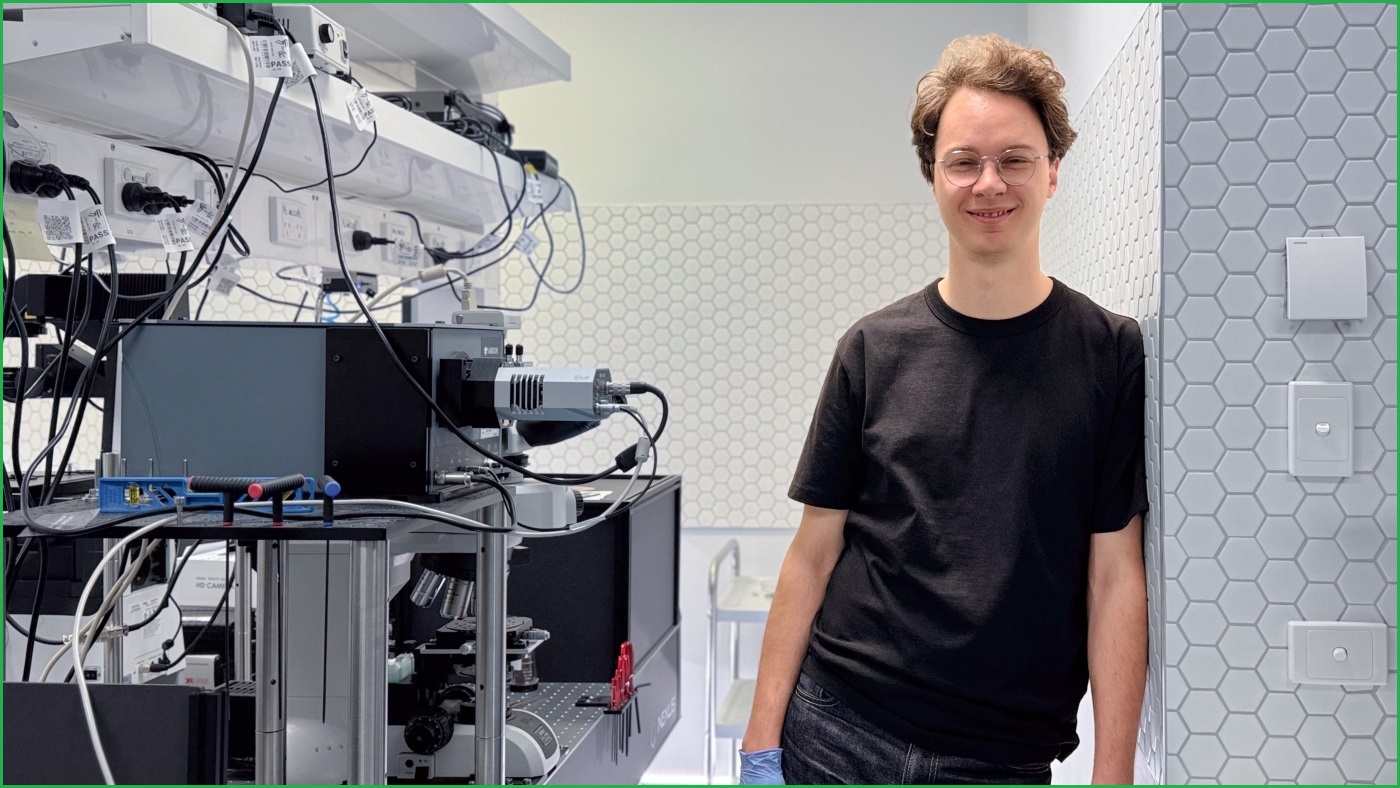
Daniel Tibben says researchers want to eventually create a quantum battery which can hold its charge for long periods. Image: RMIT University / Supplied
How would a quantum battery work?
Where traditional batteries rely on chemical reactions, QBs rely on elusive quantum superposition and interactions between light and electrons.
It is complicated science, but Tibben said it helped to think of molecules “as little antennas that absorb light particles, known as photons”.
For the study, molecules were placed in an optical resonator: an arrangement of mirrors and polymer thin films that essentially traps light waves.
Tibben said molecules in a resonator could be strongly coupled with photons by “matching the energy gap” of the molecules with the energy of the photons.
“Molecules more efficiently absorb photons that have the same energy as their characteristic frequency, or energy gap,” Tibben explained.
This coupling results in quantum states known as polaritons: part light, part matter particles which enable extremely quick energy absorption.
“The issue we have is that energy also leaves polaritons just as quickly,” explained Tibben.
“In our experiment, we show that when polaritons also have the same energy as some other molecules that can hold energy for long times, we can funnel energy from the polariton to these molecules, and store energy for much longer than previously possible.”
The road to a working device
Tibben said if longer storage times were achieved, QBs could deliver energy to “low-power portable electronic device” including wearable sensors and small processors.
“Any system that could benefit from ‘instantaneous’ charging stands to benefit from this type of device,” said Tibben.
He said the fabrication techniques used for the experiment — despite dealing in nanometres and requiring precise control — were already standard in electronics.
“There is promise in scaling-up this technology,” he said.
Tibben added future challenges would be in “incorporating much more stable ways” to hold energy for as long as conventional batteries can, while still “retaining the quantum advantage” associated with polaritons.
The research comes after other Australian quantum scientists unveiled a new silicon chip in June which was expected to help accelerate the development of quantum computers.