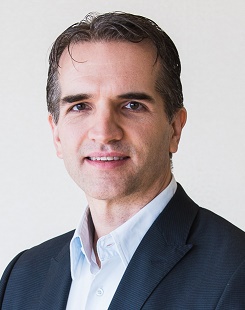





A 24-year-old former robotics engineer has been denied bail after allegedly planning a series of firebombings on the Gold Coast as part of his efforts to recruit dozens of people to a campaign to overthrow Australia’s government and recast it as a ‘cybernetic’ state.
Queensland police arrested Sepehr Saryazdi – a Brisbane-based PhD candidate and researcher who has been working with CSIRO Data61 and Sydney University’s Australian Centre for Robotics (ACR) – on 22 January after he was reported to Crime Stoppers.
Saryazdi, who police said was “making plans for acts of violence”, was charged with one count of other acts done in preparation for, or planning, terrorist acts.
Brisbane Magistrates Court was told that Saryazdi had been frequenting a private Facebook Messenger group, with more than 50 participants, and exhorting its participants to join him in stockpiling vodka bottles to make Molotov cocktails for a series of Australia Day attacks.
“I will be leading the Gold Coast riots on Jan 26,” he allegedly said, urging forum members in Melbourne to begin weapons training, infiltrate ASIO and the ADF from within, and buy bottles for attacks that he called “purely logical given the current trajectory of this nation.”
Prosecutors alleged that Saryadzi said he wanted to “overthrow the government” and its authoritarian “tyranny” and replace it with a “cybernetic government” and offered the group a manifesto containing “a few wishes in case I die” during the attacks.
Magistrate Penelope Hay ultimately ruled Saryadzi was too dangerous to be released, denying him bail and remanding him to custody in the leadup to a court appearance in February.
Building an interest in autonomous robots
Whatever the root cause of Saryazdi’s anti-establishment views, his interest in robotics and autonomous sensing had grown steadily in recent years.
A recent Sydney University graduate, he was a talented student who completed a Bachelor of Science and Master of Mathematical Sciences degree, tutoring students in physics, mathematics, data science and robotics for over two years.
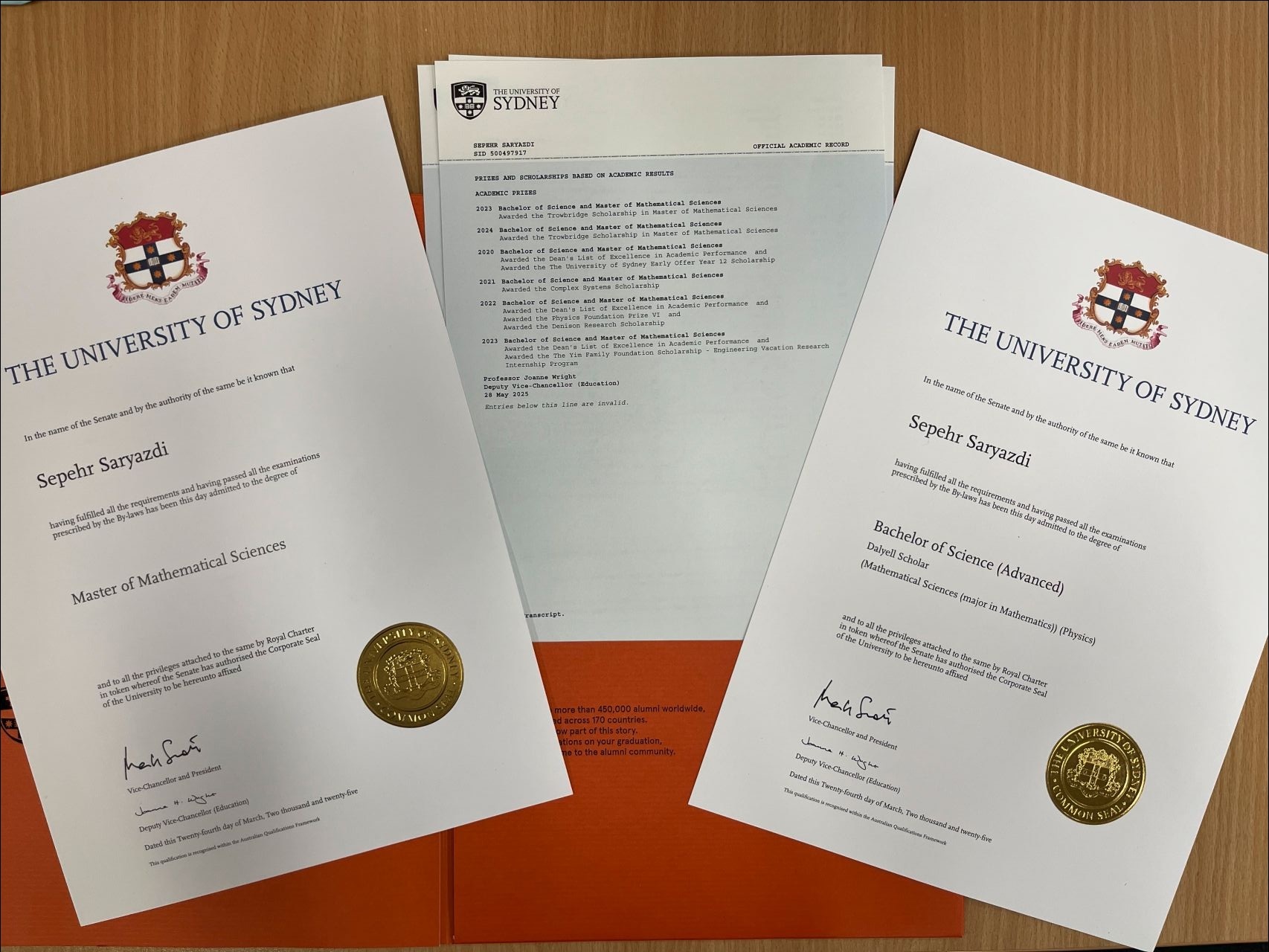
Saryazdi was well-credentialled with several degrees to his name. Photo: Supplied
He secured a three-month internship with the ANU Institute of Space and worked at Mt Stromlo Observatory on spacecraft communications, and also scholarship working as a machine learning researcher with the Sensors, Clouds, and Services Lab.
That work led to a 2024 paper discussing techniques for using reinforcement learning to improve the precision of aerial drone landing – and eventually to Brisbane and the ACR, where he explored “robotic perception with Visual-LiDAR SLAM in dynamic environments”.
His work with robotics firm Emesent, he said, would “produce commercialisable results and push the frontier of robotics.”
Yet the move to Brisbane had left him feeling isolated, defence lawyer Hellen Shilton told the magistrates court, and sent him down a rabbit hole of online videos, protests, and influential online agitators that left him “overwhelmed emotionally”.
“He felt that he should do something and bring attention to the way that the world was heading and the government,” the ABC cites Shilton as saying.
What is a cybernetic government?
Anti-government sentiment is hardly uncommon, but Saryazdi’s call for Australia to establish a ‘cybernetic’ government reflects a worldview stemming from Karl W Deutsch’s 1963 book The Nerves of Government: Models of Political Communication and Control.
Deutsch, who commentators have called “one of the most creative scholars in contemporary political science,” argued that cybernetics – the study of communication and control – is “a conceptual scheme on the grand scale” that unifies trends across a range of fields.
Its form is built around fundamental computer concepts such as inputs, outputs and processing – suggesting that a cybernetic government would be one driven not by political will and debate, but by impassionate data, processing and algorithmic decision making.
In this model, government becomes an apolitical “regulator” that detects differences between the desired state and the current state – and then implements behavioural changes to correct that deviation.
Such cybernetic governance, which is built on feedback loops and iterative changes, underscored a revolutionary 1971 sociopolitical experiment in Salvador Allende-era Chile known as Project Cybersyn.
That work was based around a computer system that, author Eden Medina explained, included a high-tech operations room buzzing with real-time alerts about social, industrial and economic deviations, a national telex network, and real-time industrial control.
The project died with Allende during the Chilean coup of September 1973, but the appeal of its fundamental principles to Saryazdi reflects the enduring appeal of its principles to anti-establishment revolutionaries.