


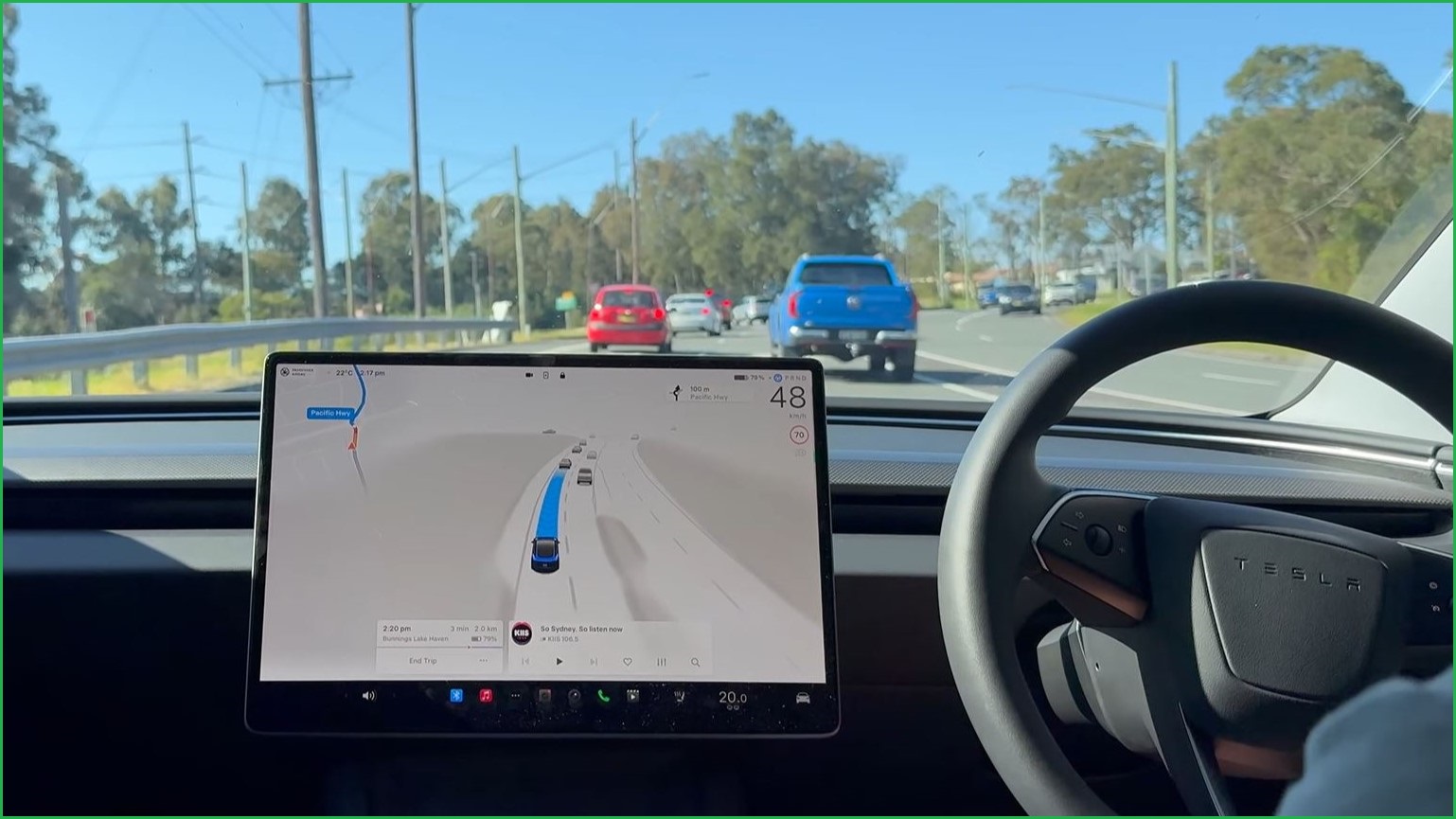

Influencers have been testing Tesla’s controversial full self-driving (FSD) features on Australia’s public roads for weeks, with a full local launch said to be imminent.
FSD, which uses an array of cameras to monitor and steer the car through traffic, has been available in the United States, Canada, China, Mexico, and Puerto Rico for some time, but has so far not been launched in Australia or other right-hand drive geographies.
Rumours of tests on Australian and New Zealand public roads have circulated for months, but the publication of YouTube videos showing FSD in a variety of local conditions recently made it all too real.
Videos show FSD driving largely with supervision and the driver’s hands touching the steering wheel along highways, to Bunnings, and even taking on the trams and hook turns that have been the ruin of many learner drivers in Melbourne.
Drivers were given early access to the supervised FSD technology, including Melbourne Tesla vlogger Ryan Cowan, who said “Tesla have stated that it’s going to be rolling out wide to everyone else soon”.
That was news to VicRoads, Victoria’s statutory road authority, whose parent Department of Transport and Planning (DTP) confirmed to Information Age that it “has not approved any testing of fully autonomous vehicles in Melbourne’s CBD”.
Australian road regulations require drivers to maintain control of their vehicle at all times, which is generally interpreted to mean they must keep their hands on the steering wheel whenever the car is moving.
Cowan declined to comment on his videos, but a DTP spokesperson said the agency “will continue to engage with Tesla”, which spruiks FSD with a caveat that “certain countries do not allow hands-off use of FSD … Follow local regulations”.
Tesla has not yet announced a date for when hands-off unsupervised FSD — a technology Australia is yet to approve — will be available to customers.
Australians aren’t emotionally ready for self-driving
If you are concerned to know the car next to you on the freeway may be driving itself while the driver rhapsodises about the “surreal” experience of driving handsfree, you are not alone.
A recently published survey of more than 6,000 Australian adults, which ran over several years by and was conducted by Australian Road Research Board and Mendeley Data, found Australians were still overwhelmingly afraid of autonomous vehicles.
Information Age analysis of the data found 74.5 per cent of respondents “concerned” or “very concerned” about the ability of a self-driving car to perform safely in all conditions, with 76.2 per cent worried the car could not safely interact with conventional cars.
Four-fifths of the respondents said they would be “concerned” about allowing their child to ride in an autonomous vehicle by themselves, with 57.1 per cent “very concerned” and a similar proportion worried about legal or financial responsibility for the car.
Only six per cent of respondents said they were unconcerned about the ability of the car to perform safely in all conditions, showing Australians are far less trusting than the 13 per cent of Americans who trust self-driving vehicles.
Even more significant, just 3.6 per cent of surveyed Australians were unconcerned about trusting their children’s lives to the technology — confirming that Tesla and its increasingly popular competitors have a long way before FSD is widely accepted here.
Can Elon become a $1 trillion man?
The slow uptake of FSD has been hindered by reports of deaths, near misses, collisions with simulated children, and lawsuits — with Tesla last month forced to pay $375 million ($US243 million) for a fatal 2019 crash, and a judge last month authorising a California class action.
An Australian class action has targeted the carmaker for other problems such as phantom braking, but the lack of FSD availability here has so far failed to spawn legal action as in the US, where FSD has been available for years as a monthly subscription.
Increasing FSD’s acceptance and the revenue associated with self-driving Tesla robotaxis that CEO Elon Musk envisions will crisscross US roads in the near future have been identified as critical to Tesla’s economic viability.
The technology is so important to the company that it this month offered Musk a $1.5 trillion ($US1 trillion) compensation package, staggered across 12 financial milestones, if he can grow its market capitalisation to $12.85 trillion ($US8.5 trillion) over 10 years.
Coming on the back of a $44.8 billion offer Tesla made just a month ago, the $1 trillion proposal — which has been slammed as “obscene” and is worth more than the GDP of 162 countries — reflects the company’s determination to undo a year’s worth of damage.
Musk’s on-off relationship with US President Donald Trump, and his scything of the public service as then head of the so-called Department of Government Efficiency, drove a backlash that saw attacks on Tesla cars, stock selloffs, and a profit plunge.
With Tesla robotaxis already drawing controversy after the first units hit the road in Texas in June — charging $635 ($US420) per ride — Musk faces an uphill battle to overcome concerns about FSD technology even as Tesla ramrods it into Australia.