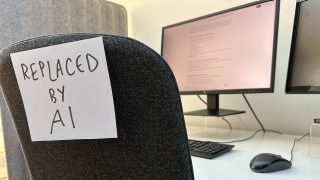





There is "no evidence to date of broad labour market upheaval” in Australia caused by generative artificial intelligence, a first-of-its-kind government report has found, despite the technology being cited as a factor in some recent layoffs.
While the report found no proof of “large AI-driven job loss”, it did find growth in jobs more exposed to potential automation by genAI has begun to slow since the launch of OpenAI’s ChatGPT in November 2022.
Employment in such roles grew by 5.6 per cent to February 2026, compared with 9.5 per cent growth in jobs with the least exposure to automation, according to the AI and Employment in Australia report released on Wednesday by the Department of Employment and Workplace Relations.
Software developers were found to be among the most exposed to potential automation, with the rise of AI coding software believed to have already played a role in job cuts at Australian software firms such as Canva, Afterpay, Atlassian, and WiseTech.
Despite software developers’ exposure to potential AI automation, employment in such roles was found to have increased by 25 per cent since November 2022 – now encompassing around 200,000 workers.
“There are 40,000 more people in Australia employed as ‘software and applications programmers’ than in the quarter before ChatGPT was introduced,” the report found.
“Employment in the ‘database administrators’ occupation is also up modestly.”
Elsewhere in the ICT sector, employment of business and systems analysts has dropped – as has employment of multimedia specialists and web developers, according to the report.
Other jobs most exposed to AI were found to include the likes of accountants, receptionists, clerks, cashiers, and advertising and marketing professionals – reflecting previous government research which found jobs requiring manual activity were the most protected from potential automation.
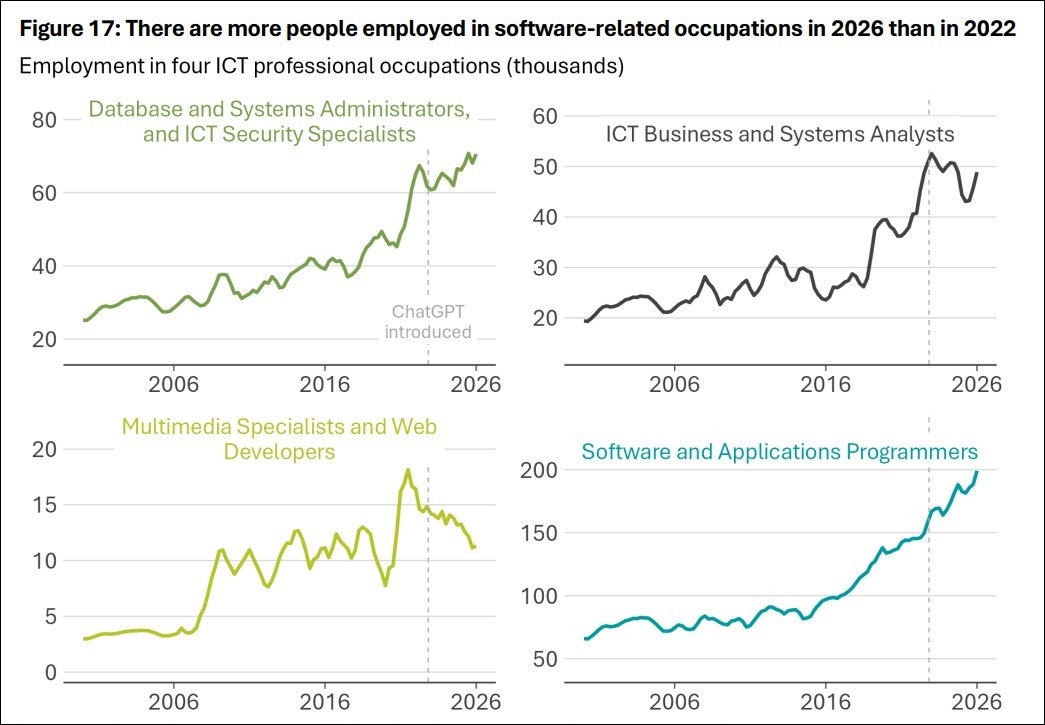
Image: 'AI and employment in Australia' report, Department of Employment and Workplace Relations
'Youth outcomes have mostly held up’
The report found “the labour market for young workers and young graduates is also not showing broad deterioration”, despite international evidence suggesting they may be among the most exposed to automation risks – and previous government research which found some Australian employers are now hiring fewer entry-level workers.
“Employment for people aged 20 to 24 has grown slightly faster than employment for people aged 25 and over since ChatGPT was introduced,” the latest report found.
"... Employment outcomes for young tertiary graduates have been positive, despite expectations young graduates could be among the first groups to be affected by AI.
“Their unemployment rate remains low relative to older graduates, and the share of young graduates employed in degree-level jobs has risen.”
Minister for Employment and Workplace Relations, Amanda Rishworth, said the federal government “is determined to ensure AI is harnessed to create good jobs, not threaten them”.
“Artificial intelligence could yet reshape the jobs market in Australia, but this report shows labour market conditions remain strong by historical standards, youth outcomes have mostly held up, and occupational reshuffling has not accelerated,” she said.
“... We will continue to make sure Australians are supported through this change, with the skills, training and pathways needed to adapt and benefit.”
The Department of Employment and Workplace Relations said it will “continue monitoring the relationship between AI exposure and employment growth”.
“Ongoing monitoring of the impacts of AI on the Australian labour market is needed to provide the best foundation to advise government,” it said.
Aussie firms planning new AI roles
As AI use increases in Australia, AI-related jobs have become some of the fastest growing roles in the nation.
A survey in June of more than 500 senior staffers at Australian organisations that use AI found 45 per cent of those firms planned to create new AI-focused positions.
The research, commissioned by AI search company Elastic, found 18 per cent of firms were already recruiting for such roles.
Despite the rising cost of many AI platforms causing some companies to reevaluate their budgets, the research also found half of the companies surveyed were increasing their spending on AI in the new financial year – despite around a third of them going over budget last year.
Nitish Tyagi, a software engineering analyst at research firm Gartner, said in June that sector leaders “are increasingly concerned as token-driven AI spend becomes harder to justify, with budgets often being depleted earlier than expected”.
Amid the pricing pressures, AI coding costs are forecast to overtake the average salaries of software developers by 2028, according to Gartner.