

Australians are too busy to study or undertake work-related training, according to new Australian Bureau of Statistics (ABS) figures that have charted a steady decline over the past four years – and reveal that young people are studying more to improve their job prospects than to boost their skills.
The newly released 2024-25 Survey of Work-Related Training and Adult Learning found the proportion of Australia’s 20 million 15 to 74-year-olds undertaking study or training during fiscal 2024-25 had declined since the last survey in 2021, from 39 per cent to 34 per cent.
That figure suggested a million people have opted out of education in just four years – suggesting major problems for skills pathways that depend on continuous engagement and growth.
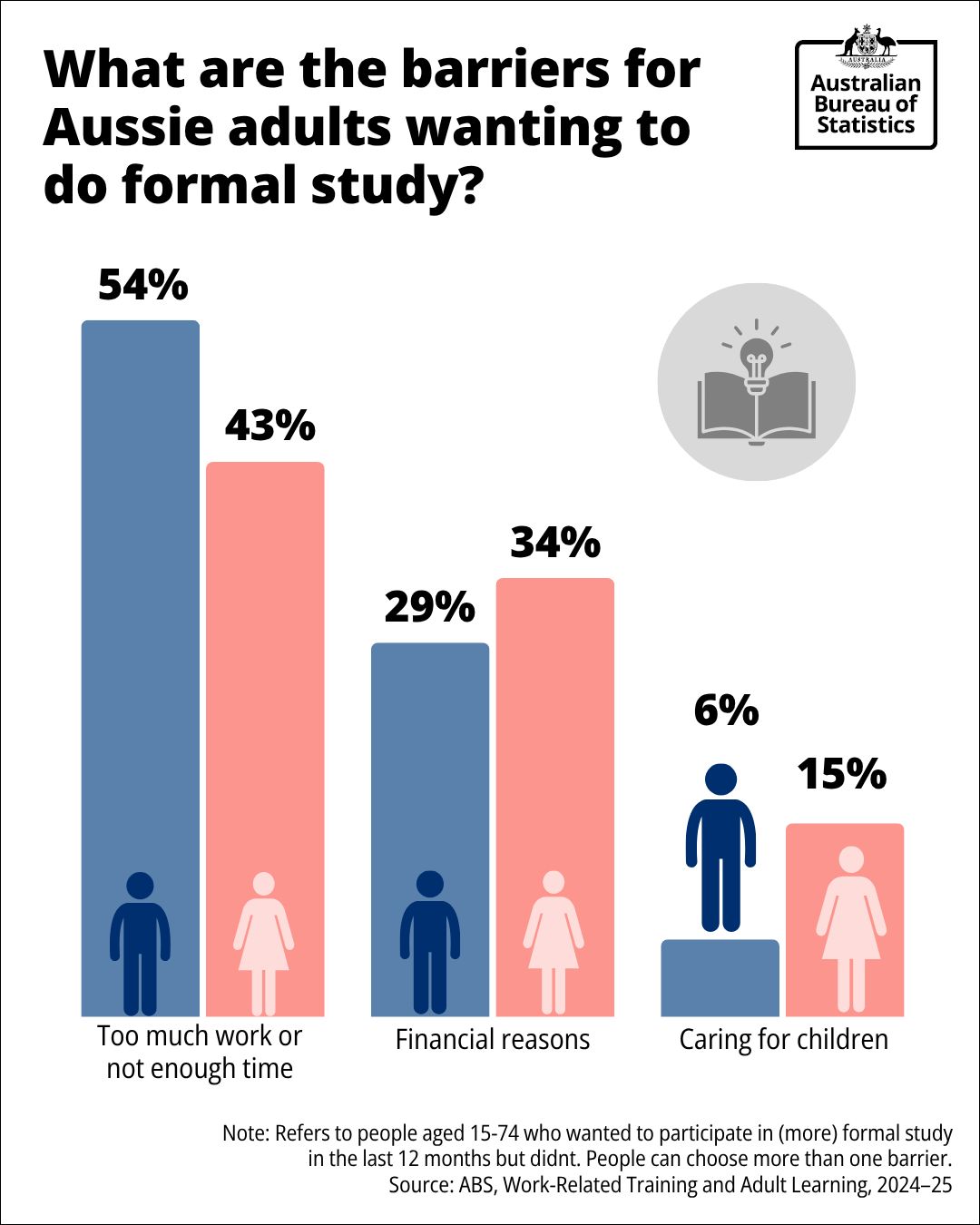
The reason for the decline? We’re too busy, apparently, with the ABS reporting that 53.5 per cent of males and 42.5 per cent of females said the main reason they weren’t pursuing study or training was because they didn’t have the time or were already working too much.
Fully 60.3 per cent of respondents working full-time said they don’t have enough time to study, yet the same explanation was given by a third of part-time workers – suggesting programs are too inflexible to even accommodate more flexible schedules.
Figures on people who said they were too busy to study showed differences between those who had completed Year 12 (49.9 per cent too busy) and those who had not (35.6 per cent).
There were also differences among those born overseas (54 per cent too busy) and those born in Australia (43.2 per cent), and those with third quintile incomes (56.1 per cent too busy) versus second quintile (38 per cent).
The cost of living was also an issue, with 35.7 per cent of full-time workers and 29.4 per cent of part-time workers saying financial reasons prevented them pursuing further study – well ahead of the 2020-21 and 2016-17 surveys when 18.4 per cent and 26.1 per cent, respectively, said cost was a barrier.
AI is redefining perceptions of training
The figures – which reflect ongoing changes in Australians’ perceptions of work and work-related personal development – come as a new ABS review finds record numbers of 25 to 34-year-olds say they are “permanently unable” to work, further reducing Australia’s talent pool.
This, as the surge of enterprise AI adoption leads many workers to question their job security – and drives broad concerns that they aren’t being given the skills to thrive in this new era.
Just 36 per cent of the 13,000 employers, employees, and job seekers responding to people2people’s Market Report 2026 survey said their jobs won’t be impacted by AI, with 69 per cent saying their employers aren’t giving them the training or support for the “AI-driven future”.
Indeed, the ABS found that just 21 per cent of workers had participated in work-related training over the previous 12 months, with sales workers, professionals, and managers most likely to have done three or more training courses.
Reflecting stated concerns about financial barriers to learning, the ABS found 17 per cent of workers had covered some of their training costs themselves.
Employers must boost employee support as migration changes bite, people2people said in warning the slowdown “is likely to intensify competition for skilled talent, increasing pressure on employers to strengthen attraction, retention, and workforce planning strategies.”
This tension remains a key issue for employers to resolve, particularly as they rush towards AI – Deloitte recently found 65 per cent of Australian companies will increase AI investment this year, without fully considering its implications for workforce training and career development.
Young people want the job more than the skills
Employees value training more than their employers, people2people found, with 15 per cent of employees saying they would quit due to lack of training or upskilling – nearly twice the 8 per cent of employers who believe employees would quit for that reason.
The ABS figures also highlighted a perception disconnect about the value of study – with 47.7 per cent of 15 to 24-year-olds saying they mainly study to improve their job prospects, compared with just 27 per cent that actually want to increase their job skills.
Given that people2people found employers ranked improving productivity and performance, AI and digital upskilling, and attracting top talent as their key priorities in 2026 – and that 37 per cent of employees say they would accept additional training in lieu of a pay rise – it’s up to employers to bridge the gap.