
Australians will get a crash course in Microsoft’s AI worldview after the company announced a $25 billion investment on major infrastructure, cyber safety collaborations, and AI workforce training for 3 million Australians – but sceptics worry about a lack of detail.
Positioned as an enabler for the government’s National AI Plan, Australia’s new memorandum of understanding (MoU) says Microsoft will “support Australian AI diffusion and innovation” by expanding the $5 billion investment in local AI and cloud capability it announced in 2023.
That investment is funding nine new Australian data centres, with the new $25 billion – to be invested by 2029 – expanding that as Microsoft makes its largest Australian investment in the 40 years it has been operating here.
The MoU says Australia “is uniquely positioned to shape the responsible development and deployment of frontier AI technologies both regionally and globally,” committing Microsoft to the government’s expectations for data centres and infrastructure developers.
It aims to establish Australia as a “trusted regional hub” for AI infrastructure, with “technical exchanges and collaborative research” on frontier AI with agencies including the AI Safety Institute and National AI Centre, and cybersecurity collaboration with Home Affairs and the Australian Signals Directorate (ASD).
Despite the high-level nature of the Microsoft deal, Minister for Industry, Innovation and Science, Tim Ayres, said it outlines a plan “to ensure AI delivers real economic and social benefits for Australians while keeping safety front of mind.”
By progressing the work of the National AI Plan, he added, the deal will “help drive productivity, support skilled jobs and strengthen Australia’s position as an attractive place to invest.”
Some details yet to come
Analysts are unpicking the details of Microsoft’s latest investment – with some warning that the announcement is big on promoting adoption of Copilot and light on detail about the direct economic benefits for the country.
Australia’s MoU with Microsoft is set to increase government use of the company’s AI tools – with reference to “capability building” through a Volume Sourcing Arrangement between “a Microsoft affiliate and the Commonwealth of Australia”, represented by the DTA.
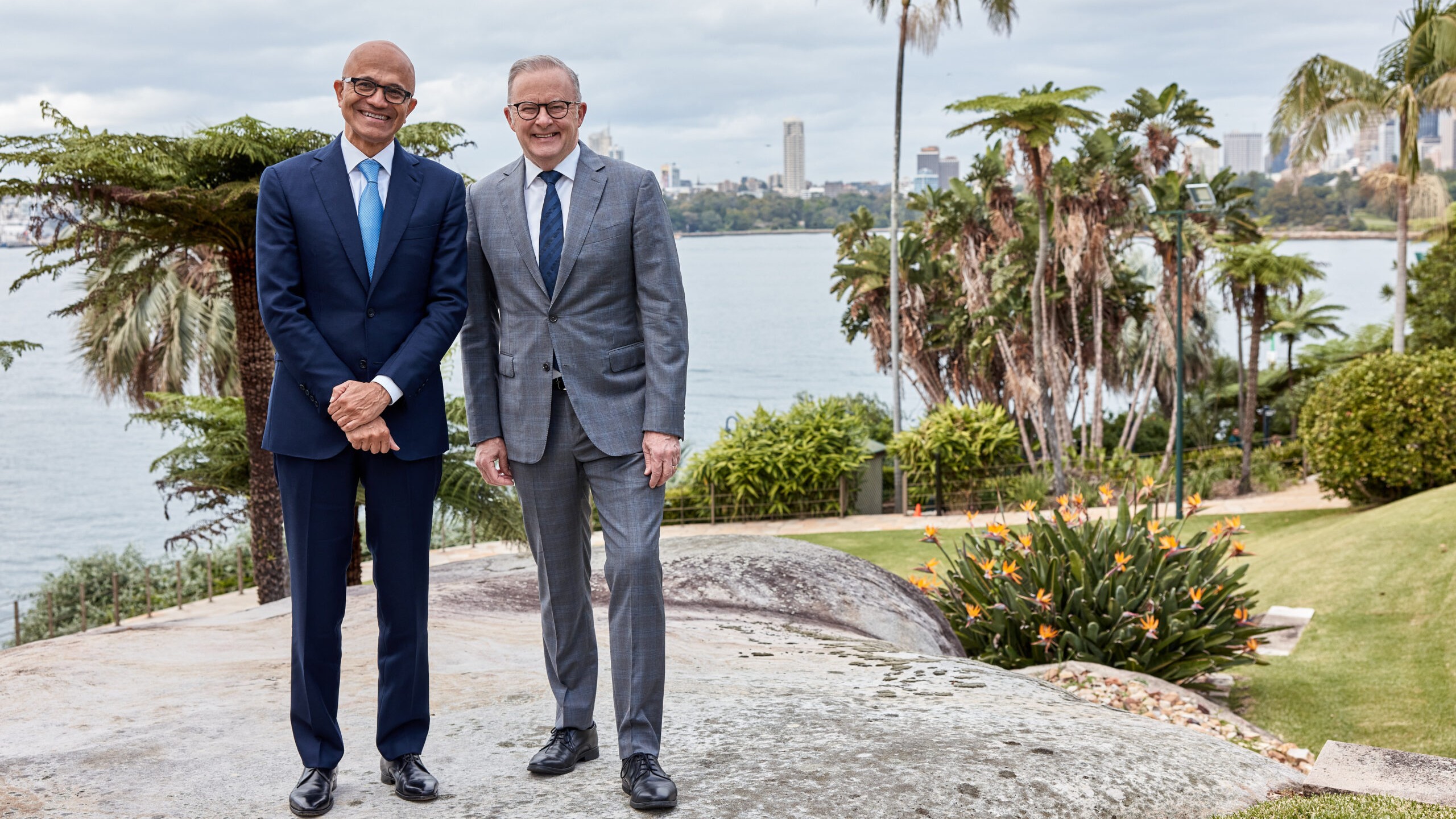
Microsoft CEO Satya Nadella (left) with Prime Minister Anthony Albanese (right). Image: Microsoft / Supplied
Microsoft has also committed to adding additional firmed renewable energy resources, suggesting that it will work with infrastructure builders and the federal government to build new solar or wind farms to offset the power consumed by its additional data centres.
It’s a key part of the government’s expectations policy – yet renewables planning and environmental approvals take years, begging more detail about what Microsoft can actually deliver within three years.
Expectations are nonetheless high, with Assistant Minister for Science, Technology and the Digital Economy, Dr Andrew Charlton, welcoming Microsoft’s commitment.
“By partnering with responsible global AI leaders like Microsoft,” he said, “Australia is setting the regional benchmark for safe, secure and inclusive AI, and improved energy and water security.”
Training Australians in AI
Announced simultaneously with the infrastructure commitment was a pledge to significantly ramp up AI training in Australia, with Microsoft setting itself the goal of delivering “practical, responsible” AI training to 3 million Australians by the end of 2028.
The new target expands on the 1 million goal Microsoft set in late 2024, when it promised a major skills delivery program just months after the federal government’s Digital Transformation Agency (DTA) signed onto a six-month trial of Microsoft’s Copilot AI.
“Australia doesn’t just need more people who can use AI tools,” Microsoft ANZ president Jane Livesey said with the latest announcement, “[but] a much broader set of capabilities: how to apply AI to real work, how to use it safety, and how to judge when not to use it.”
That type of judgement isn’t necessarily being imparted to those using AI, with a new NSW Office for Youth poll finding that up to 70 per cent of the 2,300 surveyed young people in that state use AI regularly – but many worry that blind AI adoption is compromising thinking.
Recent research has warned about overreliance on AI, including a University of Pennsylvania study of 1,372 participants that found broad adoption of AI is creating a form of “cognitive surrender” – with participants trusting AI output even when it is inaccurate.
Steering Australia’s AI users to a better understanding of the technology’s strengths and limitations will be crucial for the newly announced training, with Microsoft citing a new EY-Parthenon study it commissioned that predicted $22 billion in AI-enabled productivity gains.
Australia “is among our leading markets globally” for Copilot adoption, Livesey said, flagging major customers like Westpac and Arinco, as well as the work of Microsoft’s nearly 1,000-strong engineering hub as one of the largest Microsoft development centres in the world.