
Australia has a “propitious mix” of AI skills, research and industrial resources but needs to upskill millions of workers to realise its benefits, according to a new analysis of the AI preparedness of 89 countries that ranked Australia second behind only the United States.
A strong showing across all four categories – skills alignment, academic readiness, the future of work, and economic transformation – gave Australia a total score of 97.5 in the QS World Future Skills Index 2027, holding steady on a leaderboard largely the same as last year’s.
The US set the benchmark by scoring 100 in the Skills Alignment and Future of Work categories, while the UK topped Academic Readiness and China led the Economic Transformation metric, setting the standard against which other countries were measured.
QS – whose widely cited ranking of top universities counts nine Australian unis among its top 100 – flagged Australia’s “world-class universities” as a “powerful competitive differentiator” and lauded its economy as having “one of the most balanced profiles in the world.”
Despite their fundamental strengths, however, it warned Australian institutions “must redouble efforts to create the economic conditions that turn underlying strengths into workforce transformation at scale” – including boosting productivity and R&D spending.
“Australia’s longstanding status as a world-class higher education powerhouse, and its strategic strengths in high-value sectors like earth sciences and mining, position it well to benefit from technological transformation,” Quacquarelli Symonds CEO Jessica Turner said.
Australia has a “propitious mix of highly-skilled knowledge workers, research power and industrial acumen,” she continued, but warned the battle is long from over.
“To convert these promising fundamentals into world-leading growth and innovation,” she said, “Australia must increase the penetration of AI skills throughout its economy.”
Unis still aren’t producing the AI skills industry wants
Strong scores in the Entrepreneurial and Innovative Mindset and Sustainable and Ethical Workforce categories confirm that we have good ideas – but deficiencies in Human Cognitive Skills and Human-Centred Leadership suggest we don’t know what to do with them.
And despite strong institutional scores and AI and digital instruction, Australia’s subpar 72.9 score for Skills Demand – which reflects current labour market signals – highlights the stubborn disconnect between what unis teach and what skills industry is hiring.
“Higher education systems are struggling to equip graduates for a rapidly changing labour market,” the report notes, “with employer demand for AI, digital, and green skills increasing faster than traditional educational models can respond…. and employers are frustrated.”
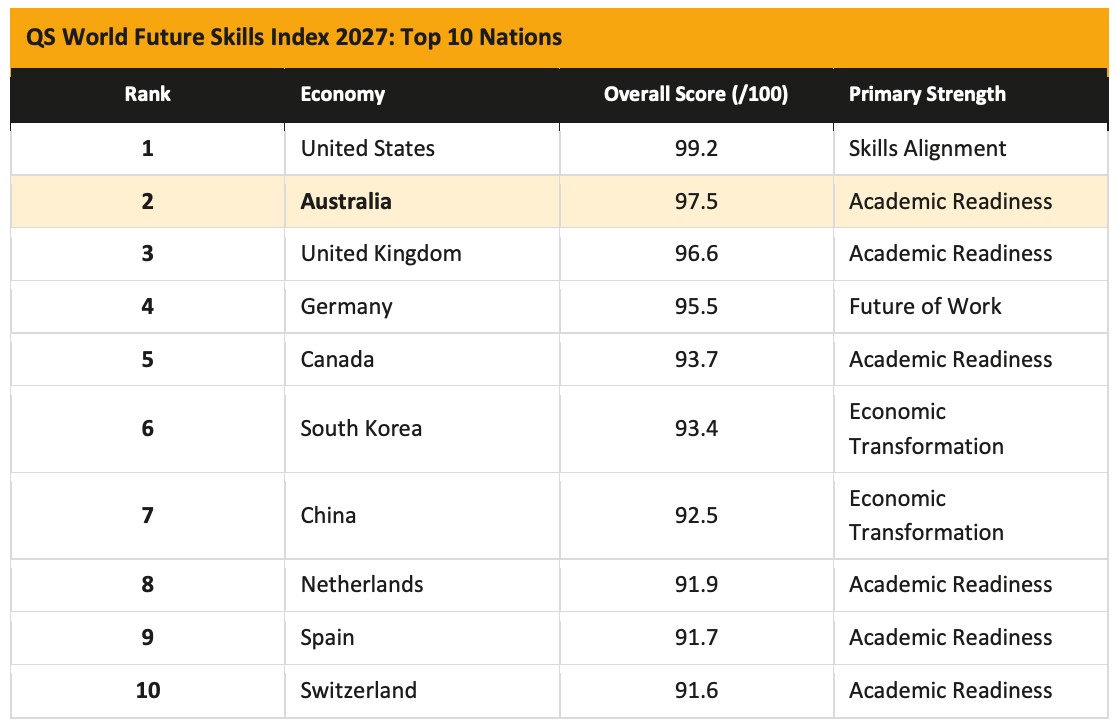
Australia ranks favourably in the world's top AI prepared nations. Source: © QS Quacquarelli Symonds 2025-2026
UNSW in Sydney this month launched Applied Degrees designed with industry to deliver targeted skills in high-demand ICT areas – although, perhaps proving QS’s point, none of the new courses focus on AI – with software development, cybersecurity and business favoured.
QS sees such industry engagement as crucial for universities to realise their potential as facilitators of the AI training that will be critical to bridging the gap between AI expertise and AI practice – yet “this is not a challenge which universities can solve alone,” it warned.
“It requires alignment across higher education policy, funding, curriculum governance, institutional agility, and employer investment in workforce development and lifelong learning.”
We have the skills – but what are we doing with them?
Despite Australia’s strong university and economic base, its practical shortcomings have long been the subject of debate – with CSIRO’s struggles to maintain funding and staff reflecting a broader malaise in Australian innovation and translation that must be overcome to win in AI.
Australian researchers secured 14 of the 100 most highly cited AI related publications in 2024, according to the recent Human-Centered AI (HAI) centre’s 2026 AI Index Report – which found Australia’s AI literacy runs well ahead of its AI engineering capabilities.
Indeed, that index ranked Australia as the sixth highest user of ‘intentional AI tools’ globally and seventh in terms of the number of ‘top AI authors and inventors’ despite ranking it twelfth in terms of the number of granted AI patents per capita.
In other words, Australians are enthusiastically adopting AI in their work but very few are working in AI, with a dismal national showing when comparing the growth of AI hiring to overall hiring – a ratio of just 0.37 per cent, ranking it 44th out of 46 analysed countries.
Group of Eight chief executive Vicki Thomson openly acknowledged the contrast, crediting Australia’s high placement in the index to “the strong performance of our world class Go8 universities and depth of our research base.”
That said, she continued, Australia’s “weakest pillar is economic transformation, which is slow relative to global competitors…. The next decade will be defined by how quickly the system can align skills, industry and policy around fast-changing workforce needs.”
“We have built the knowledge base – but we are not yet investing enough, or connecting the system well enough, to turn it into economic outcomes at speed.”