



While AI is so far having a "low impact" on job vacancies in Australia according to the Australian Bureau of Statistics (ABS), new data from the agency shows several industries are reporting more reductions in vacancies than others.
The ABS added two new questions to its quarterly Job Vacancies Survey in August 2026 relating to the current and future impacts of AI on job vacancies, and published the results of these questions last week.
The bureau's head of labour statistics, Sean Crick, said the reported impact of AI on job vacancies differs across industries.
"Information media and telecommunications had the highest proportion of businesses reporting a decrease in vacancies due to AI at 16 per cent," Crick said.
This industry includes publishing (including of software, and physical media such as newspapers and books), as well as radio and TV broadcasting, motion picture and sound recording, internet publishing, telecommunications services, and roles related to libraries, archives, internet services, and data processing.
“This was followed by wholesale trade, at 8 per cent, and manufacturing, at 6 per cent," Crick added.
The professional, scientific, and technical services sector – which includes most IT jobs – saw 5.2 per cent of organisations report a decrease in vacancies due to AI.
Overall, only 3.8 per cent of businesses reported that AI had led to a decrease in their job vacancies, and most businesses reported no impact.
"About 82 per cent of businesses reported that AI did not impact the level of job vacancies in August 2026," Crick said.
Around 13 per cent of businesses were unsure of AI's impact on their number of job vacancies.
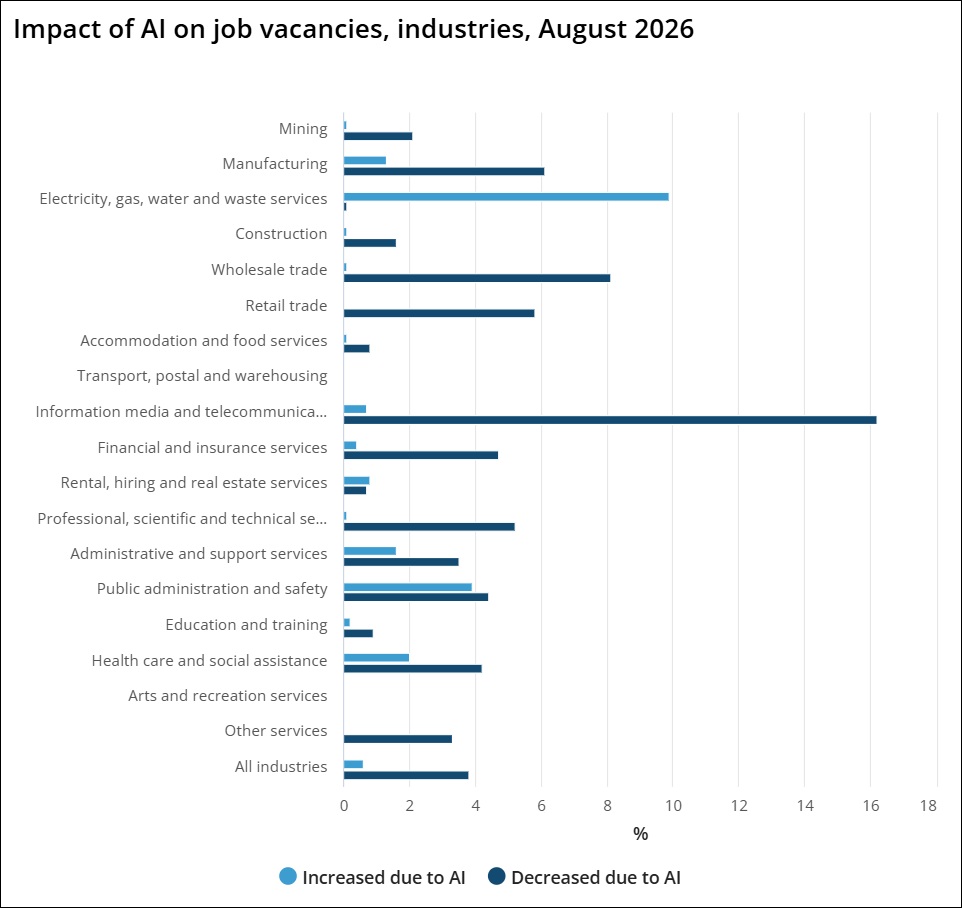
Chart: ABS Job Vacancies Survey
AI impacts expected to accelerate
Australian businesses expect AI to increasingly impact job vacancies over the next 12 months.
Around 4 per cent of businesses reported AI having an impact on their level of job vacancies in August 2026, but almost 10 per cent expected such impacts in the coming year.
"About eight per cent of businesses expected that AI will lead to a decrease in job vacancies and one per cent expected it would lead to an increase," Crick said.
While more than 80 per cent of businesses reported no impact on job vacancies from AI in August 2026, fewer reported that they do not expect such impacts over the next year.
"About two thirds of businesses said that they did not expect AI to impact their job vacancies over the next 12 months," Crick said.
While businesses expected information media and telecommunications vacancies to again be the most impacted in the coming year, this was followed by professional, scientific, and technical services roles.
Aside from jobs in IT, this category also includes roles in scientific research, engineering, consulting, advertising, accounting, legal services, and more.
Data released by the ABS in October showed job vacancies in professional, scientific, and technical services roles have already fallen sharply over the past year.
A government report released in July found there had been "no evidence to date of broad labour market upheaval” in Australia caused by increased use of AI tools.
However, the technology sector has seen companies such as Atlassian, WiseTech, Block, Canva, and the Commonwealth Bank shed jobs while increasing their investments in AI.
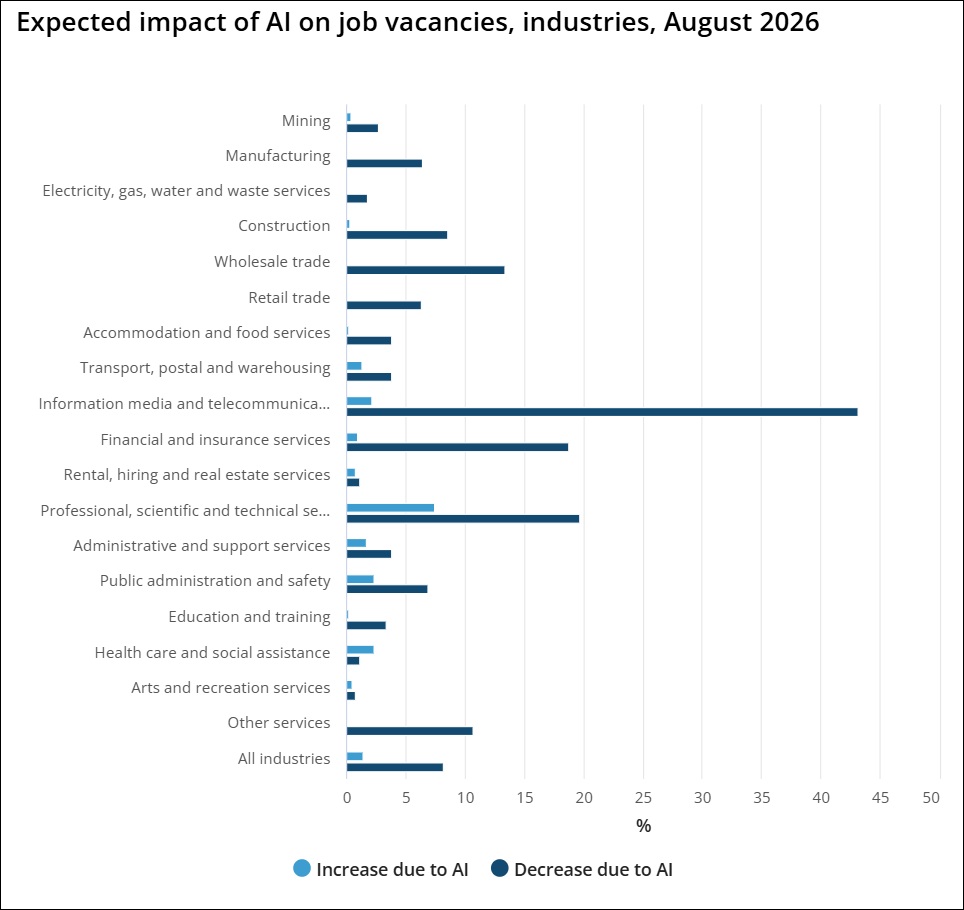
Chart: ABS Job Vacancies Survey
The industries seeing more job vacancies due to AI
Only 0.6 per cent of businesses reported an increase in job vacancies due to the use of AI, according to ABS.
Among them, the sector with the highest proportion of businesses reporting vacancy increases was in electricity, gas, water, and waste services, where 10 per cent of businesses reported jumps.
This was followed by public administration and safety at 4 per cent, and health care and social assistance at 2 per cent.
The industry with the highest proportion of businesses which reported no impact from AI on job vacancies was the transport, postal, and warehousing sector, at 94.2 per cent of that sector's surveyed employers.
Businesses with up to four employees were excluded from the ABS survey data.
The agency's next release of job vacancy statistics is expected on 13 January 2027.