





Australians can expect to ask their own personal AI agents to complete tax returns and access government services for them in the future, officials from the Australian Taxation Office (ATO) and Services Australia said on Monday.
Artificial intelligence agents, otherwise known as agentic AI, are AI models which can autonomously complete multi-step tasks on behalf of their users.
While most consumers have had little exposure to AI agents, representatives from both the ATO and Services Australia told the Gartner IT Symposium/Xpo on the Gold Coast that they foresee taxpayers' AI agents directly interacting with government AI agents in the future.
Services Australia deputy CEO, Jonathon Thorpe, said he could see a future in which an individual's AI agent "potentially could do a fairly good job" of using their personal information and context to access the right government services.
"We're seeing – and I think anyone would attest this in most industries – that increasingly customers are experimenting with agents in their everyday life," he said.
"Increasingly, we're going to have to think about what that means in the context of government service delivery.
"... If you start to think about agentic systems or multi-agent systems, you could see a moment in time where you've got society, consumer, customers starting to do this themselves."
The ATO's chief information officer Mark Sawade agreed.
"I think we'll be in a world where we'll be eventually talking to our personal agent, saying, 'All right, it's now mid-July, can you please just fill out my income tax return?'
"And the personal agent will talk to one or more other agents through the government ecosystem," he said.
'We're not there yet': The security and liability concerns
Both Thorpe and Sawade admitted government agencies were still a long way from directly engaging with AI agents used by Australians, due to current technological limitations and security and liability concerns.
"Where it starts to run into a lot of trouble really quickly is proving who someone is," said Thorpe from Services Australia.
"And at the moment, we don't have the plumbing necessary for agentic identity, particularly in the consumer and citizen space.
"I think we'll solve it, but it's not here yet."
A key challenge is "liability and responsibility" if things go wrong, Thorpe said.
"What happens if you set up an agent and you didn't quite set the appropriate guardrails? What's government's responsibility in that interaction?" he said.
Sawade agreed that government services are "a long way" from embracing AI agents from individual users, and identity issues are "one of the key things we'll need to solve".
"But if we're not thinking about how do we get there now, and the types of building blocks we'll need to put in place, it'll be an incredibly long time before I think we'll be ready to have government services that are safely and securely and transparently interacted with in in that way," he said.
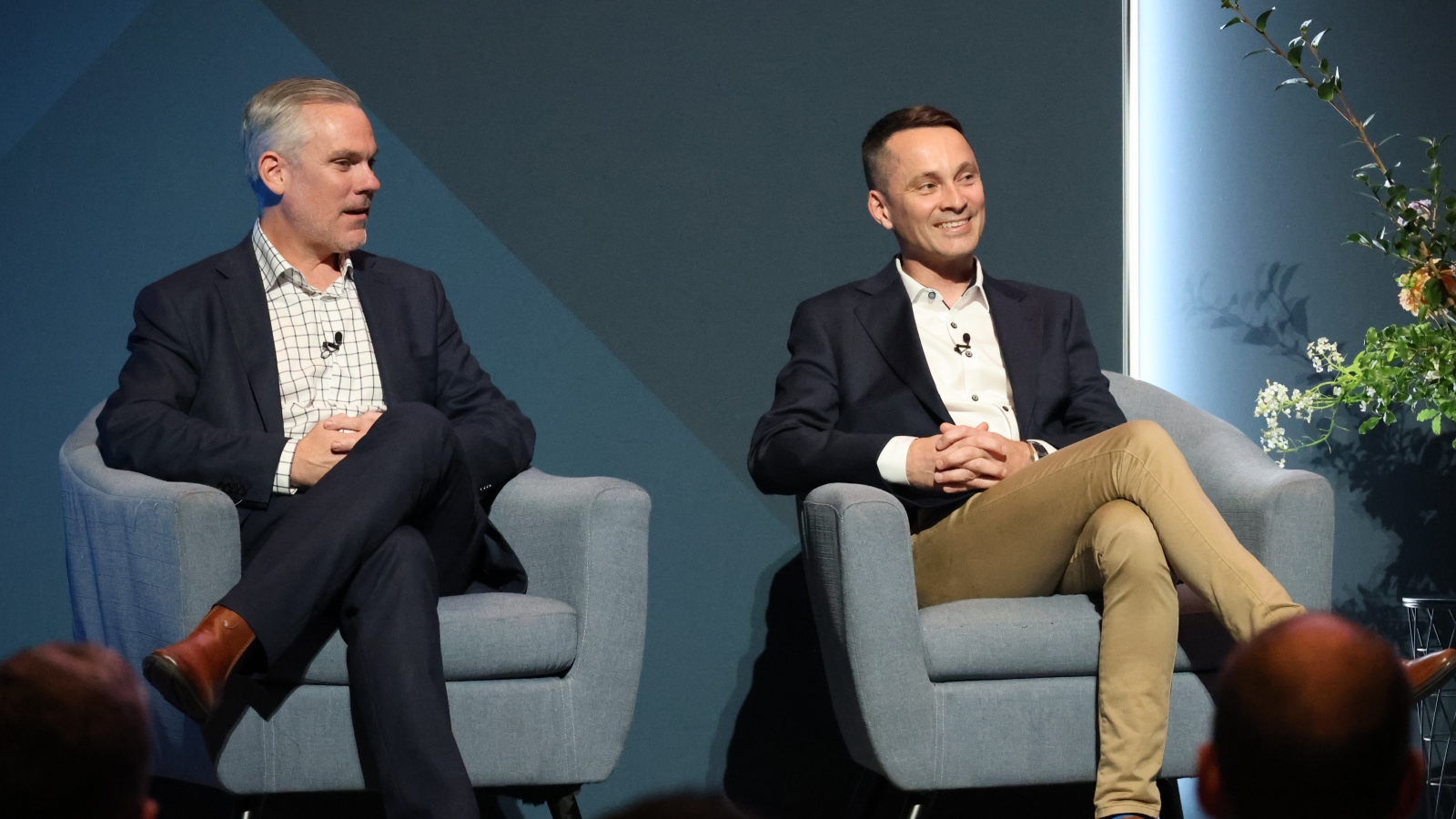
ATO chief information officer Mark Sawade (left) with Services Australia deputy CEO Jonathon Thorpe (right) at the 2026 Gartner IT Symposium/Xpo. Image: Gartner / Supplied
Internal agentic opportunities likely 'a lot easier'
Thorpe from Services Australia, which delivers government programs such as Centrelink and Medicare, said he saw agentic AI opportunities within organisations as "in some ways ... a lot easier".
"That being said, I think we'll still need to work out: Are they on organisational charts? Who's responsible for the agent deployment? How do you deal with machine speed assurance?"
Thorpe added that Services Australia is "quite cautious" about how it applies generative AI, and sees the technology "as an opportunity to evolve that service and make it better, not replace it".
"I do think there's places where agentic can play a better role, and that could be assisting our staff," he said.
"I don't think it's in front of our staff – I think it's I think it's actually behind it.
"How AI can support public servants to do a better job and better inform the community about what obligations, payments, and services are available to them."
These techniques are among what Services Australia is "looking at now as we transform our contact centre", Thorpe added.
Services Australia released its first AI and automation strategy in May 2025 – which did not explicitly mention agentic AI – after publicly defending its trials of AI technology.
The organisation's national manager of enterprise architecture and cloud engineering, Darren Vrettas, was gifted tickets to attend IBM's Agentic AI Summit in November 2025, according to Services Australia's gift disclosures.
Sawade from the ATO, which this year warned taxpayers against using AI in their tax returns, told the conference that his organisation had put generative AI "in the hands of as many of our staff as we can" to help with administrative tasks.
But he added the ATO workforce has "an appetite to go faster".
"They would like to be able to see where we could automate a whole range of different opportunities to give a better experience for both our staff and in terms of our mission," he said.
"We've had to be really, really careful about ensuring that we've got the right foundations in place. We've got transparency, we've got observability, and we've got a way of industrialising our use of AI with a lot of confidence.
"Because, quite rightly, we'll come under a lot of scrutiny for where we choose to start using AI – not so much in those administrative-type tasks – but where we are thinking about how it might add real value in those rewired business processes inside the ATO."
Gartner analyst Dean Lacheca said, "Success with agentic AI will depend on modern governance, workforce readiness, and the ability to redesign business processes, while creating an adaptable foundation for future innovation."