



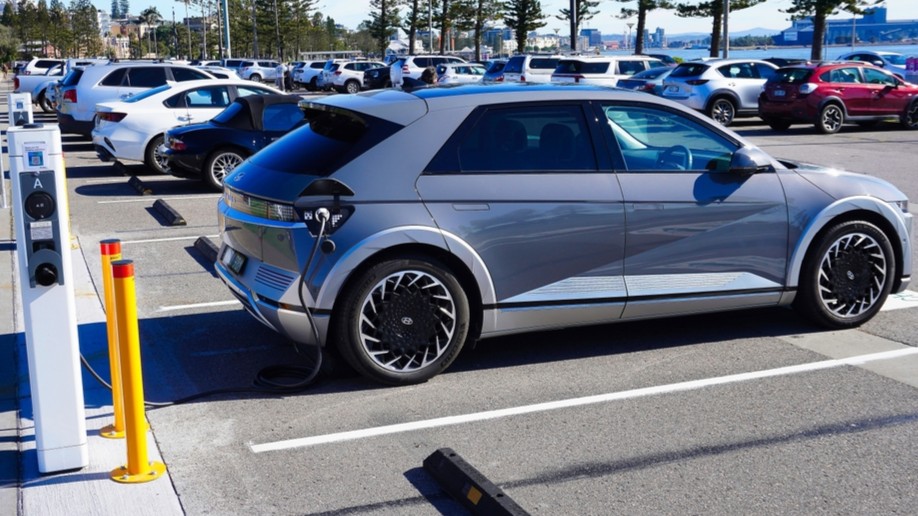

Popular tax breaks for electric vehicles (EVs) and home battery installations are facing the chop as the federal government looks to rein in spending and curb inflation.
The Labor government’s expenditure review committee is hunting for savings ahead of next month’s Mid-Year Economic and Fiscal Outlook (MYEFO).
Tax incentives for EVs and home batteries are reportedly among the programs under consideration, prompting some ministers to step up in their defence.
Under the current EV scheme, eligible vehicles purchased by employees through salary packaging arrangements are exempt from fringe benefits tax (FBT), allowing payments to be made using pre-tax income.
The exemption is expected to cost $1.35 billion this year, 15 times the original forecast, as demand for EVs in Australia continues to surge.
EV incentives under scrutiny
The federal government has already moved to scale back the FBT exemption.
Under changes announced last year, the full exemption will remain in place for eligible EVs until the end of March next year.
From April, vehicles costing $75,000 or less will continue to receive the full FBT exemption, while more expensive vehicles will receive a 25 per cent discount.
From April 2029, the 25 per cent discount will apply to all eligible EV purchases.
However, the incentives could now face further cuts or be scrapped altogether.
Shadow Energy Minister Dan Tehan labelled the scheme a “disaster”.
“Once again, the government has set up a subsidy where they have no clue what they are doing,” Tehan said.
“What we’re seeing now is that the people that can afford EVs are using them, but those who can’t are paying the price.”
Minister for Social Services Tanya Plibersek recently defended the incentives.
“I think EVs have made a huge difference in the cost of living for many Australians and the changes that we made have actually brought down the cost of EVs,” Plibersek said.
EV sales in Australia have doubled in the past year, with electric models now accounting for nearly 30 per cent of new car sales.
An EV is purchased every 100 seconds in Australia, with more than 600,000 now on the road.
The Electric Vehicle Council released a report earlier this week arguing that EV adoption could help reduce inflation and that the FBT exemption should be retained.
The report, prepared by Endgame Analytics, found that almost one-fifth of Australia's annual inflation was attributable to rising petrol and diesel costs.
It argued that switching to EVs could help protect household budgets and reduce Australia's exposure to global oil price shocks.
“Inflation is squeezing household budgets, and every rate rise adds to that pressure,” Electric Vehicle Council CEO Julie Delvecchio said.
“The more Australians who drive electric, the less exposed households and the wider economy are to oil price shocks.
“Getting more Australians into EVs faster is good economic policy.
"That means keeping the New Vehicle Efficiency Standard strong, maintaining the FBT exemption and building more chargers.”
Home battery subsidies also in firing line
The Cheaper Home Batteries Program was introduced to encourage households and businesses to install battery storage systems.
It provides a discount of around 30 per cent on the upfront cost of eligible small-scale battery installations for households, businesses and community organisations.
The scheme is now forecast to cost $7.2 billion over four years, up from the initial estimate of $2.3 billion, with more than two million Australians expected to install a battery by 2030.
The federal government adjusted the program in May to “ensure the discount remains appropriate for small, medium and larger battery systems”.
The changes maintained a 30 per cent discount across several battery categories, with the level of support designed to adjust as battery costs fall, the government said.
However, Treasury has reportedly been tasked with developing options to scale back the increasingly expensive program.
Energy Minister Chris Bowen has taken to social media to defend its value, pointing to more than 600,000 battery systems subsidised since July last year.
Prime Minister Anthony Albanese also highlighted the figure when asked about the prospect of the programs being scaled back.
“We’ll have budget announcements when we make them,” Albanese said.
“We work them through in an orderly way. But the program, for example, on Cheaper Home Batteries, has benefitted 600,000 Australian households and small businesses.”
Former Liberal prime minister Malcolm Turnbull argued that both schemes should either be scrapped or made means-tested.
“There is always a problem with subsidising worthwhile things that you might actually be subsidising people to do something they would otherwise have done anyway,” Turnbull said.
“The case for EVs is overwhelming. It’s like the case for solar panels. The subsidies are important to get these things going, and then there comes a point when…they should either drop off entirely or be simply means-tested.”