



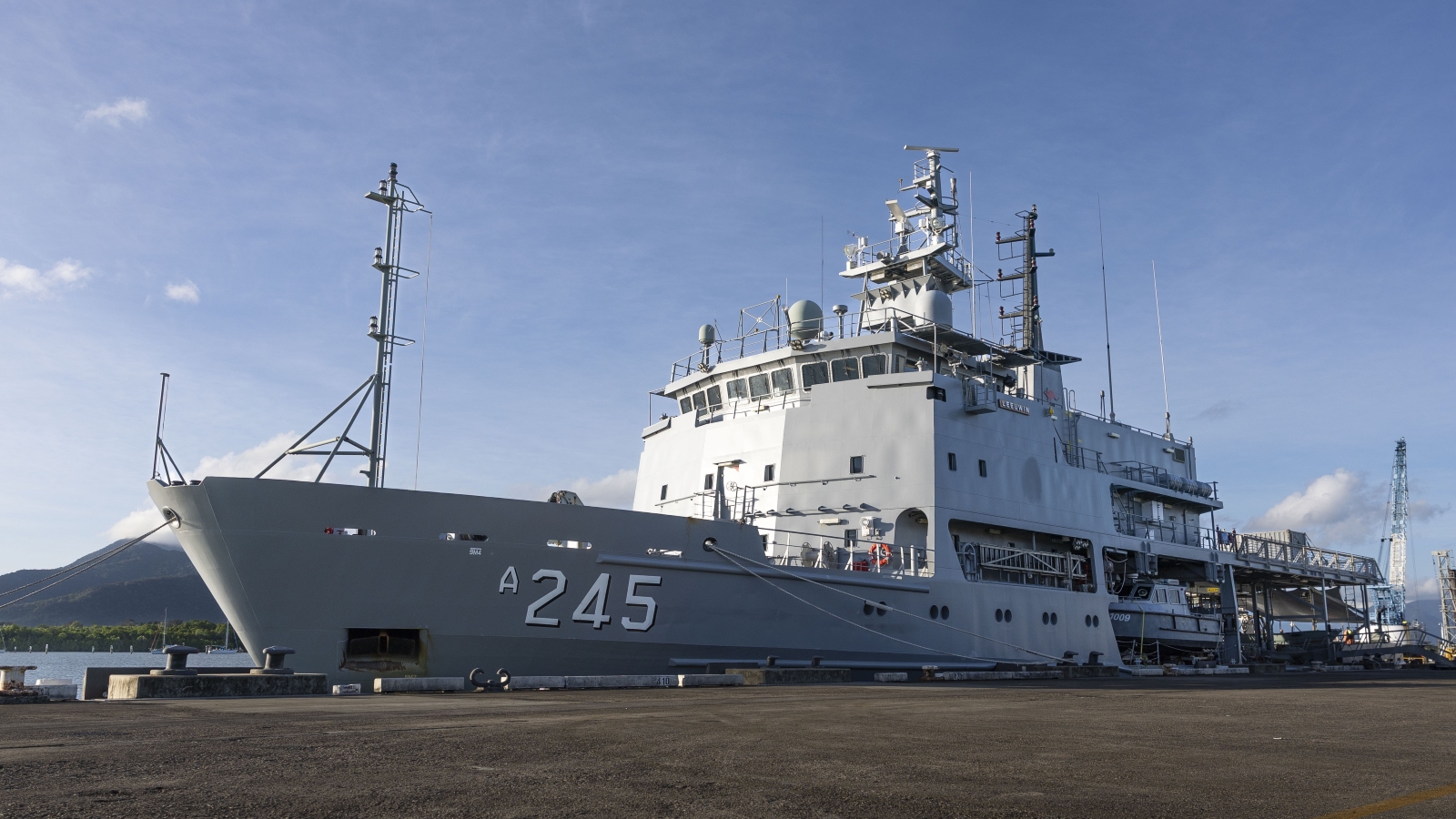

The Royal Australian Navy (RAN) is urgently sweeping its vessels for hidden recording devices, after a secret recording device was found in the women’s showers of the HMAS Leeuwin in what authorities have called an “absolutely reprehensible” incident.
Discovery of the camera, which was found on 11 October while the ship was docked in Cairns, was announced during a Senate speech by Senator Jacquie Lambie after she was contacted with news that the device had been found in a women-only area of the ship.
Some of the footage “may have been uploaded online before the cameras were discovered”, she said, urging Australian Defence Force (ADF) authorities to proactively check other vessels to ensure that there were no other similar devices secreted away.
Details of the camera or the circumstances surrounding its installation on the ship have not been shared given the ongoing investigation, but a day after the announcement the ADF said in a statement that a “person of interest” is assisting the Joint Military Police Unit (JMPU).
“This act is the most despicable betrayal of trust and is fundamentally misaligned with our values,” Chief of Navy Vice Admiral Matt Buckley said, confirming that he had ordered a 100% audit” of all bathrooms across the RAN.
Defence, he said, “is fundamentally a human endeavour performed by highly functioning teams with high degrees of trust in one another…. establishing and preserving this trust is critical.”
Speaking with ABC News Breakfast, Minister for Defence Industry Pat Conroy savaged the “appalling… disgraceful and absolutely reprehensible incident”.
“We’ve got no indications that it is espionage at this stage,” Conroy said, conceding that so far, the hidden camera seemed to reflect an incident of serviceperson misconduct and restating his commitment to improving an ADF culture that has repeatedly come under fire.
With women now comprising one in five new ADF personnel, Conroy said, “we’re committed to changing the culture so that everyone who joins the ADF is treated with respect and dignity…. But these incidents are still occurring, and they’re completely unacceptable.”
Cameras compromising privacy, defence secrecy
It’s not the first time military personnel have been caught in such circumstances: in 2019, the US Navy discovered that a Marine hid a GoPro camera in a ship bathroom, throwing the camera and its memory card overboard when it was discovered.
An appeals court later affirmed his conviction on charges that included obstruction of justice – leading to a demotion, jail time, and a dishonourable discharge.
Such devices’ diminutive size, always-only design and ready availability have made them a military bugbear: in August, UK authorities discovered that cameras on K3 Scout maritime drones were sending location and status information to an IP address in China.
Private-sector companies are dealing with similar problems, with OpenAI announcing earlier this month that it had fired a 35-year-old Saudi national after a “sophisticated recording device” was found plugged into a conference room television.
And last year, 29-year-old trainee surgeon Dr Ryan Cho faced 908 criminal charges – including stalking, producing an intimate image and installing an optical surveillance device – after he was found to have installed cameras in staff toilets at several Melbourne hospitals.
Cho filmed a reported 876 people and produced thousands of intimate images and videos from the cameras – highlighting the compounding risks posed by cameras that are not only easy to access, but produce readily available footage that can be easily disseminated.
A time of reckoning for a surveillance culture
The incident on HMAS Leeuwin comes as sales of surveillance camera systems continue to increase rapidly, with revenues expected to grow at 13.5 per cent annually through 2034 – and sales of tiny hidden security cameras set to grow by 9 per cent annually through 2033.
Authorities are wrestling with the implications of ubiquitous camera surveillance, with popular smart glasses in particular raising concerns this year as they put surreptitious recording devices on streets and in offices, theatres, restaurants and other spaces.
With many users openly admitting they are using the glasses to secretly film people – and some men using the devices to record and publish videos of themselves harassing women – privacy regulators have attacked loose controls over the surveillance technologies amidst calls for outright bans on the technology.
While legal experts note that current laws facilitate recording in public and don’t even apply to individuals, government workplaces face different regulations – and Buckley set higher standards of behaviour for ADF personnel, calling the incident “a most serious matter”.
“Eradicating sexual violence in our workplace,” he said, “is fundamental to the fighting efficiency of the Navy…. We will tackle this act of sexual violence with all of our energy [and] any perpetrator will be held to account.”