
Google is reimagining Gmail with a new ‘AI Inbox’ built around AI-generated summaries and to-do items.
Powered by Google’s flagship AI model Gemini, the new feature will bake AI summaries directly into users’ Gmail accounts along with buttons to write AI-generated responses, set up calendar events, and provide summaries of email threads, according to preview footage.
By checking which people you email frequently and using message content to infer your relationships with them, AI Inbox will identify “VIPs” to help prioritise “high-stakes” emails such as upcoming bills or appointments.
Those items then get pushed to the top along with simple “to-do” recommendations based on their contents.
The tech giant argued email has “changed considerably” since Gmail launched in 2004 – what was originally a one gigabyte mailbox is now being positioned as a “personal, proactive inbox assistant” that will help its 3 billion users manage an “all-time high” in email volumes.
“We're bringing Gmail into the Gemini era,” wrote Google.
“AI Inbox is like having a personalised briefing, highlighting to-dos and catching you up on what matters.”
Google has kicked off its rollout with a group of “trusted testers” before expanding to a broader audience in coming months.
How does it work?
In a blog post explaining the new feature (which itself had the option for users to read an AI-generated summary instead), AI Inbox was shown sitting at the top of Gmail’s side menu, above the conventional Inbox.
Beta footage showed no individual emails in AI Inbox whatsoever – instead, users were presented with “topics to catch up on” that summarised ‘important’ emails in dot-points.
At the top of the inbox was a “suggested to-dos” section with prompts such as “reschedule your upcoming dentist appointment” and “reply to Coach Mike about field monitor duty”, along with concise summaries of the related emails.
Google has reportedly confirmed users will be able to disable the new AI view, while Gemini’s analysis will be performed securely with the “privacy protections you expect from Google, keeping your data under your control”.
"As we’ve made very clear: we distinguish between the AI that helps you and the models we build for everyone,” a Google spokesperson told Information Age.
“When you use Workspace Gemini features, including those in Gmail, we do not use your personal content to train our foundational models.”
Last week, Google also started to roll out free access to its existing ‘Help Me Write’ tool for drafting and “polishing” emails, along with ‘Suggested Replies’ that leverage AI for one-click responses that match users’ writing styles.
AI in search engines, AI in emails
Google also announced its AI Overviews which have taken over Google Search in recent years are being made available in Gmail at no cost.
Further to providing AI summaries for lengthy email threads, these AI Overviews will be paired with the ability to “ask your inbox a question” in exchange for a Gemini-generated answer.
Similar to using a chatbot, Google explained users can “just use natural language” to ask about information in their inbox rather than “hunting for keywords or digging through a year of emails”.
At the time of writing, the ability to ask your inbox questions is being made available to US subscribers of Google AI Pro and Ultra.
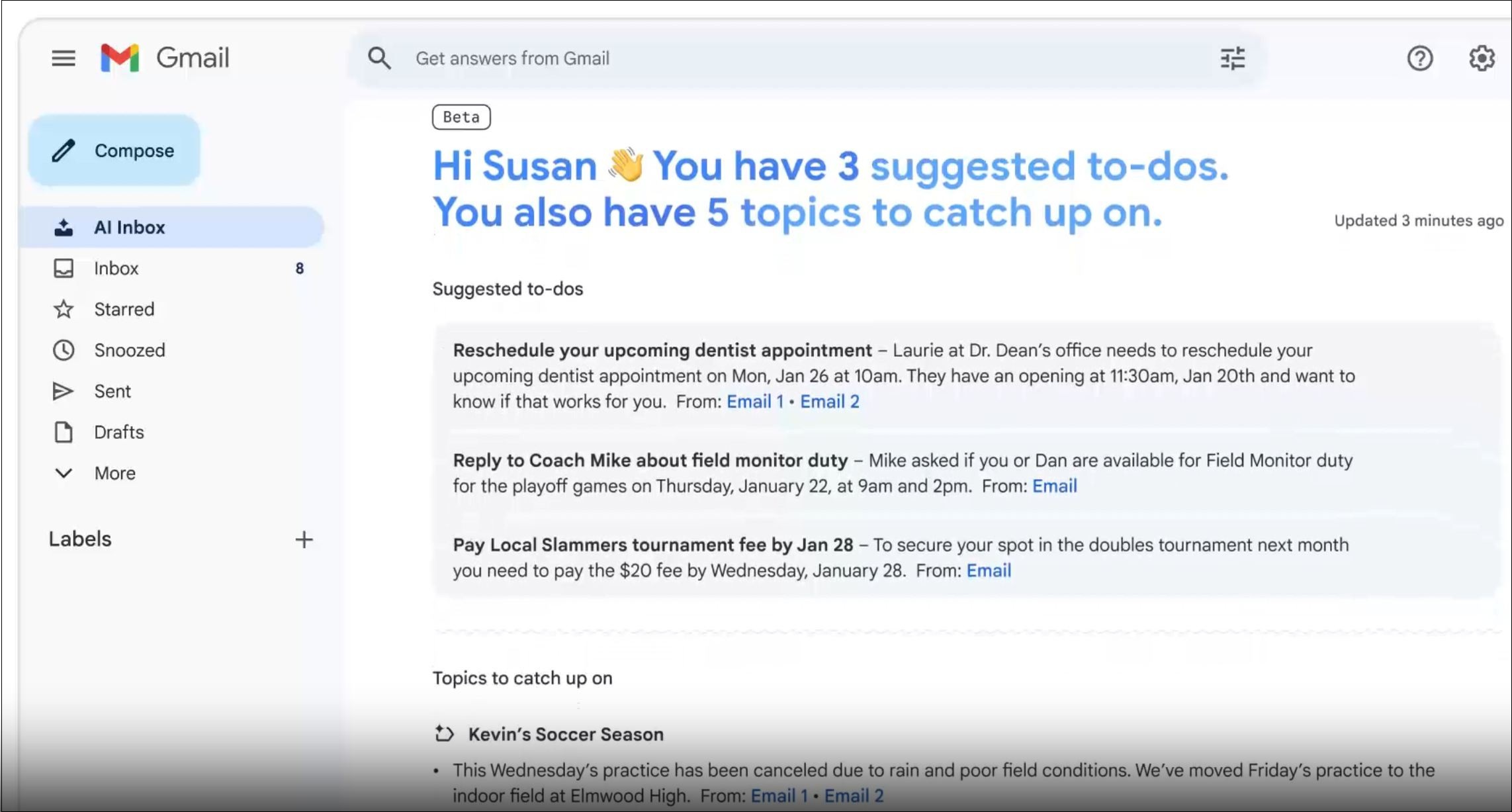
Gemini cherry-picks important emails and reads them on your behalf. Source: Google
Convenient, or intrusive?
Abhinav Dhall, associate professor at Monash University’s Department of Data Science and Artificial Intelligence, explained while there was a “clear demand” for Google’s new AI features, “AI fatigue” was also a “real concern”.
“As AI becomes ubiquitous, users, especially long-time and senior users can feel overwhelmed by frequent changes and added features,” said Dhall.
“The issue is not AI itself, but how it is introduced.
“AI that is optional, transparent and focused on real user needs is more likely to be welcomed than AI that feels intrusive, imposed or disruptive.”
Dana McKay, associate dean of Interaction, Technology and Information at RMIT's School of Computing Technologies, said although Gmail had been receiving “bits and pieces of AI support for some time”, Google’s AI Inbox introduced a “third layer”.
“That layer will, for many people, become the default interaction with their email, and things not surfaced in that layer will be ignored,” said McKay.
“This will prompt us to write in ways that work well for AI, rather than for other people.”
McKay added the tool will “definitely affect people’s workflows” given that people nearly universally “deal with what is at the top of the page first” and could also have significant implications for personal emails.
“It will become a race between marketers who want our attention, and Google deciding where our attention should go,” said McKay.
“The new email marketing skill will be AI optimisation.
“The ideal product, of course, would be more interactive and allow people to set their own priorities based on summarisation, rather than summarising for us.”