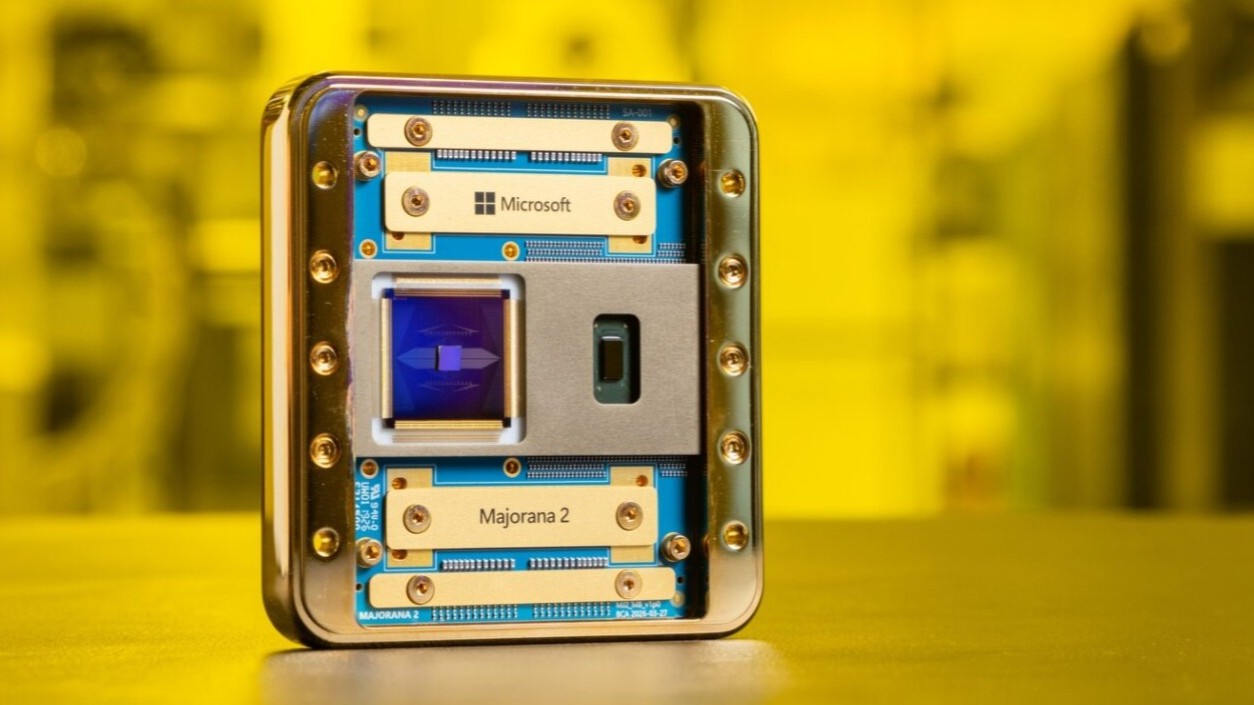

Microsoft has accelerated its quantum computing timeline to 2029 after the company’s latest quantum chip allegedly outperformed its predecessor by 1,000 times.
On Wednesday, the tech giant unveiled ‘Majorana 2’ – a next-generation quantum chip which boasts quantum bits, or qubits, that are “1,000 times more reliable than their predecessors”.
Similar to bits in regular computing, qubits are quantum computing’s basic unit of information.
Unlike bits, however, qubits are extremely sensitive to temperature fluctuations and electromagnetic interference – and keeping them stable has remained a pivotal challenge in quantum computing.
With Majorana 2, Microsoft is so confident in the chip’s next-gen level of stability that it expects a scalable and commercially valuable quantum computer will be ready by 2029.
Such a machine could tackle “intractable problems” in global health, food supply, sustainability, energy production, and more, the company said.
“We’ve got to keep marching to that roadmap to accomplish that, but where are we relative to last year?” asked Chetan Nayak, Microsoft technical fellow.
“We’re 1,000 times better.”
From microseconds to minutes
Where qubit ‘lifetimes’ are conventionally measured in microseconds, Majorana 2 reached mean qubit durations of 20 seconds.
Some higher-end measurements lasted as long as one minute, according to Microsoft.
“That improvement is roughly comparable to inventing a phone battery that instead of dying in a day could last for nearly three years on a single charge,” read a company blog.
Last year, Microsoft’s predecessor chip Majorana 1 made headlines for its use of a topological superconductor – a category of material that could create an entirely new state of matter which was neither solid, liquid or gas, and which ultimately allowed for more stable quantum computing.
Though this original superconductor relied on aluminium, Microsoft decided to instead base Majorana 2 on lead.
While it was already known that a lead-based superconductor could help shield qubits from destabilisation and ultimately improve qubit lifetimes, the company said it took years to “figure out how to overcome other trade-offs”.
“[This] was actually a fairly large change, and it led to big, big improvements in device quality,” Nayak said.
An AI-backed breakthrough
To feasibly achieve the chip’s “atom-by-atom” design – which required keeping each atom in its intended spot using a fine balance of complimenting materials – Information Age understands Microsoft relied on AI-driven simulations.
“Through simulations, you can see where the highly probable target is,” said Zulfi Alam, corporate vice president for quantum at Microsoft.
“With that knowledge, you ideally only have to experiment once.”
Alam claimed that with AI, the quantum team was able to make correlations between data that “we as humans cannot see”, while some experiments which would have otherwise taken weeks were sped up by “orders of magnitude”.
Researchers were also able to develop an AI agent which could produce meaningful insights from raw data – including one case where it “sniffed out” an uncalibrated temperature sensor reading that was “throwing things off”.
Notably, the company paired its quantum breakthrough announcement with heavy promotion of Microsoft Discovery, a research-oriented agentic AI platform that has been made generally available as of Wednesday.
Physicist calls ‘PR bull**it’
Counter to Microsoft’s claims, Henry Legg, a physicist at Scotland’s University of St Andrews, said the company’s 2029 timeline was “massive PR bulls**t”, and its proclaimed qubit lifetimes of 20 seconds were simply “not true”.
“What Microsoft claims to show is simply how long they stay in a 1 or 0 state,” Legg wrote.
“If anything, it's the lifetime of a classical bit.”
Legg further criticised Microsoft data from March as “incredibly unconvincing”, before observing some key measurements for Majorana 2 were suspiciously postponed to “future work”.
Notably, a commercially viable quantum machine would require millions of qubits, while the BBC reported Microsoft's current chip has achieved just 12.
Quantum timelines, threats, accelerating
Sarah Carney, national chief technology officer for Microsoft Australia and New Zealand, said although quantum is “not a general purpose technology” for consumer use, its impact will be felt through “advances in areas that matter to Australians, including healthcare, energy, agriculture, logistics and finance”.
“This technology is closer than many assume – years not decades,” she told Information Age.
“That’s why the focus now must be around quantum readiness and post-quantum cryptography to help ensure Australia’s economy and critical systems are prepared and secure.”
Indeed, Microsoft’s latest announcement puts its quantum forecasts closer in line with those of Cloudflare and Google – which recently warned quantum machines could crack the encryption standards underpinning modern digital security sooner than expected.
Both companies have moved their internal post-quantum cryptography timelines to 2029, while the Australian Information Security Association (AISA) last week warned that government and critical infrastructure organisations were still underestimating future quantum threats.
Greens senator David Shoebridge said there are “real concerns” that other sectors, including small and medium businesses, also remain at risk.
“It’s clear there are significant parts of the economy exposed to the increasing risks of quantum-encryption and it is up to the Government to be taking this seriously,” Shoebridge told Information Age.