
OpenAI began testing advertisements within its popular artificial intelligence chatbot ChatGPT on Monday, spurring a researcher to resign and inspiring a tongue-in-cheek Super Bowl ad from major competitor Anthropic.
Testing of ads in ChatGPT began for logged-in users in the United States on the chatbot’s free or cheapest subscription, but OpenAI said it had plans to expand the project more widely.
The company, which became a for-profit entity in October 2025, said the introduction of ads into ChatGPT was the result of “significant infrastructure and ongoing investment” needed to keep its free and Go subscriptions "fast and reliable”.
OpenAI is yet to turn a profit and its investors have spent hundreds of billions of dollars scaling its AI infrastructure, with the company allegedly planning to spend more than $US1 trillion ($1.4 trillion) over the next eight years.
The AI firm is also facing increasing competition from the likes of Google’s Gemini models and Anthropic’s Claude as it reportedly works towards an initial public offering (IPO) later in 2026.
For now, ads would not appear for users of ChatGPT’s more expensive Plus, Pro, Business, Enterprise, and Edu subscription plans, OpenAI said.
Users in ChatGPT’s free tier could opt out of ads entirely, but would face greater restrictions on how many messages they could exchange with ChatGPT each day, and would not be able to generate images or undertake deep research, the company added.
Ads also would not appear for accounts in which users had confirmed, or were predicted to be, aged under 18 by OpenAI’s systems.
Will my ChatGPT conversations influence the ads I get?
While OpenAI said it would not share users’ ChatGPT conversations or data with advertisers, the company confirmed its system decided which ads to show by analysing “what’s being discussed in your current chat thread”, as well as a user’s location and language.
Chat topics would be matched to relevant ads from advertisers — and if users chose to allow greater personalisation, their past ChatGPT chats and ad interactions may also be used to tailor the ads they received, OpenAI said.
“For example, if you're researching recipes, you may see ads for meal kits or grocery delivery,” the company said.
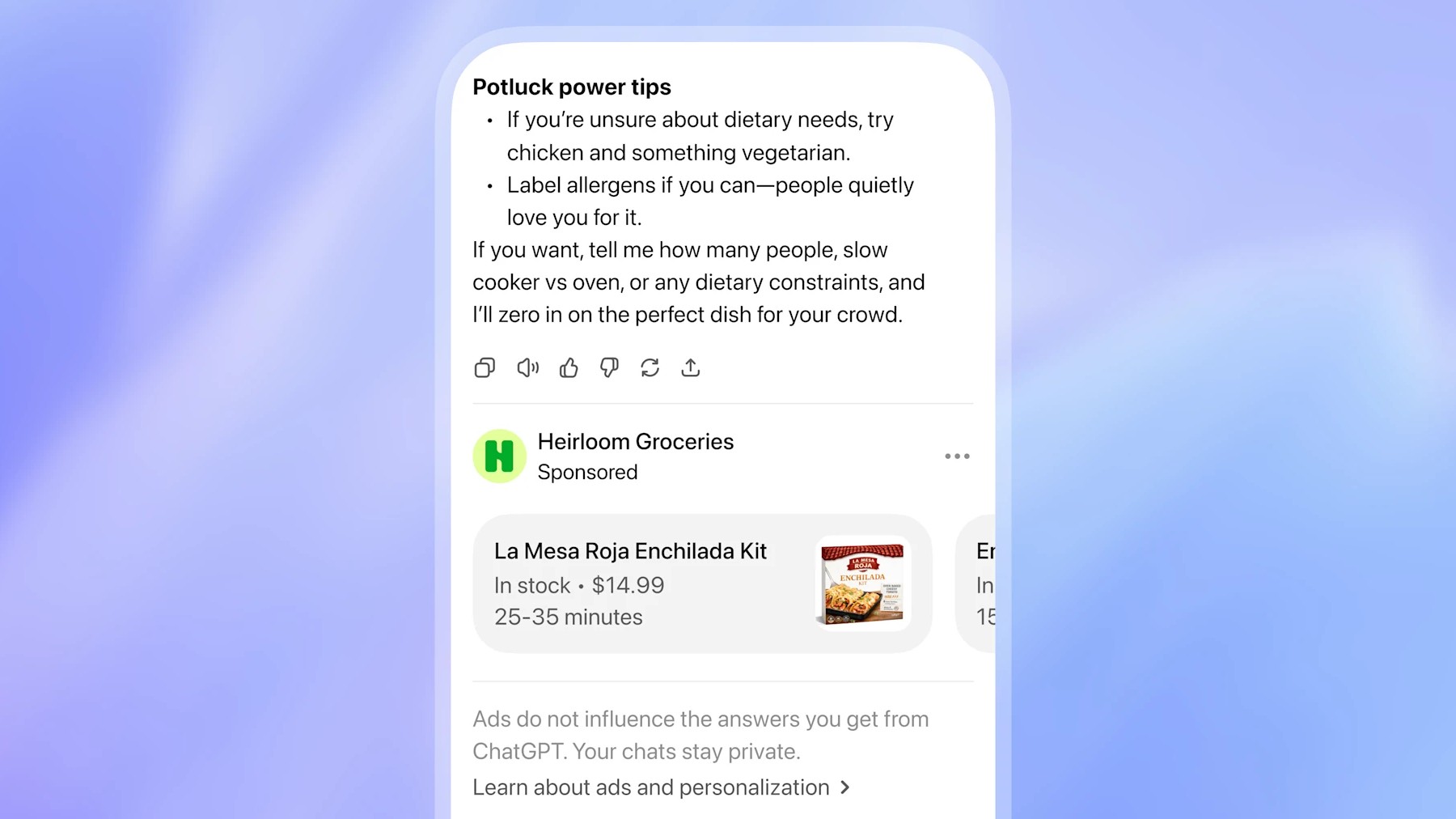
OpenAI says ads are labelled and appear below ChatGPT responses. Image: OpenAI
Advertisements would not appear “near sensitive or regulated topics, including health, mental health, or politics”, OpenAI said.
Ads for “dating, health, financial services, or politics” have also been excluded from ChatGPT “at this time”, the company added.
Users were able to clear the data and history used for ads without affecting their chats, OpenAI said, or it would be automatically removed after 30 days.
As for whether ads would influence ChatGPT's responses, the firm said, “Ads do not influence the answers ChatGPT gives you.”
Anthropic takes a swing, OpenAI researcher resigns
Anthropic, which was founded by former OpenAI staffers who disagreed with the company’s mission, poked fun at the ChatGPT-maker in an ad shown on primetime US television during the NFL Super Bowl on Monday.
In the ad, a young man struggling to do chin-ups asks a trainer if he can “get a six-pack quickly”.
The trainer, responding positively and appearing to somewhat mimic ChatGPT’s Voice mode, says he will put together a training plan.
However, the trainer suddenly begins promoting a brand of insoles for the young man’s shoes which he says “help short kings stand tall”.
The spot ends with the final tagline, “Ads are coming to AI. But not to Claude.”
Anthropic released three other similar ads in which seemingly helpful characters suddenly began promoting products and services.
OpenAI CEO Sam Altman described the ads as "funny”, but said he wondered “why Anthropic would go for something so clearly dishonest”, labelling the spots “deceptive”.
OpenAI would "never run ads in the way Anthropic depicts them”,” Altman wrote on X.
“Anthropic serves an expensive product to rich people.
“We are glad they do that and we are doing that too, but we also feel strongly that we need to bring AI to billions of people who can’t pay for subscriptions.”
Anthropic later changed the tagline on the television versions of its ads to, “There is a time and place for ads. Your conversations with AI should not be one of them.”
While Anthropic has publicly declared it will not integrate advertising, ads are reportedly in the pipeline for Google’s Gemini and xAI’s Grok, and have already appeared in Perplexity and in Microsoft’s Copilot.
OpenAI researcher Zoë Hitzig said she resigned from the company on Monday when the AI firm began testing ads in ChatGPT, as she had “deep reservations about OpenAI’s strategy”.
Hitzig said while she understood AI models were expensive to run and she did not see ads as immoral or unethical, she did not trust OpenAI to protect “the most detailed record of private human thought ever assembled”.
“People tell chatbots about their medical fears, their relationship problems, their beliefs about God and the afterlife,” she wrote in an opinion piece for The New York Times.
“Advertising built on that archive creates a potential for manipulating users in ways we don’t have the tools to understand, let alone prevent.”