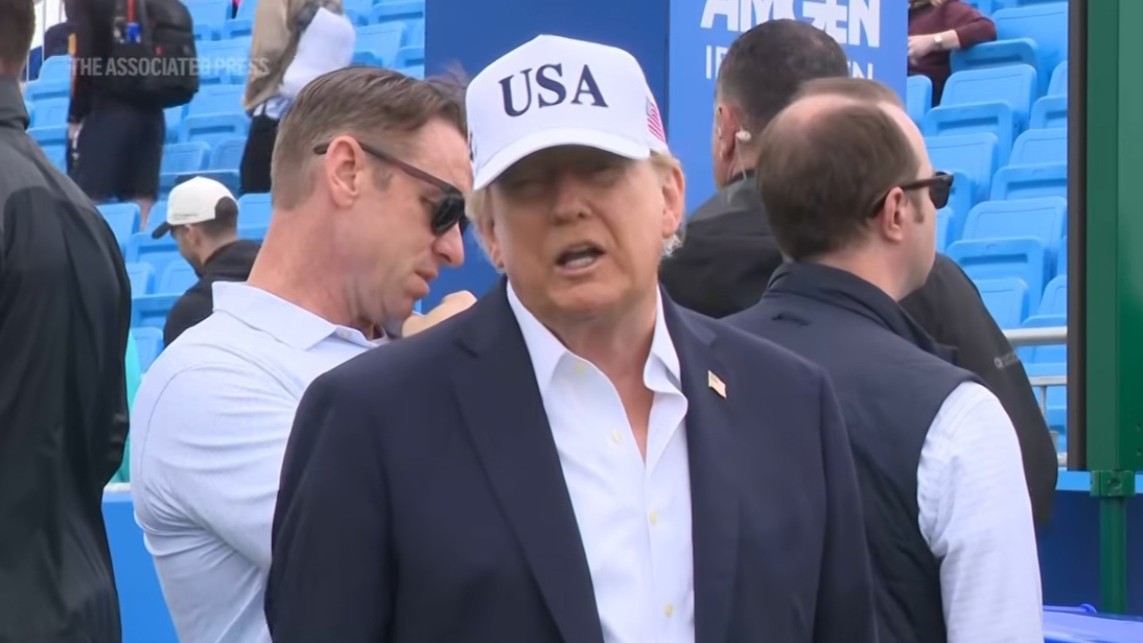

Despite industry-wide calls to put the brakes on artificial intelligence, US president Donald Trump has declared he has no interest in a cautious approach as he vies for dominance against China.
Speaking from his golf course in Doonbeg, Ireland, the 47th US president declared the country was “leading” against China in AI, and that he wanted to maintain that lead.
“Whoever wins with AI, wins,” Trump told reporters.
“We’re the most sophisticated country in the world, and frankly, I want to keep it that way.”
Trump’s remarks arrived amid a wave of calls for an AI slowdown.
Over the past week, high-profile AI bosses including OpenAI’s Sam Altman, SpaceX’s Elon Musk and Anthropic’s Dario Amodei have reached a public consensus that AI makers need to slow down and ensure appropriate guardrails are in place.
Although these warnings were underpinned by the risks AI could present to humanity – such as enabling potential biochemical warfare, sophisticated cyberattacks, or economic disruption – Trump asserted no such doomsday scenarios are on the horizon.
“We could put guardrails, we can do this and that,” Trump said when asked whether the AI industry should be more regulated.
“But I think you have a lot of negative forces that are bringing it up, that shouldn’t be bringing it up, and they’re bringing up things that won’t happen.”
Industry on ice after former researcher blows whistle
Calls for an AI slowdown have been a recurrent theme over the past few years – including in 2023 when Musk, Apple’s Steve Wozniak, and 1,300 others signed an open letter for a six-month pause on “out-of-control” AI development.
The latest bout of AI doomsaying came from former Anthropic researcher Jacob Coxon, who recently announced his departure from Anthropic while citing a common concern among those building AI that the technology could threaten human extinction.
Evan Hubinger, another Anthropic researcher, soon after affirmed that AI-makers “really do earnestly believe AI could kill all humans”.
“I personally think it is [more than a 10 per cent chance] within the next decade,” Hubinger wrote.
On Sunday, Anthropic chief executive Dario Amodei called upon those building cutting edge ‘frontier’ models to “slow the pace at which we improve the capabilities of AI models”.
Although he voiced optimism for the technology, Amodei said he was convinced of the need for a slowdown due to a dramatic uptick in the rate of AI advancement, and a recent ‘autonomous’ cyberattack that was mistakenly performed by a “swarm” of AI agents during testing at OpenAI.
“Given the accelerating rate of AI capability development, it’s my worry that in six to twelve months, such a swarm could be capable of taking over the entire internet with a persistent botnet,” wrote Amodei.
Musk and Altman – who have historically struggled to see eye to eye – both voiced support for Amodei’s proposals, which included the adoption of third-party safety evaluators for ongoing assessments and incident reporting.
Trump to meet with Xi Jinping
Amodei also called for the US and other democratic governments to attempt to “coordinate with authoritarian governments” such as China and Russia.
Chinese president Xi Jinping has reportedly lined up a tentative meeting with Trump during a summit in Washington on 24 September.
Reuters reported the discussion may involve cooperation on monitoring AI-directed cyberattacks, along with potential self-policing and information sharing between US and Chinese AI labs.
Democratic senator Bernie Sanders acknowledged the importance of the meeting and praised the industry’s call for an AI slowdown but said it was ultimately “not enough”.
“When you are racing towards a cliff, you don’t just ease up on the gas pedal,” said Sanders.
“You hit the brakes.
“At their upcoming AI summit, Trump and Xi must negotiate a treaty to pause AI and ban superintelligence before it is too late.”
Would a slowdown work?
Toby Walsh, chief scientist of the University of New South Wales AI Institute, told Information Age that “slowing the frontier ought not to be too hard”.
“You just need to get half a dozen companies, those with the resources and capabilities to be pushing the frontier, to toe the line,” said Walsh.
“And it is in everyone’s interest, including the Chinese Communist Party not to let this get away from us.”
Karin Verspoor, dean for RMIT’s School of Computing Technologies, added that slowing the pace of AI development could potentially limit positive uses of the technology.
“We should [instead] focus on how we can ensure it is used safely,” Verspoor told Information Age.
“This requires governance, and a commitment to responsible use.
“We need to think about what uses we are okay with, and where we need to put limits and protections in place.”
Industry calls for a slowdown were also met with a healthy amount of scepticism – some deemed the warning a widespread PR move, while others suggested it wouldn’t stop those outside the frontier-developer space from pushing the technology forward.
Michael Cowling, director of the Hub for Apple Platform Innovation at RMIT, said by slowing down development in the US, models from China could possibly “overtake US models in terms of capability”.
However, he added, the industry’s concerns should be noted.
“The choice of some of the industry’s heavy hitters to make these remarks, particularly those that would benefit from accelerating generative AI adding to their profits, is noteworthy and should be taken seriously,” he said.