
Since I was elected to the role of Vice-President of Academic (Technical) Boards nearly 12 months ago, I have focused my time on restructuring the ACS technical committees, which had previously lost some momentum and direction.
Today, ACS has nine active, functioning technical committees involving over 120 professional experts who are actively contributing thought leadership, producing publications, and providing advice to government and industry bodies.
The Vice-President’s portfolio also covers responsibility for ACS’s relationship with the International Federation for Information Processing (IFIP) – the global community of international partnerships delivering transformative benefits for national technology sectors.
It aspires to a worldwide, professional, and socially responsible development and application of information and communication technologies.
With our own technical committees successfully refreshed and revitalised, my next strategic task was simple: to investigate firsthand how the ACS – IFIP relationship truly adds value to our members.
Revitalising ACS’s technical community
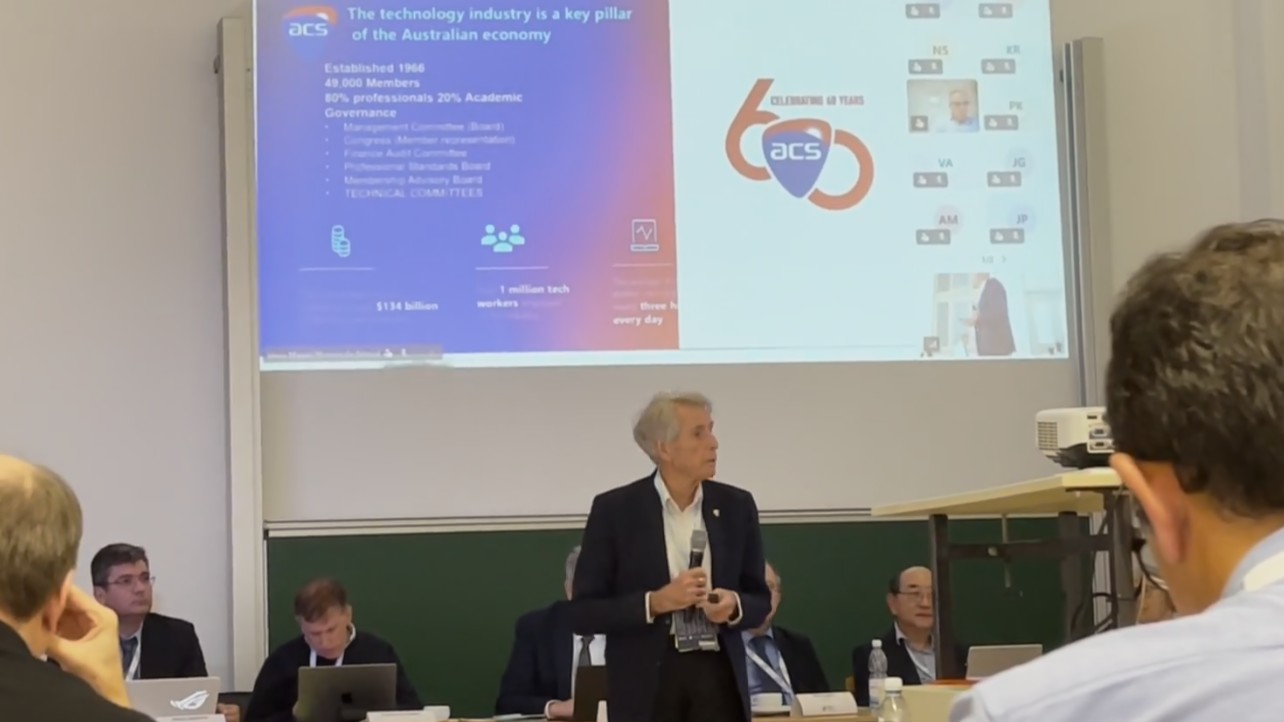
A first step in understanding this relationship was to represent ACS at the IFIP General Assembly in Dresden, Germany, this past September.
I’ll admit I wasn’t entirely sure what to expect. The General Assembly consists of representatives from over 40 countries and the leaders of the 14 technical committees.
As Australia's largest technology professional community, ACS has been part of IFIP for many years, but the Management Committee specifically charged me to find out exactly what our membership gets from our investment in this relationship.
I was joined in Dresden by Cindy Chung, National Congress representative on the Management Committee and our IP3 (International Professional Partnership) representative.
Cindy flew the ACS flag by working on the alignment of professional standards across IFIP members.
This work is incredibly important, as it creates opportunities for the bilateral recognition of Australian standards across the world, helping our members take their skills into a global technology workforce.

[L-R] ACS's Cindy Chung, Rod Dilnutt, and Anthony Wong in Dresden, Germany. Image: Supplied
Finding common ground on the global stage
What struck me most during the assembly was just how universal our challenges are.
Whether you are in Germany, Ukraine, or Australia, the issues facing professional tech communities are remarkably similar.
Member engagement, financial sustainability, and the need for clearer communication are not uniquely Australian problems – they are global.
Recognising that alone made the trip worthwhile, creating an immediate sense of connection and allowing us to build positive networks with like-minded leaders facing the exact same questions.
The General Assembly itself was a fascinating blend of formal governance and genuine connection.
Yes, there were elections and constitutional updates (the Austrian Association Registration Authority keeps everyone on their toes!), but what really mattered were the conversations happening in the margins.
Between formal sessions, I found myself discussing the future of tech education with committee chairs from across Europe, exploring how different countries are tackling digital equity, and learning about IFIP's ambitious Africa initiative.
One highlight was having the opportunity to present ACS's story to the Member Societies Assembly.
Our organisation's approach to balancing industry, government, and education perspectives clearly resonated with the international audience.
It was a powerful reminder that Australia's voice matters on the global stage – and that our members should know that voice is actively being heard.
Turning global connections into member value
But here's what genuinely excited me: the massive, untapped potential sitting right under our noses.
We currently have approximately 180 Australians listed as members of IFIP technical committees and working groups.
Most of them probably don't realise they are part of something this significant.
Furthermore, the IFIP Digital Library holds over 22,000 publications – a treasure trove of research, professional development, and international collaboration resources that our members could be accessing and contributing to right now.
The conversations I had with IFIP leadership about the value proposition for ACS's investment were candid, open, and constructive.
They understand that member societies need tangible, practical benefits.
That is why we are already turning this long-standing institutional relationship into something members can see and use.
We are currently auditing our Australian representatives, exploring how to leverage IFIP's digital library alongside our own journal initiatives, and planning to promote IFIP opportunities much more actively within our membership.
Attending the Informatik Festival alongside the General Assembly was the icing on the cake.
Hearing about cutting-edge research initiatives from Germany, Ukraine, France, and the European Union reinforced a vital reality: technology doesn't stop at national borders, and neither should our professional development and collaboration.
If you are an ACS member working in a technical committee or research group, there is a very good chance you are already connected to IFIP without even realising it.
My challenge to you is simple: find out where that connection can take you. Engage. Contribute. Share your expertise.
The global tech community is closer than you think, and your voice matters.
Dr Rod Dilnutt is ACS's Vice-President of Academic (Technical) Boards. He is a Fellow of the Australian Computer Society, a Fellow of the British Computer Society, and former National Director of the ACS Membership Advisory Board.