
Plans to build and deploy a low earth orbit (LEO) satellite are the thin edge of a wedge that the head of Optus satellite operations believes will open new export opportunities for a host of new technologies, including space imaging and laser backhaul.
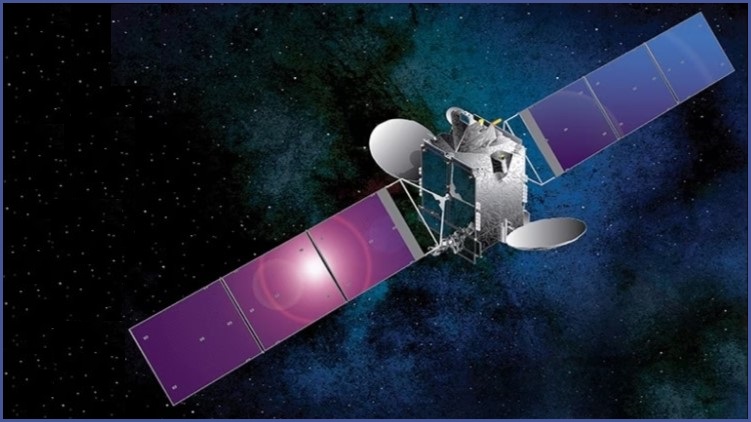
The satellite, which is set to launch in early 2028, will be built by Adelaide-based Inovor Technologies and operated by Optus from its Belrose Space Operations Centre in Sydney, which has managed geostationary satellites for four decades.
Geostationary satellites – which orbit at 35,786 km above Earth’s equator – stay fixed at a single point relative to the ground, making them invaluable to relay communications data and live TV broadcasts around the globe.
Their distance from Earth, however, means data must make a round trip of at least 70,000 km, which translates to latency of at least 233 milliseconds at light’s speed of around 300,000 km per second – three times the typical latency over NBN fibre.
LEO satellites speed data by orbiting at less than 2,000km – shortening the distance the information must travel and enabling broadband services like SpaceX’s Starlink, Amazon’s Kuiper, and Eutelsat’s OneWeb.
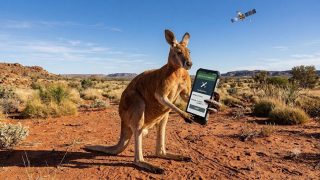
Like Telstra, Optus has embraced Starlink in a move to deliver messaging and, soon, mobile voice and broadband services anywhere in Australia – but Optus head of satellite and space systems Nick Leake says the LEO investment won’t change that.
“We’re not chasing Starlink, Kuiper or OneWeb,” he told Information Age, noting that the Optus consortium’s differentiation “is the technology that we’re actually putting up there.”
The value is in the payload
The Optus-led consortium will complement its work on the LEO satellite with equipment including a high-resolution space camera and laser communications terminal, providing marketable orbital imaging and communications capabilities.
The space telescope – a 20cm Adler Imager built by HEO and the University of Southern Queensland – will provide non-earth (NEI) imaging of satellites, planets, and anything else in the solar system with a resolution of 22cm at a distance of 100km.
That will make it beneficial for businesses and governments that need to monitor the ever-growing range of objects orbiting Earth, a part of space that Leake noted “is becoming a very congested area”.
The second component, which will be developed by the University of South Australia with the support of SmartSat CRC, is a compact small optical terminal that will allow LEO satellites and other orbiting equipment to communicate using high-speed lasers.
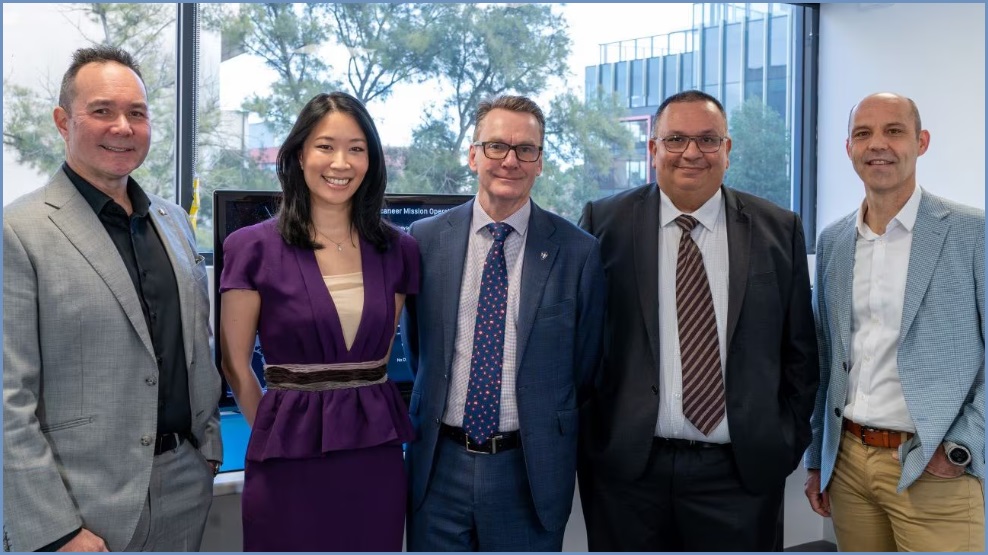
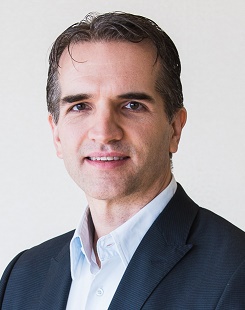
Pictured at the announcement [L-R]: Darin Lovett of iLaunch TrailBlazer; space lawyer Joann Yap of HEO; Nick Leake of Optus; Suneel S Randhawa of Defence Science and Technology Group; Matthew Tetlow of Inovor Technologies.
That project builds on an existing iLaunch partnership with ANU, Optus, and Leonardo UK that is building low-cost optical communication ground stations, at which the orbiting equipment will aim the communications lasers to enable high-speed links.
The optical terminals “need to communicate with something, so putting on an optical payload means that you can have space to Earth communications,” Leake explained – ultimately delivering an orbiting laser backhaul network not unlike the terrestrial NBN.
Sovereign innovation feeding a global industry
The Optus consortium is the latest venture from an increasingly confident Australian spacetech industry that has this year alone also seen announcements about the likes of Gilmour Space Technologies’ Eris rocket launch and SMC’s Optimus Viper satellites.
The Australian Defence Force has also come to the party, recently announcing that next year it will begin recruiting “highly specialised” space specialists into a “purpose -built workforce” that has already made a debut in the current Exercise Talisman Sabre 2025.
Whereas the likes of Starlink have orbited thousands of satellites to provide continuous global coverage, for now Optus is only developing one LEO satellite – far fewer than the 50 to 70 ‘birds’ Leake says is necessary to provide full Australian coverage.
It’s his hope that the commercial validation of the satellite design, camera and laser terminals to Technology Readiness Level (TRL) 9 – space industry speak for a commercially proven solution ready for deployment – will inspire global investment.
Goldman Sachs predicts surging global demand for space and earth imaging, maritime communications, aviation support and more will see over 70,000 LEO satellites launched in the next five years.
That could make the Optus consortium key to helping Australia position itself in an industry whose revenues are expected to surge from $23 billion ($US15 billion) this year to as much as $700 billion ($US457 billion) by 2035.
The consortium is “an encouraging development [that] comes at a time when Australia’s dependence on foreign-owned satellite infrastructure – most notably Starlink – raises serious strategic concerns,” telecoms analyst Paul Budde noted in a recent blog.
Given the “fragility of relying on commercially driven, foreign controlled systems for national connectivity,” he called sovereign LEO capabilities “vital for protecting national interests, securing critical infrastructure, and asserting strategic autonomy.
Yet “while the vision is sound, execution will be key,” he warned, noting Australia’s habit of launching major infrastructure “with bold headlines [that] lose momentum due to political short-termism, commercial self-interest, and lack of regulatory foresight.”
Optus sees the consortium as key to its expanding roster of satellite services, Leak said, noting that “once we prove the technology and commercialise those two payloads, we can export that capability globally and sell them back into Australia.”
“We’re trying to take the lead in developing a sustainable satellite and space industry and to develop a sovereign satellite LEO capability using the innovation of our universities and some of our small businesses like HEO and Inovor,” he said.
“Optus can see the opportunity here and we are now heavily invested in ensuring this works.”