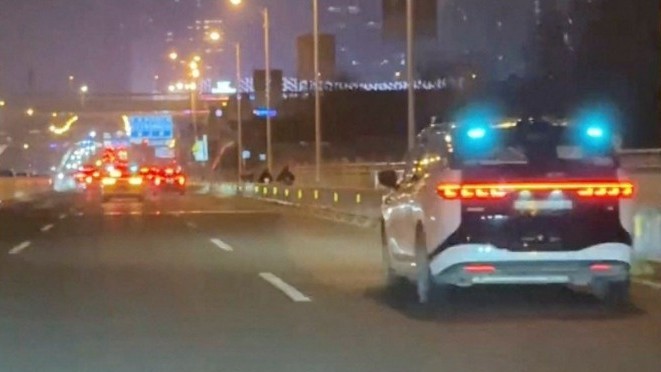

A “system malfunction” has stalled hundreds of robotaxis in China and left some passengers stranded in busy traffic for hours.
At about 9pm Tuesday night local time, robotaxis in Wuhan, China, came to an abrupt halt in the streets and turned their hazard lights on, causing traffic chaos.
Depending on where their robotaxi had stopped, some passengers were stuck in the cars, surrounded by busy traffic, for hours.
The Apollo Go robotaxis are operated by Chinese tech giant Baidu, which also operates driverless vehicles in the Middle East and is planning to launch in Europe.
The issue was caused by a “system malfunction”, according to local police, who added there were no injuries caused by the incident, and that they received calls “one after another” reporting the vehicles had ground to a stop.
“Multiple Apollo Go cars stopped in the middle of the road, unable to move,” local police said in a statement.
“After investigation, preliminary findings suggest the cause was system malfunction.”
Stuck on an overpass
One robotaxi passenger posted about their experience on China-based social media platform Rednote, saying they were stuck in the vehicle for more than 90 minutes on an overpass, surrounded by trucks
“I called robotaxi’s customer service [at 9pm], but couldn’t get through at first,” they said.
“After calling repeatedly, everyone I called said they had dispatched a specialist.
“After 10.30pm, my order was cancelled, and I was stuck on the overpass with dump trucks all around me.”
NEW: Dozens of robotaxis by Baidu stopped on the road in Wuhan, causing crashes on highways and trapping passengers in the cars—some for more than an hour. One passenger told me it took her 30 minutes to even connect to a customer representative.
— Zeyi Yang 杨泽毅 (@ZeyiYang) April 1, 2026
Here’s a video of a crash. pic.twitter.com/fTitNMv8kj
The rider was eventually rescued from the stalled vehicle but claimed that the company’s customer service representatives provided “useless platitudes” instead of “solutions for handling such an emergency”.
The Apollo Go driverless taxis launched in China in late 2020 and are now in operation in several cities.
According to company filings, there were 3.4 million driverless rides in the fourth quarter of 2025.
In December last year the Apollo Go robotaxis were suspended in the Chinese city of Zhuzhou after one hit two pedestrians, leading them to be placed in intensive care.
In August last year, one of the Apollo Go autonomous vehicles fell into a deep construction pit while it had a passenger on board, who was uninjured.
Paralysed robotaxis
It’s not the first time a fleet of driverless vehicles has come to a halt due to tech issues.
Late last year, a mass power outage in San Francisco caused Waymo robotaxis to stall across the city in streets and intersections, also with hazard lights on.
The company said with traffic signals out due to the power outage, the vehicles are designed to treat this as a four-way stop, but the “sheer scale” of the situation led to instances where the cars remained stationary for too long.
The Alphabet-owned Waymo is planning to bring its robotaxis to Australian shores, with hopes of testing its services locally from as early as this year.
Waymo officials met with the Assistant Secretary for the Department of Infrastructure, Transport, Regional Development, Communication, Sport and the Arts in 2025, and the federal government is working towards a conditional deployment of automated vehicles from next year.
Waymo requested a “confidential briefing” with Minister for Transport Catherine King to explain its “2026 plans in Australia”.
Its robotaxis have been operating in California since 2023.
The company has also reportedly discussed plans with the NSW government to launch in Sydney and is on the hunt for office space in the city.
It was revealed earlier this year that the Waymo vehicles are receiving “guidance” from workers based in other countries around the world, some as far away as the Philippines, leading to concerns around safety and security.
Waymo has previously stated that self-driving technologies are safer than human drivers, with Waymo robotaxis travelling more than 200 million kilometres through last September with 90 per cent fewer serious injury crashes and 81 per cent fewer injury-causing crashes.