

State and federal authorities have lined up to support Monday’s test of the nationwide AusAlert emergency warning system despite concerns from some parties, but Australians with iPhones from 2019 or earlier – or Android phones made before 2021 – may not receive the warnings.
The Cell Broadcast technology behind AusAlert – which lets government authorities broadcast an emergency message and audible alert to all phones in a certain area regardless of whether they’re in silent or do-not-disturb mode – is used in 35 countries and will go live in Australia in October.
Led by the National Emergency Management Agency (NEMA) and supported by individual state emergency authorities, the $132 million rollout began in 2020 after the Royal Commission into National Natural Disaster Arrangements flagged issues with the existing Emergency Alert system.
Nine live tests have so far been conducted in small, defined areas like Port Lincoln, SA but Monday’s 2pm AEST national test – which will send an alert and a 10-second siren sound to every 4G and 5G-connected device within range of an Australian mobile tower – marks the system’s biggest test yet.
Minister for Emergency Management Kristy McBain told a press conference this week that testing has confirmed that not just mobile phones, but SIM-equipped smartwatches and tablets are receiving the warnings, even in areas where low signal strength puts the devices in SOS mode.
Mobile devices running iOS 26.9 or later, or Android 12 or later should receive the warnings but, she admitted, “there are a range of devices that AusAlert may not go to at this stage [and] we continue to work with both telco providers and device manufacturers to provide advice directly to customers” on this.
iOS 26 is the current version of Apple’s iOS, iPadOS and WatchOS operating systems and does not work on devices as old as the iPhone 11 – which was released in September 2019 – while Android 12 was released in 2021 and doesn’t support any Google Pixel phones older than 2018’s 3 and 3XL.
“Most people’s phones are connected to update automatically,” McBain said while conceding the one-way nature of the broadcasts mean there is no way for authorities to know how many phones do or don’t receive each message “because we’re not sending messages to phone numbers.”
State emergency bodies still have reservations
Despite its ubiquity overseas – India, for one, successfully tested cell broadcast technology in May with a nationwide Cell Broadcast trial to its 1.5 billion phones – some Australians have given AusAlert a lukewarm reception.
Conspiracy theorists are out in force, while domestic violence support organisations like NEMA collaborator WESNET have long warned that the loud and unavoidable alert sound will reveal hidden and potentially problematic phones.
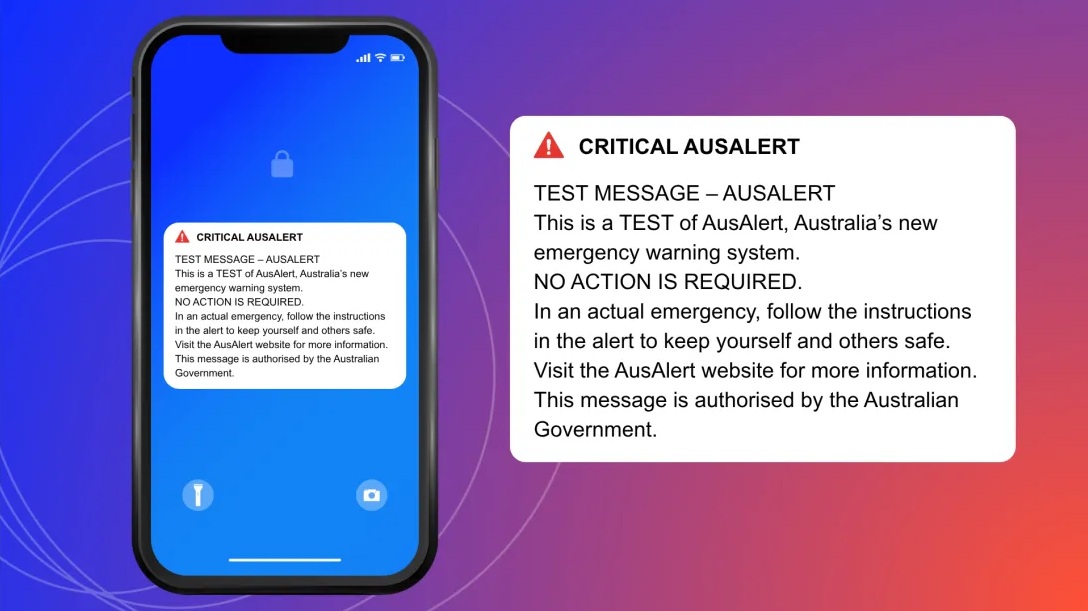
The test message Australians will receive on Monday. Photo: AusAlert
AusAlert Priority Alerts can be disabled through in-phone settings but Critical Alerts cannot, which is why WESNET advises users to turn off sensitive devices from at least an hour before the test, and to keep them that way until 24 hours after it.
Emergency authorities fear AusAlert may exclude regional, elderly and other citizens that currently receive both SMS and automated voice calls from the ubiquitous Emergency Alert system, which helps the 12 per cent of Australians still using landlines and 2 per cent using only landlines.
AusAlert’s lack of automated voice message (AVM) capability is a key reason it and Emergency Alert will operate in tandem for now, McBain said, adding that NEMA is “continuing to work through a procurement process to have AVM-capable AusAlert messages as well.”
Queensland Minister for Emergency Services Daniel Purdie expressed reservations, noting that “AusAlert is potentially life-saving technology, and we do support that… but we do need to make sure Queenslanders aren’t put at risk – and there are concerns around the [functionality] gaps.”
The Queensland Police Service has been actively facilitating AusAlert’s introduction in that state and – despite reports suggesting the Queensland Fire Department (QFD) would not adopt AusAlert – it now seems QFD will simply wait until April 2027, after peak bushfire season is over, to join.
“We’ve got a lot of people in those regional communities that rely on those landlines,” Purdie said as he joined McBain and his interstate peers for a roundtable discussion about AusAlert, “so we’ll be asking questions”.
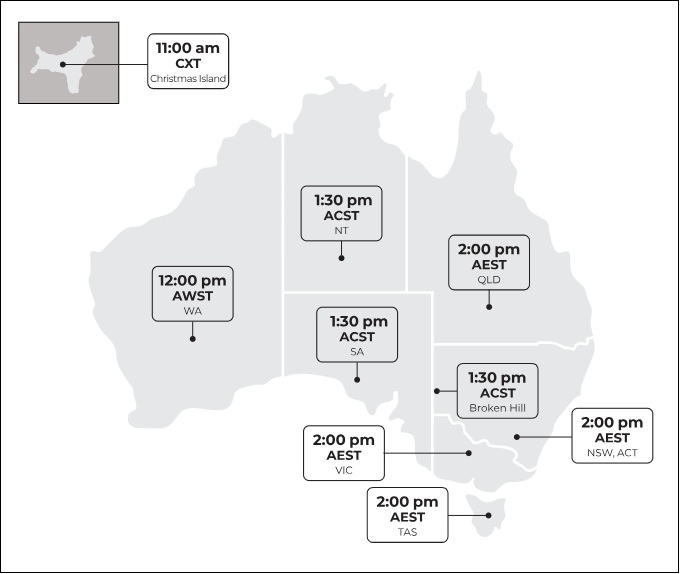
A map showing the local times Australians will receive the AusAlert message. Photo: AusAlert
NSW Minister for Emergency Services Jihad Dib was equally cautious, noting that “we’ve certainly had a few [questions about AusAlert] in NSW over the past three years, but as somebody who has been through natural disasters… the critical point is to get communication out to people.”
“The quicker and the better messaging that we can get out to the communities, the safer we can be.”
A target for hackers and pranksters
For all its promise for Australia’s disaster-prone summer months, experts warn that prior experience overseas suggests AusAlert will be irresistible for hackers likely to use it for spreading fear and panic, and extorting money.
Last November, software company OnSolve’s widely used CodeRed emergency alert system was targeted by ransomware criminals, while in June a hacker breached Brazil’s alert system and woke up millions of people by setting off nine false Cell Broadcast alerts in at least seven states.
A 2019 breach of the Early Warning Network sent phishing messages to thousands of Australians, while in 2013 hackers compromised a TV alert system for a prank warning viewers about an ongoing zombie invasion.
“Emergency warning systems sit at the unique intersection of critical infrastructure, government capability and the public trust,” said Jason Pearce, APJ field CTO with security firm Claroty, “and any system of national significance, can and will be a target for cybercriminals seeking to cause disruption.”
“These attacks expose the vulnerability of public warning systems and represent a dangerous escalation in cyber-psychological warfare in conflict.”
“Government must ensure that every layer of the system is secure, from the platforms emergency services use to authorise and issue alerts, through to the telco networks that deliver them.”