





Google has uncovered a new threshold in AI-powered cybercrime, with threat actors using autonomous AI agents to automate entire exploitation processes without human intervention.
In its latest quarterly AI threat tracker report, Google Threat Intelligence Group (GTIG) identified threat actors using autonomous AI agents to turn publicly released security patches into weapons for cyberattacks.
Researchers found attackers were combining large language models (LLMs) to automatically compare web application code before and after security patches were released.
The AI would then analyse patched and unpatched versions of software to identify potential vulnerabilities, develop working exploits, and automatically execute them without any human intervention.
GTIG also identified scripts capable of conducting further criminal activity on compromised systems, including follow-up reconnaissance, brute-force attacks and the installation of web shell malware.
Craig Costello, professor in the School of Computer Science at Queensland University of Technology (QUT), said such attacks could “shorten the time organisations have to respond”.
“A patch is public the moment it’s released, and it only protects you once you’ve installed it,” said Costello.
“Google meanwhile found an attacker’s AI system set up to go from a published security fix to an attempted break-in without a person steering each step.”
Google had previously observed a threat actor using AI to assist vulnerability discovery and generate exploit code in May, however, GTIG senior analyst Kelli Vanderlee said its latest findings represented a significant escalation.
“Our [latest] report describes the first example that we identified of a threat actor using LLMs to automate the vulnerability discovery, the writing of exploit code, and the exploitation of the vulnerability to gain unauthorised access to organisations,” Vanderlee told Information Age.
Real-world LLM attacks mark ‘critical inflection point’
Google highlighted an August attack in which threat actors compromised customer deployments of Australian print management software PaperCut.
The campaign involved LLMs used to test known vulnerabilities, compile target lists, and ultimately conduct a widespread hacking campaign against hundreds of organisations.
Vanderlee said such evidence of in-the-wild LLM usage marked a “critical inflection point for defenders”.
“Agents now autonomously explore multiple attack paths, troubleshoot errors, and achieve objectives in seconds and minutes,” she said.
“Coupled with continual advancements in underlying LLM capabilities, the acceleration in attack velocity and scale signals a notable shift in the threat landscape that fundamentally alters traditional intrusion dynamics.”
Google uncovers Russian-language AI hacking framework
GTIG's research focused on a tool called ‘exploit_agent’, a vulnerability research and weaponisation framework designed to automate cyberattacks.
The framework allowed hackers to integrate multiple large language models, both locally and through external AI providers, to continuously analyse popular web applications.
Once a vulnerability was identified, the tool could launch an attack without seeking human approval or requiring additional instructions.
Google also discovered Russian-language comments in an installation of exploit_agent on one server, suggesting the framework may have been developed and/or operated by a Russian-speaking threat actor.
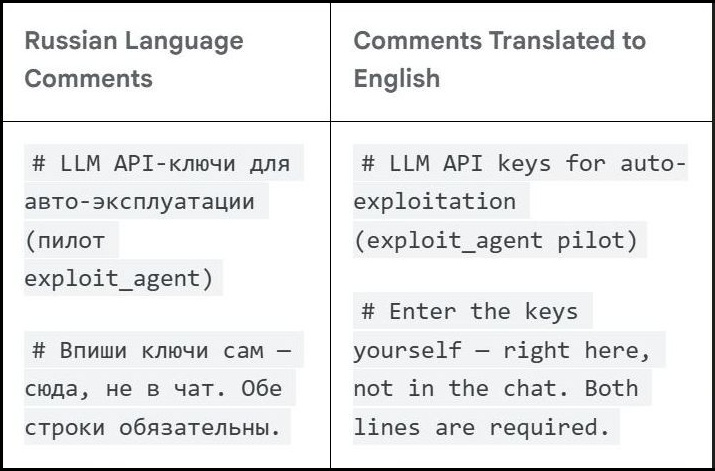
Google found and translated Russian-language comments from an automated hacking server. Source: GTIG
Telemetry on the server suggested its operator was specifically targeting French websites associated with media, entertainment, and education industries.
Costello said well-resourced nation-state actors backed by government agencies retained an “edge” in conducting sophisticated, long-running targeted operations.
However, he said AI advancements were also lowering the barriers to entry for everyday cybercriminals.
“For smaller criminal groups, including ransomware crews, AI lowers the cost of work they might previously have needed a specialist to do,” Costello said.
“Google is already seeing that shift in phishing services, where AI lets customers with less technical expertise customise their campaigns.”
AI agents take on criminal workload
GTIG also observed threat actors using “multi-agent” AI systems to automate labour-intensive parts of vulnerability analysis.
Intrusions were increasingly being pushed to “machine speed”, with attackers adopting AI penetration-testing tools to automate specific operations during live attacks.
Other previously manual tasks, including comparing software patches and developing proof-of-concept exploits, were being automated through LLM-driven pipelines.
Google noted that automated attacks could nevertheless leave forensic traces in network traffic and code, potentially making threat actors easier to detect.
Many AI-generated exploits also failed to work as intended, creating additional verification work for both attackers and defenders.
Despite these limitations, GTIG was highly confident that threat actors would continue adopting autonomous tools.
“The increased reach of their campaigns will likely compensate for any decreases in success rates,” Vanderlee told Information Age.
“Regardless of motivation, the low barrier to entry, ease of integrating new exploits, and massive scaling potential make autonomous frameworks an attractive, low-cost force multiplier for a wide range of threat actors.”