
Australia's education minister says the increasing prevalence of technology is largely to blame for high school students' maths and reading scores falling to their lowest point on record, leading him to suggest local students need a "good digital detox".
Despite a slight increase in science scores since the previous tests in 2022, Australian students' maths and reading scores fell almost 2 per cent in 2025 according to the latest Programme for International Student Assessment (PISA) results, released on Tuesday by the Organisation for Economic Co-operation and Development (OECD).
"I think you can draw a line between this and the ubiquitousness of technology," Minister for Education Jason Clare said of the results during an interview with ABC News on Wednesday.
"This is a test for 15-year-olds, for 91 countries around the world – we're seeing the same sort of trends in most countries in their results today as well," he said.
"I think the common factor is the way in which kids interact with technology, both at home and at school.
"The PISA results are telling us that the children that are online more are getting lower results – the more you're online, the more your results decline."
The test results showed Australian students continue to perform above the average across OECD member countries.
But Minister Clare agreed with a suggestion that the increasing availability of technology for students had contributed to shorter attention spans and more chances for distraction.
"The experts call this 'cognitive stunting' – that technology can be used as a crutch in the classroom, or it also can be a distraction," he said.
"We've taken mobile phones out of schools, but you go into the average classroom today, and you'll see tablets and laptops on every desk in every classroom.
"That's a bit different to 20 years ago ... and you'd have just a computer room at the school, and the evidence is telling us that we probably need a good digital detox in our schools."
The prospect of a "digital detox" in schools will be discussed at the next meeting of state and territory education ministers, the government said.
Technology's effect on student marks
While the PISA tests found some use of digital devices for learning or leisure was associated with higher science scores, using technology for longer periods – or using generative AI tools for specific tasks – were both found to contribute to lower scores.
The OECD's director for education and skills, Andreas Schleicher, said while "limited or moderate use" of digital devices during learning could lead to better results, there are "substantially lower levels of student performance" when devices are used for leisure during school hours.
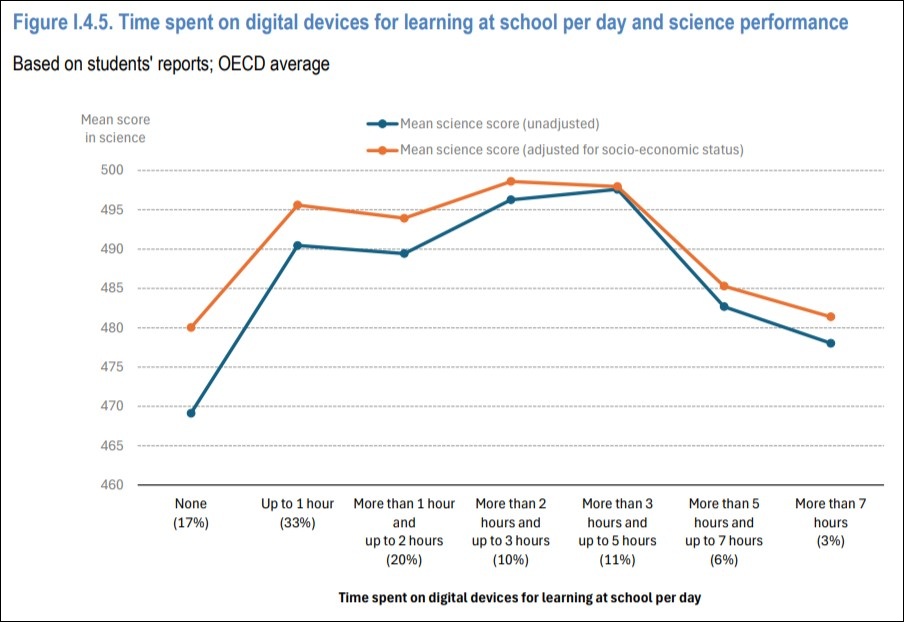
Chart: PISA Results 2025 / OECD
"Students who are using AI chatbots for specific tasks such as summarising texts get lower scores in science, on average, than those who don’t," Schleicher added.
Half of Australian students reported using AI tools to help them learn at least once a week, slightly above the OECD average of 45.5 per cent.
Only 23 per cent of Australian students reported experiencing no distractions from using digital devices – much lower than the OECD average of 39 per cent.
In a positive finding from the PISA exams, Australian students' highest scores came in a new assessment domain called 'Learning in a Digital World', which tests how well they can use digital tools in their education.
"More than 75 per cent of Australian students attained the National Proficient Standard, highlighting Australia’s relative strength in digital-age learning and problem-solving," according to the Australian Council for Educational Research (ACER), which delivers PISA tests locally.
"Students achieved a score of 532 points compared with the OECD average of 500 points."
That strong performance in digital learning came despite Australia's curriculum authority ACARA recently finding a “troubling” 30 per cent drop in digital literacy scores since 2008.
Still a place for tech in education, minister says
Australia's latest PISA results do not mean there is no place for technology in the country's education system, Minister Clare told ABC News.
"Our kids need to learn digital skills, and that includes AI," he said.
"They need to know how to use it and how not to use it.
"But if it's everywhere, then it's having negative impacts on our kids."
Reforms already underway include an overhaul of Australia's maths curriculum, the introduction of Year 1 phonics and numeracy checks, and an additional $20 billion over the next decade to improve public school funding, the federal government said.
Time spent using digital devices both inside and outside of school dropped slightly across OECD countries since 2022, according to the PISA results, with high school students "spending 1.7 hours per day using digital devices at school for learning activities and 1.1 hours per day for leisure while at school".
"This decline might be interpreted under the lens of several factors, including post-pandemic reassessment of the use of digital devices for learning, school policies restricting the use of digital devices, or a more general trend of decreased use," the OECD said.
"It could also reflect patterns indicating that children’s digital lives are increasingly embedded in their everyday activities, suggesting the distinction between 'digital' and 'offline' time is less relevant."