



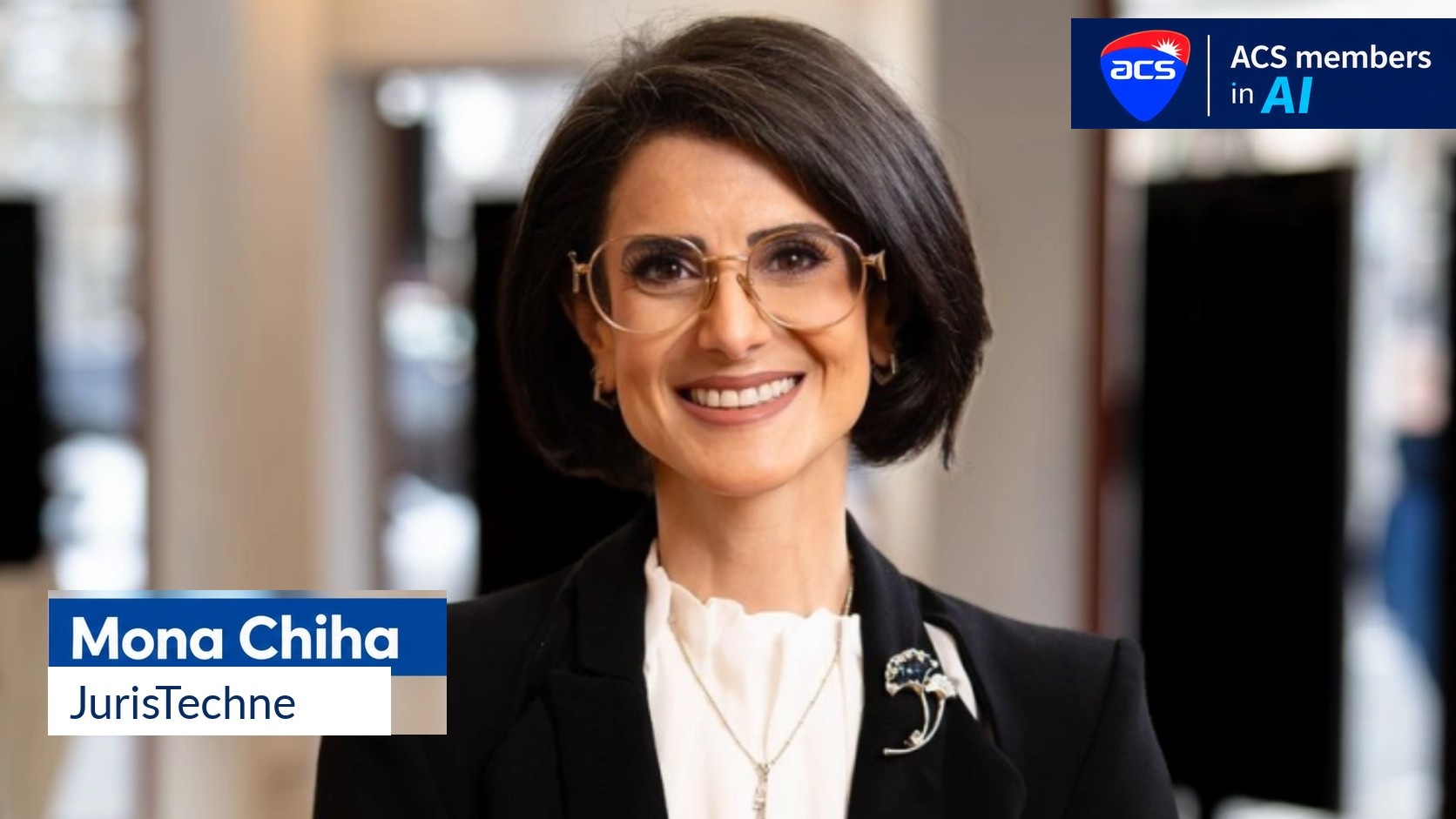

‘ACS members in AI’ is a series profiling Australian Computer Society (ACS) members working in the artificial intelligence (IA) space.
This week, we speak to Mona Chiha who leveraged experience, academic rigour and research to develop JurisTechne, a proprietary AI solution that makes great legal research accessible to all.
Legal research is highly manual and time-intensive, giving large law firms with dedicated research teams a distinct advantage over smaller organisations and ‘legalpreneurs’.
But could AI change this?
What inspired you to develop your AI product and/or establish your company?
I used to be a litigation funder, and before that, I was a developer. The problem I found in litigation funding is there is no technology to help me make a financial decision.
When I was in credit lending, we could build a decision matrix around how people spend their money, how they earn their money, then build a profile to determine whether they're suitable for a loan.
When it came to litigation funding and assessing the law on its legal merit or its economic value, none of that existed.
I went down the rabbit hole of trying to use GenAI, and that just did not work at all. So, I thought, okay, why don't I build this? And I thought, you know what, just to make sure I'm doing it right, why don't I also start a PhD on this, which I'm doing now at UTS [the University of Technology Sydney].
It's called the Algorithmic Legal Framework, and that led to this business artifact, which is JurisTechne.
Just to add another compliance level for myself, I also started a Juris Doctor [a graduate-entry degree that prepares students to practise law] to make sure that I've got the coursework and the underlying information I didn't have as a litigation funder to support my PhD, to support the business that supports our clients.
How does your technology work, and what makes it different?
So, legal research is done really manually. If you're using a generative AI tool, generative AI hallucinates because it's a probabilistic model.
We've seen instances where lawyers are submitting cases or submitting applications with hallucinations embedded in it, or missed contexts, or it's just not getting it, because the underlying architecture of that solution isn't to be deterministic for a research purpose.
I took it back down to data principles, and I said, okay, how do we create a system that doesn't use generative AI, so that we can create a research tool that lawyers can rely on, that judges can rely on?
Mona Chiha created JurisTechne. Image: Supplied
Essentially, what I've done is I've created this beautifully labelled database. It's all knowledge graphs that we can navigate through, so that we can create research reports that are accurate, that haven't missed the context, that give real citations to real law from a real database.
Algorithmic law is a new practice of law, and it's here to support, not to replace, legal judgment. So, I'm working directly with the lawyers. I will create the legal research reports based on their questions, based on what they're trying to do, and then I send them the legal research report.
What has been the biggest challenge in developing and/or commercialising your technology?
There's a big knowledge gap. Because this is so new, I'm having to do a lot of educational pieces around what the difference is between generative AI and explainable AI.
I've presented at a lot of legal conferences, legal tech conferences, I've written a number of articles, and a number of articles have been written about me. It's a lot of talking to people.
Also, I do free reports. Like, I put my money where my mouth is. Submit a case to me, I'll do this free report for you and show you what it's made out of, and that's really helped.
I guess the commercialisation piece is I don't have the VC funding for that big commercialisation, and you already know how much VC funding goes into women-founded businesses. Like, nothing. But you’ve got to work within the reality of what you're given and push forward.
How has being an ACS member helped you in your career or business?
I love the newsletters, they keep me up to date. Going to the events has helped me network and meet so many people I would have never met before.
There are a lot of people that I'm working with out of UTS that are part of ACS as well.
What’s next for you and your business?
So, we've already launched our Strategy Intelligence Reports, which are those legal research reports. We are launching an application called Your Legal Team soon.
You can go on a product review and look at real estate agents, how many houses they sold, what areas, all of those analytics. No one's ever done that for law, so I thought, well, why don't I do it?
What advice would you give to other technology professionals looking to build an AI product or business?
You can do it! You do not need hundreds of millions of dollars. You don't need to listen to other people's limitations.
In the beginning, the majority of people said, “Mona, what you're proposing is impossible. You can’t do this.” And I was just like, I'm pretty sure I can. And I did.
And also joining places that believe in you too.
Nobody at ACS, nobody at UTS, has ever said to me, "Oh, this is impossible. You can't do it."
So, surround yourself with a good community. It makes a massive difference.