


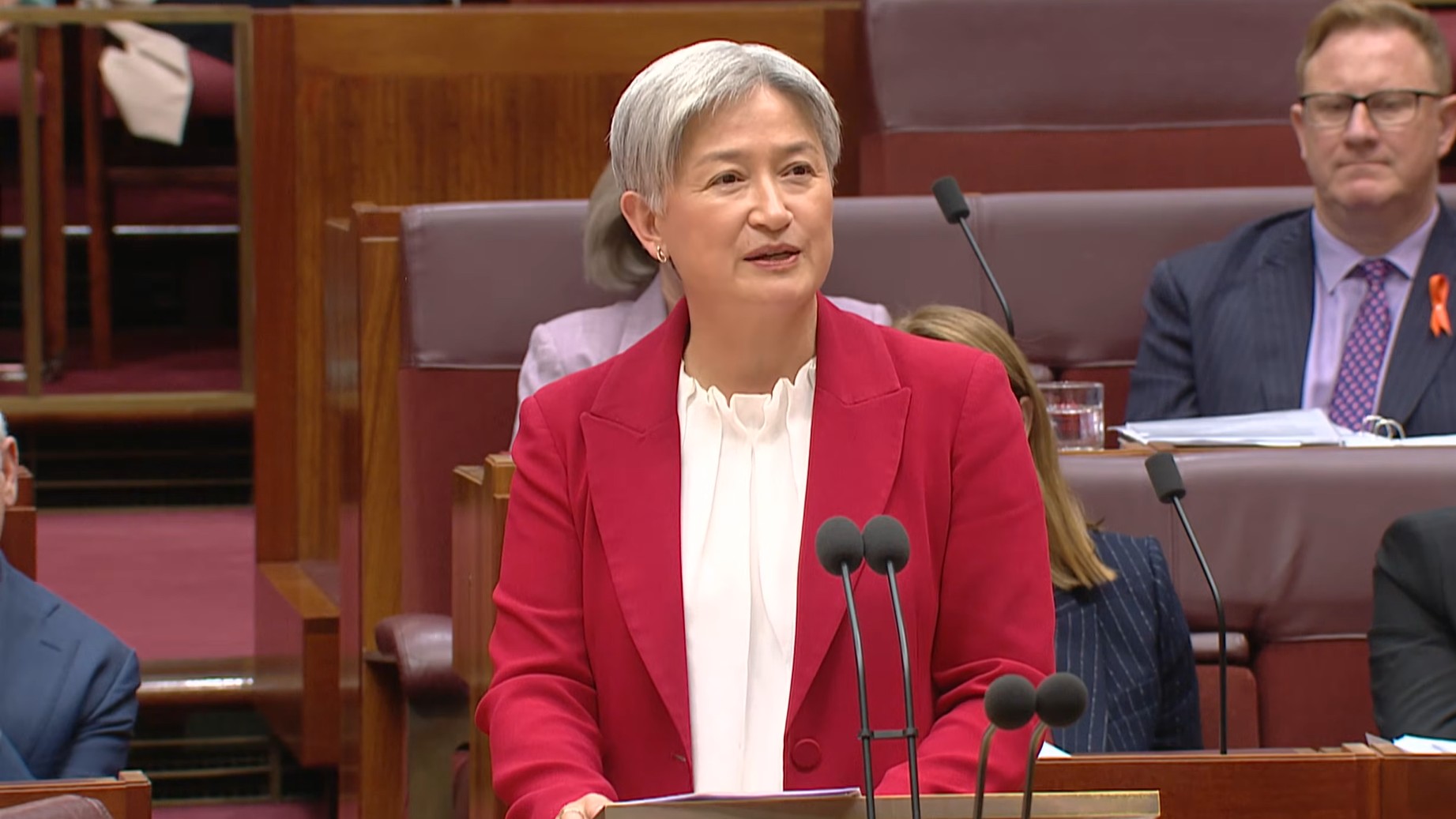

Artificial intelligence is enabling "more sophisticated" foreign interference in Australia, Foreign Affairs Minister Penny Wong told the Senate in a major 35-minute foreign policy speech on Tuesday.
AI is "reshaping the foundations of our societies", said Wong, who cited emerging technologies as one of six fundamental shifts currently reshaping the world.
"Cyberattacks are more frequent and dangerous, and trade settings, investment flows, shipping lanes, food security, undersea cables, and critical minerals are all being weaponised in this new era," she said.
"... The great powers, the United States and China, are competing across every domain with less regard for the guardrails that once kept competition from tipping into conflict."
AI and emerging technologies "are spreading and disrupting faster than any previous revolutionary technologies, reordering our lives, economies, and militaries in ways we cannot fully foresee", Wong said.
"Technology is already changing how wars are fought, how information is manipulated, how foreign actors can interfere in our societies, and the threat of foreign interference is becoming more sophisticated."
AI is making such interference "faster, cheaper, and harder to recognise", Wong added.
Her comments come after Minister for Home Affairs and Cybersecurity, Tony Burke, and the head of Australian intelligence agency ASIO, Mike Burgess, raised concerns over local data centres potentially being used by nation states for foreign interference.
The Australian government plans to introduce a dedicated AI safety regulator, update criminal laws, and legislate "strong mandatory safety and security protections" under its national AI standards in 2027.
Australia had "helped shape the international order before, in nonproliferation and in online safety", said Wong.
"And with artificial intelligence, we intend to do it again."
AI creates new 'opportunities and challenges', AFP says
In an October submission to a parliamentary committee on AI, published this week, Australian Federal Police (AFP) deputy commissioner of capability, Ian McCartney, said the increasing accessibility of AI tools is "likely" to increasingly blur "the distinction between state-sponsored activity, criminal offending, and broader influence activities".
Law enforcement's increasing use of AI would also create "new investigative opportunities and challenges relating to evidentiary reliability, attribution, privacy, resourcing and prioritisation", McCartney said.
He also suggested "governments, law enforcement, and national security agencies will require stronger capabilities to identify, attribute, and respond to malicious activity" related to AI.
"AI can strengthen Australia's national security posture by improving threat detection, enabling analysis at scale and supporting more timely response to emerging risks," he wrote.
"At the same time, robust governance, transparency, and accountability are essential to maintaining public trust."
Govt 'right to treat AI as a security issue', ACS says
The Australian Computer Society (ACS), which advocates for the nation's technology workforce, said people must be central to Australia's AI future.
ACS CEO Dr Prins Ralston said Minister Wong "is right to treat AI as a security issue".
"But you can't shape a technology you can't operate," he said.
"Ten days ago one fault at Microsoft disrupted the AFP, ASIO, Australia Post and health services.
"Last week Bunnings announced it would cut 40 per cent of its technology team and move the work offshore, days after Qantas said 850 corporate jobs would go under an outsourcing deal.
"That's the country now saying it will help write the world's rules on AI."
ACS is the publisher of Information Age.