





A reckoning is occurring in Australia's technology workforce.
The sector's recruitment rate has dropped "well below" other industries, job advertisements are at historic lows, and ICT occupations are facing fewer worker shortages.
This has culminated in the industry's workforce shrinking for the very first time, amid major job cuts at sector stalwarts like Atlassian, Canva, and WiseTech.
Even the federal government's target of having 1.2 million Australians in technology jobs has been quietly retired.
These shifts are not lost on Gold Coast-based IT solutions architect Scott Brown, who tells Information Age he has been out of work for almost a year and is now working a part-time retail job "to bring some money in".
"I'd been contracting for 12 years and have never been out of work much longer than maybe a week or two," the 53-year-old says.
"I was always quite confident I could do whatever job I was thrown into, and I was reasonably good at it – and if I needed another job, I could probably find one.
"Whereas now I'm not so confident," he adds, laughing quietly.
"So I've taken a bit of a knock to the ego, and there's a bit of soul searching that goes along with that.
"... Even the people I know who are working are all scared about leaving – because if they leave their job, will they be able to get another one?"
Scott says he has noticed a "lack of optimism" among his peers, and admits "panic" set in for him after a few months of job hunting.
"As long as I've been an adult, since the '90s, there has always been optimism about the tech industry growing, and booming, and developing," he says.
"Pretty much everybody I speak to now, it's not optimism about the future – it's pessimism."
A July survey of more than 700 Australian IT professionals by recruitment firm Clicks found only 23 per cent of workers were optimistic about the IT job market, while 44 per cent were actively pessimistic.
The firm's Queensland state manager, Philippa Willis, says Australia's technology talent market has recently "moved from being candidate-led" to something "much more balanced".
"During 2021 and 2022, organisations were competing aggressively for scarce talent, and salary and rates growth accelerated as a result," she says.
"We've now seen a period of correction as economic conditions have tightened and businesses have become more disciplined about costs.
"At the same time, there are more candidates actively seeking work than there were a few years ago, which naturally reduces salary pressure in many areas of the market."

The number of job vacancies in Australia’s technology sector has fallen over the past year. Image: Shutterstock
Job applications vanishing 'into the void'
American-born technical writer Helen O'Boyle migrated to Australia back in 2010.
Originally a software developer, she now has more than 20 years of experience creating technical documentation inside software companies.
Like Scott, Helen has also been in the job market for around 12 months.
"It has been very disheartening," she says.
"I think my current statistics are that 45 per cent of the applications I put in ... after probably getting the initial acknowledgement ... I don't hear a thing back.
"You know, it just vanishes into the void."
Government analysis released in September found around a third of surveyed IT employers reported receiving 20 or more applications for each job vacancy, from a "relatively large" applicant pool compared to other sectors.
However, other similar research suggests the average number of applications for each job is likely higher.
A recent survey of 560 job candidates across tech and transformation, financial services, and corporate services by Australian recruitment firm Keegan Adams found job seekers are submitting more applications than they did the last time they applied for roles.
On average, they are sending 32 applications a month in today's market, compared to their previous average of around 24 applications a month, according to the company.
Almost a third of respondents also said they were not confident that they could find a suitable role.
Of the 71 per cent of respondents to Clicks IT Recruitment’s survey who had applied for an open role in the previous 12 months, around 30 per cent said they had submitted more than 40 applications in that time.
"All the recruiters I speak to, they say the amount of applicants they get these days is the most they've ever seen," Scott says.
"Roles that I apply for – fairly senior technical roles, where you might get 10,15, 25 applicants – now they're getting 50, 60,70, and it just makes it super competitive."
Pakistani-born Sydneysider Immad Nasim moved to Australia in 2023, and has been looking for a full-time job since completing his master's degree in IT in May 2026.
The 31-year-old has a part-time IT role at investment bank Goldman Sachs and also works a part-time job as a hairdresser – but he hopes to gain full-time employment to help him remain in Australia and build his tech career.
While part of Immad's decision to come to Australia was what he saw as "a surplus of opportunities" in top-tier companies, the IT job market has been more difficult than he initially expected.
"I have to apply to anywhere between 20 to 60 jobs a week to get any form of response," he says.
"... For most job applications, we don't hear back from them, and if I do it's about the application not being considered.
"It obviously is a demoralising sight to see that you are a tailored fit for the role and still unable to make it for some reason or other.
"I have learned that persistence and backing yourself up always helps you feel good again."
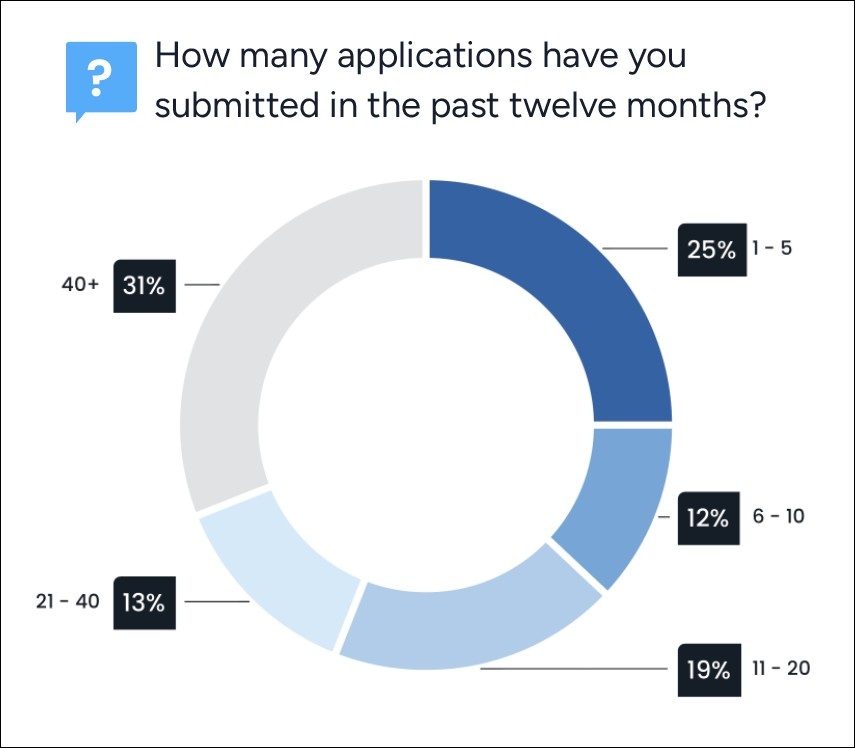
Chart: Clicks IT Recruitment, based on 'IT Workforce Insights 2026-27' report / Supplied
Recruiters at Clicks also found around a third of job applicants in their survey had been looking for work for over six months – a timespan Clicks regional manager Mark Penn says is getting longer.
"There are fewer roles available, and restructures and retrenchments have brought more people into the job market," he says.
"... More competition and slower hiring are making it harder to secure a role, while some people who are still employed are taking longer because they are more cautious about moving."
Keegan Adams managing director Claire Tate says "candidates are working harder than ever and believing in the market less".
"They're sending 36 per cent more applications and still expect a six-month search," she says.
"The market isn’t short of candidates – it's short of fit. A hundred applications can produce one interview."
Many technology employers have also reported a significant rise in job applicants who are overqualified.
"I'll put my hand up for anything," admits Scott, who adds that he "even started applying for junior roles" for a short time "just out of desperation".
But he says he eventually stopped, as it felt like "a dead-end street".
"I think employers probably know that if you're overqualified, you're not going to stay there for very long," he says.
'I don't want AI to happen to me'
Helen's last full-time role was with Australian software giant Atlassian, which she says she decided to leave in July 2025 after nearly three years at the company, so that she could upskill in generative artificial intelligence (genAI).
"At the time, my project assignments at Atlassian didn't involve enough use of AI for me to feel like I was able to keep up," she says.
"I felt I was falling behind on AI, and I didn't want to miss the revolution.
"I don't want AI to happen to me – I want to happen to AI."
Around a quarter of respondents in the Keegan Adams Recruitment survey said they would move to a new job if it offered them more opportunities to develop their AI skills.
What's more, 20 per cent of respondents said they felt a need to exaggerate their AI skills when interacting with potential employers.
Clicks regional manager Fatema Galabhai says she hears concerns about AI skills from job seekers "all the time at the moment".
"People are asking, 'Do I need to become an AI specialist?'
"My answer is generally 'no, but you probably do need to understand how AI is changing your particular job' – there is a big difference.
"... The people I think are most exposed aren't necessarily those who don't have 'AI' written on their CV," she adds.
"It's people who ignore it altogether and continue doing their job exactly the way they did five years ago.
"And I wouldn't recommend collecting AI certificates for the sake of collecting certificates.
"Employers are going to be much more interested in someone saying, 'Here is how I've actually used AI to solve a problem, improve productivity, or deliver a better outcome.'"
Helen says while AI is generally seen as "a useful thing" inside technology companies, she worries that AI skills "aren't the magic armour" some workers may think they are.
She cites recent examples of technical writers being laid off at Canva and global cloud giant Amazon Web Services (AWS) as reasons for this concern.
"What we've seen over the past year-and-a-half is that developing skills in AI – and for that matter, developing tools that make it easier for you to do your job and automate a lot of functions that you used to do yourself – it actually can be a career risk," she suggests.

IT solutions architect Scott Brown (left) and part-time IT worker and hairdresser Immad Nasim (right). Images: Supplied
Scott also worries that the rise of genAI means there are fewer entry-level roles in tech – and several Australian companies have already reported hiring fewer junior employees due to their adoption of AI tools.
Immad says that despite "a number of highly encouraging and supportive people" trying to help him get into the IT industry full-time, he is aware "there is huge competition for entry-level positions".
"The introduction of AI has resulted in many companies reducing their need for entry-level roles," he says.
"... In my opinion, a few years down the line this will leave a gap in the job market, inevitably, where we may face a shortage of skilled professionals."
Even US firm Anthropic, which developers the popular Claude series of AI models, admits it is hiring fewer junior workers in its technical departments, largely due to its use of AI tools – a shift the company described as "striking" in an October report.
"... The share of junior-level employees in technical departments at Anthropic slipped from 21 per cent to 14 per cent since early 2025," the company found.
"The proportion of junior technical hires fell even faster, from 27 per cent to 9 per cent.
"Postings for juniors have fallen particularly sharply since December 2025."
Scott suggests "the ladder is not available for people to get on", which he also believes will have "a long-term effect" on tech workers and the broader economy.
"I can't see an end to the road, because if AI fills that need, where does the opportunity come from?" he wonders.
Fatema from Clicks says entry-level recruitment "is probably one of the hardest parts of the technology market at the moment".
"AI is part of that, but I wouldn't blame everything on AI," she says.
"... When an organisation has approval for one hire, there is a temptation to hire the experienced person who can be productive immediately, rather than a graduate who needs six or 12 months of development.
"We are seeing evidence of exactly that shift in the market, but I think organisations need to be careful.
"If everybody stops hiring juniors because AI makes senior people more productive today, where do our senior engineers, architects, and cyber specialists come from in five or 10 years?"
The impact of outsourcing and migration
Another issue Australian IT workers are concerned about is offshoring, as domestic technology jobs are being lost and sent overseas as major companies such as Qantas, Telstra, Bunnings, Woolworths, Officeworks, and the Commonwealth Bank try to cut costs.
Scott asserts that businesses trying to pay less for workers is not a new phenomenon, and candidly recalls a project he worked on in which an Australian company outsourced some work to Malaysia.
"We had developers in Australia earning $80,000 a year, and we were getting the same skill level – or at least on paper, it looked like the same skill level – paying them about $17,000 Australian a year [in Malaysia]," he remembers.
"I sort of see where the value is there, at least on paper, but that doesn't necessarily translate to real life – because on paper the resources look the same, but in reality they're not.
"There are all sorts of cultural and language barriers, and sometimes the qualifications people say they have don't necessarily mean the same thing in one country as they do in another."
Mark from Clicks says he has recruited for "multiple organisations that moved technology teams offshore, only to bring capability back onshore a couple of years later".
"My sense is that the cost advantage of offshoring is not always as strong as businesses expect, particularly once they consider the full cost of managing and delivering the work," he says.
"I think that will lead some organisations to reassess which capabilities they keep offshore and which they need closer to the business."
As a migrant herself, Helen says she has been approached by contracting agencies which have historically brought migrants into tech jobs in Australia.
She says the salaries for jobs offered by such agencies "have been very low".
"I think their business model is 'we'll find somebody from overseas to do it'," she suggests.
Helen says she took a 60 per cent pay cut when she first moved to Australia more than 15 years ago, before returning to her previous salary around two years later.
"Immigrant jobs that pay less" are certainly "a thing" in tech, she posits.
Mark from Clicks says he "would not assume someone is cheaper because they have recently arrived in Australia".
"Their skills, experience, and the role they are being hired to do need to be considered," he says.
"If an employer is trying to pay below market rates, I would see that as an issue with the employer’s approach to remuneration, rather than migration itself."
Fellow migrant Immad feels that migration has "immensely affected" job prospects in Australia's IT market of late.
"A number of skilled professionals with experience have been observed taking up the roles of beginner and entry-level positions just so they can have access to local experience," he says.
"I am always in favor of skilled immigration for people who are contributing to the welfare and prosperity of this country, but I also believe the untapped introduction of people should be scrutinised so that we can maintain an equilibrium."
Despite facing an increasingly difficult IT job market, Immad says he "absolutely" believes he will land a full-time tech job in Australia.
"I am positive that I will have a full-time role, sooner rather than later," he says.
"It's all about staying persistent with the efforts we put into the cause."
Several weeks after first speaking with Information Age, Scott landed a contract IT role.
It came exactly 12 months to the week since his previous one ended.