



An OpenAI employee has been arrested after allegedly planting a listening device within a television in an executive conference room at the company’s San Francisco headquarters.
OpenAI posted on X on Wednesday, revealing the company behind ChatGPT had discovered a “sophisticated recording device” inside the meeting room.
The company then used its own AI chatbot to “understand the device and where it came from”, and eventually identified that a “specific employee had planted it a few days earlier”.
The man, 35-year-old Saudi national Abdulrahman Alfozan, was fired by OpenAI and arrested by the FBI on 9 October.
“At this time, we have no indications of this individual inappropriately accessing or exfiltrating model weights, source code, or customer data,” the OpenAI statement said.
‘Highly confidential’ meetings
The US Department of Justice issued a press release confirming the arrest of Alfozan and alleging that he had plugged an encrypted recording device hidden in some toilet paper into a TV in an executive conference room in OpenAI’s headquarters in late September.
This meeting room regularly plays host to discussions involving highly confidential technical, commercial, and strategic information, the Department of Justice said, including proprietary research, product plans, and business development opportunities, along with non-public information about OpenAI’s operations.
The listening device was discovered by OpenAI security two days after it was planted, the department said.
Surveillance footage also captured Alfozan in the meeting room, which he did not have clearance to be in, after the listening device was allegedly planted.
The FBI searched a bag that had been left unattended by Alfozan at the OpenAI office and discovered a second identical listening device, the department said.
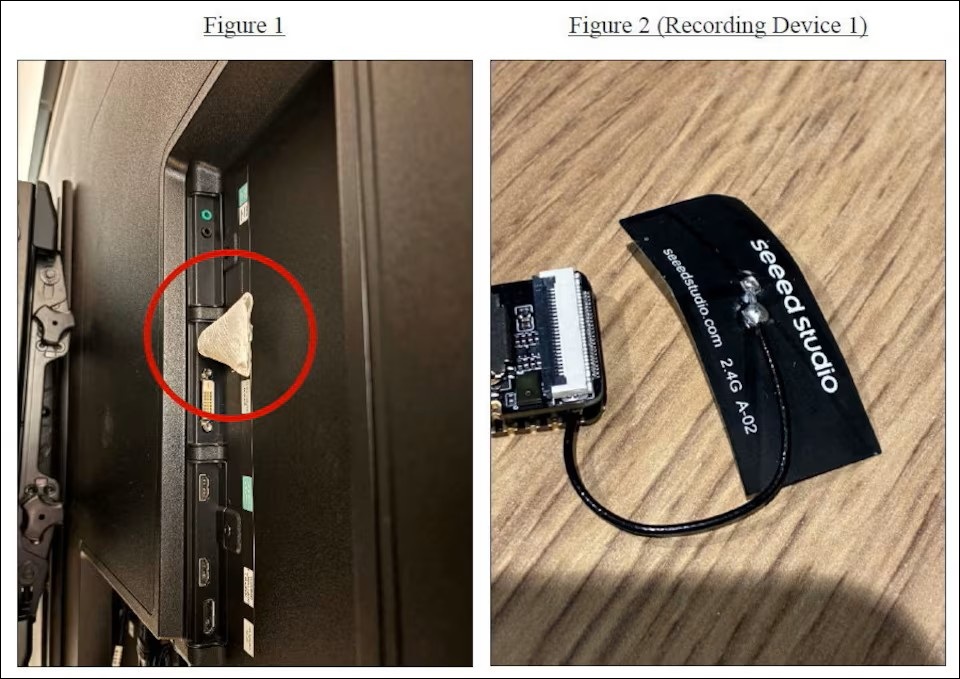
Two listening devices were allegedly found. Images: US Department of Justice / Supplied
Authorities also alleged that Alfozan used AI chatbots to help plan this operation, requesting information through these platforms on OpenAI building addresses, meeting rooms, meeting room capacities, and the calendars of the leadership and executive teams.
Alfozan’s spouse’s AI chatbot account was also allegedly found to have made several queries about “building, customising, installing, audio recording, testing, obfuscating and remote accessing a device”.
The account had also allegedly asked about building a “continuous audio recorder”, “customis[ing] Wi-Fi … connectivity”, improving audio, and encrypting an SD memory card.
Alfozan has been charged with using or endeavouring to use an electronic, mechanical, or other device to intercept oral communications, and he faces up to five years in prison and a fine of nearly $360,000 ($US250,000).
OpenAI’s statement spruiked the use of AI in helping to shut down the covert listening scheme.
“We take protecting our technology, data and people seriously, and as a matter of national importance,” the company said.
“Our security program is designed to protect against a wide range of threat actors, from insider risks to cybercriminals to nation states, and this case is an example of how AI can help address these sophisticated security threats.”
“This serious situation underscores why winning the global super intelligence race is a national security prerogative,” US Director of National Intelligence Jay Clayton said in a statement.
“… The intelligence community remains committed to safeguarding America’s cutting-edge intellectual property from foreign threats.”
We discovered a sophisticated recording device that was hidden inside one of our offices. We used our models to understand the device and where it had come from, identifying that a specific employee had planted it a few days earlier. We referred the matter to the FBI, and we’re grateful to the agents and prosecutors who moved quickly to make an arrest. The FBI’s investigation is ongoing and we will continue to support their work. At this time, we have no indications of this individual inappropriately accessing or exfiltrating model weights, source code, or customer data. The employee was terminated. We take protecting our technology, data, and people seriously, and as a matter of national importance. Our security program is designed to protect against a wide range of threat actors, from insider risks to cybercriminals to nation states, and this case is an example of how AI can help address these sophisticated security threats.
— OpenAI Newsroom (@OpenAINewsroom) October 13, 2026
OpenAI security scares
Earlier this year OpenAI CEO Sam Altman’s house was attacked twice following the publication of a major exposé about him, which he labelled “incendiary”.
The article labelled Altman a “pathological liar” and quoted several employees calling him “sociopathic”.
Altman acknowledged it had been an “extremely intense, chaotic and high-pressure few years” at the company, and that it needed to “operate in a more predictable way”.
OpenAI also recently fired three AI researchers for allegedly “mishandling sensitive information”, with reports suggesting the trio had allegedly disclosed confidential information to an external AI safety organisation.
News of Alfozan’s arrest comes just weeks after it was revealed that a ChatGPT agent had hacked into an Australian Medicare data portal.
OpenAI later admitted to a parliamentary inquiry that its response to this and other similar Australian incidents “fell short”.