



Emerging satellite-based direct-to-device (D2D) technologies are proving their value in regional and remote areas, with a new map revealing connections in some of Australia's most isolated locations.
But while early adoption is encouraging, experts warn that significant technical and commercial challenges remain before D2D can reach its full potential.
The technology is gaining momentum under the Universal Outdoor Mobile Obligation (UOMO), which was enshrined into law last week.
The mandate is driving mobile carriers to partner with satellite operators, including SpaceX's Starlink, while Amazon and AST SpaceMobile are also emerging as potential providers of connectivity beyond the reach of terrestrial networks.
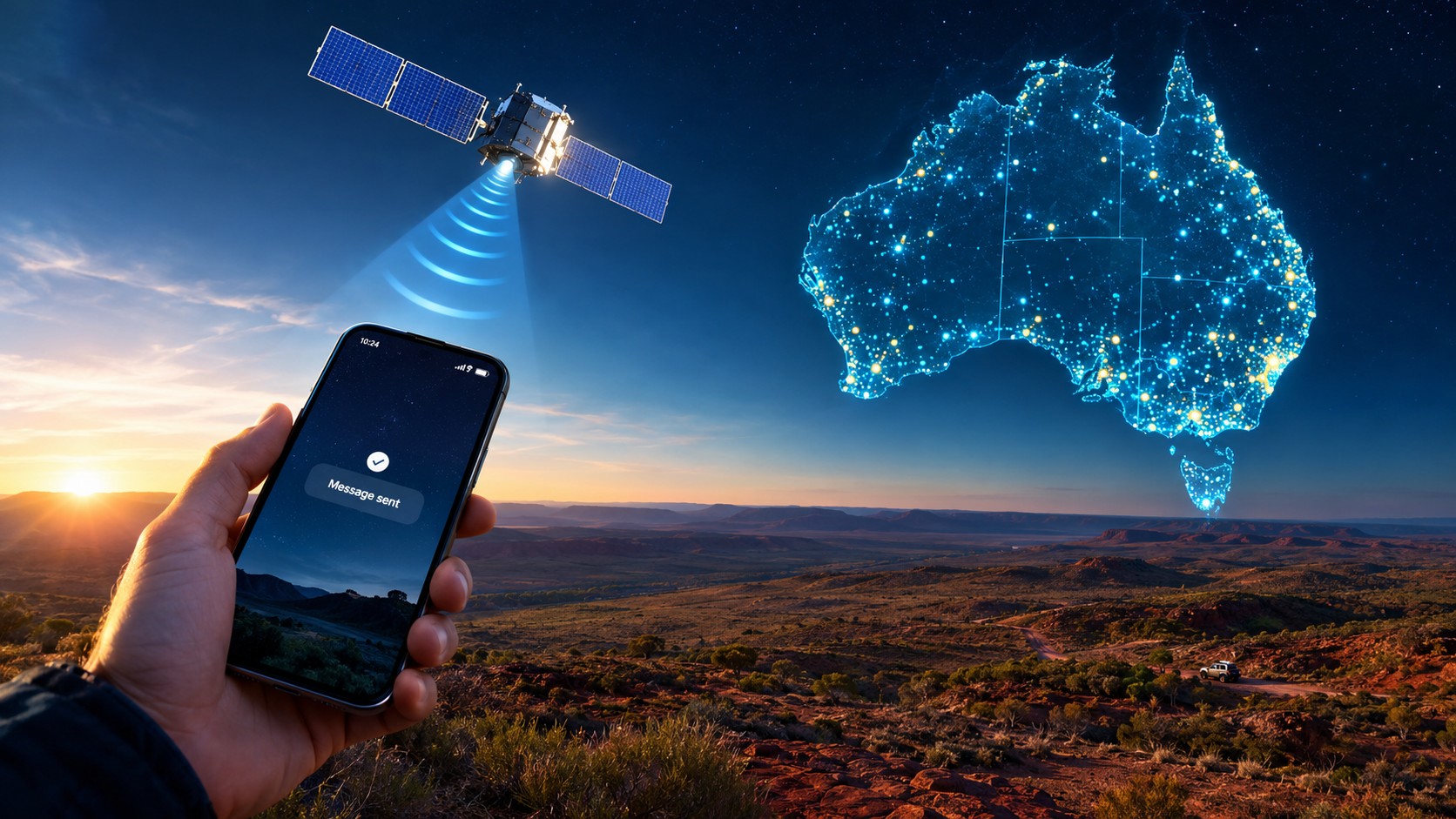
D2D technology uses antennas in compatible smartphones to communicate directly with satellites in low Earth orbit (LEO), initially enabling text messaging where conventional mobile coverage is unavailable.
Optus was the first Australian carrier to sign up, striking a deal with Starlink in 2023.
Telstra followed last year, launching its Satellite Messaging service in June.
The service has since attracted considerable uptake. When Telstra expanded its D2D offering in July, it revealed that more than 2.9 million customers had sent over 26 million messages using Telstra Satellite Messaging (TSM), with more than 200,000 connections each day.
However, the geographical distribution of those connections remained largely unknown until mobile performance testing company OpenSignal launched its D2D Satellite Map.
The global visualisation reveals where satellite-to-mobile connections are taking place, confirming significant uptake in Australia, New Zealand, the US, Chile and Japan.
OpenSignal describes the map as a “ground-truth view of where D2D connections are happening right now”, calling the technology “one of the most consequential shifts in telecommunications in a decade” because it “closes coverage gaps that terrestrial networks haven’t yet been able to fill.”
The data shows D2D connections in some of the world's most remote locations, including deep in the Amazon in Peru and Brazil, across the Pacific island of Hanga Roa (Easter Island), on Chatham Island east of New Zealand, and in remote parts of the Philippines.
In Australia, connections span every state and territory, with clusters along remote roads around Mount Kosciuszko, near regional centres such as Dubbo and Yarrawonga, north of Blackwater in Queensland, and at Iluka Resources' JA Mine in South Australia.
There are also clusters just outside metropolitan areas, around regional centres such as Ballarat and in tourist destinations such as Cape Otway, where travellers have grappled with mobile blackspots for decades despite millions of dollars invested in remediation programs.
Guiding the industry to better coverage?
Because D2D connections only activate when conventional mobile networks are unavailable, OpenSignal's map offers an inverse view of traditional mobile coverage.
That distinction is significant in Australia, where telcos were forced to redraw their coverage maps earlier this year after the Australian Communications and Media Authority (ACMA) revised the standards for what constitutes mobile coverage.
RMIT University Associate Professor Mark Gregory had previously warned that inaccurate coverage maps perpetuated “serious flaws in the way we measure and report mobile connectivity”, particularly when relying on industry-supplied data “with limited independent verification”.
Previous coverage mapping techniques had created “an overly optimistic picture that does not match people’s experience on the ground,” he said, noting regional and remote Australians “need to know whether their mobile service will actually work when they need it.”
The new D2D data provides a different perspective, showing where people are already turning to satellite connectivity to overcome the limitations of terrestrial networks.
Luke Coleman, CEO of industry body Australian Telecommunications Alliance (ATA), told Information Age that the map confirms “even the very early D2D services are starting to get some pickup amongst Australian users”.
However, rather than helping telcos identify where to build additional mobile base stations, Coleman believes the data is more likely to encourage deeper partnerships with Starlink and other emerging LEO satellite operators.
“We have a huge, sparsely populated land mass,” Coleman explained, “and the investment case for additional terrestrial coverage gets very thin as you get into low population areas.”
“That means D2D is going to be perfect for those areas where it’s very hard for that investment case to stack up,” he added, “and it will be a game-changer for people in areas where there is never going to be a real commercial case to build terrestrial networks.”
D2D still in its infancy
While D2D is already delivering text messages to some of Australia's most remote locations, the technology faces considerable technical hurdles before it can deliver the full range of mobile services.
Chief among them is latency, which currently makes it difficult for LEO satellites to support voice calls at an acceptable quality.
Satellite operators have outlined ambitions for D2D to underpin new global mobile networks that could bypass terrestrial mobile network operators altogether.
However, technical analyses suggest the technology is significantly impaired when used inside buildings, cars and trains, limiting its ability to compete with conventional mobile services.
One opportunity to improve D2D capabilities could come with the allocation of mobile satellite services (MSS) spectrum in the 2GHz band.
Australia is preparing to make the spectrum available through a process that is expected to involve auctions before the end of the year, potentially enabling larger-scale D2D infrastructure rollouts.
But resolving the technology's limitations, particularly the delivery of high-quality voice calls, will take time.
RMIT's Gregory told Information Age that these challenges could leave the Australian D2D market in limbo until at least next year, and possibly 2028.
However, he believes the market could change rapidly once the technical and regulatory pieces fall into place.
NBN Co's engagement with LEO operator Amazon, for example, could reshape the way satellite services are delivered to regional Australians.
Gregory also sees “a strong likelihood” that well-funded operators such as SpaceX and Amazon will outbid Telstra, Optus and TPG for MSS spectrum.
It is one element of what he describes as a “telecommunications spectrum apocalypse”, with D2D potentially becoming the catalyst for a broader shake-up of Australia's telecommunications market.
Gregory will outline the changes in an upcoming webinar.
He believes the competitive dynamics could shift as satellite operators exploit their access to spectrum and challenge the traditional dominance of terrestrial mobile networks.
Much of that opportunity comes down to latency, he said, arguing that existing mobile networks are “so bad that the latency over our mobile networks is comparable to the LEOs”.
That creates an opening for satellite operators to “flip it all” and potentially force mobile telcos to strike deals to access MSS spectrum.
“There’s one thing that Telstra can’t control,” he said, “and that’s the spectrum.”