




Surging data centre investment will see 97 new facilities that more than double Australia’s data centre capacity pipeline by 2030 – and more of that growth is happening outside of Sydney, the data centre industry peak body has said in releasing its latest market report.
Australia currently has 1.6 gigawatts (GW) of computing capacity across 163 data centres, Data Centres Australia’s (DCA’s) and DC Byte’s latest Australian Data Centre Forecast Report found, but current proposals will push this pipeline to 3.9GW in 260 facilities by 2030.
That’s up from 3.2GW in April – a 21.9 per cent expansion of the data centre pipeline in six months as the AI industry’s seemingly insatiable demand for computing capacity catalyses an explosion in investment in new sites.
Significantly, DCA found that proposed data centres are progressing to approval faster in Melbourne – where 1.2GW of capacity had progressed from Early Stage to Committed during the half year – than in Sydney, where just 0.7GW had been approved in that time.
Sydney has also seen a “significant” reduction in total pipeline and Early Stage capacity, by 3.6GW and 4.4GW respectively, which DCA attributes to the region’s inability to supply enough power, “less certain policy approval timelines”, and recent policies.
By contrast, Melbourne’s pipeline has increased by 1.7GW, of which 1.2GW represent projects that have recently reached the Committed stage – meaning developers have secured planning approval and financial backing that makes the sites likely to eventuate.
Planned data centres are far larger than those currently built, with DCA finding just four are currently larger than 100MW – and that 52 such oversized sites are in the pipeline, with Victoria (24) favoured over NSW (19) to host such facilities.
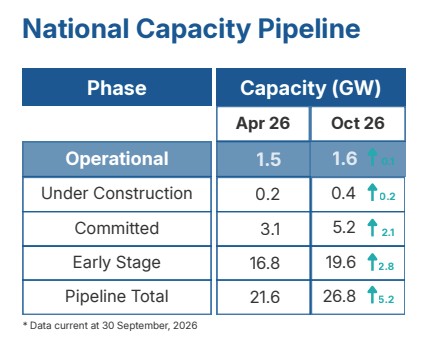
The past six months have seen a flurry of new data centre proposals, with 2.8GW of new capacity proposed and 2.1GW securing policy and financial backing. Data Centres Australia believes this trend will more than double overall capacity by 2030. Source: Data Centres Australia / DC Byte
Other states are also winning, with DCA noting the proportion of data centres set to be built elsewhere had increased from 19 per cent to 31 per cent in just two years – reflecting major new projects in regional Queensland, SA, WA, and Tasmania.
“Australia is a highly attractive market for sustainable data centre development,” DCA CEO Belinda Dennett said, “with a leading industry ecosystem and attributes such as large-scale renewable energy generation” that merits closer examination of “project viability”.
“We expect to see this pattern continue as new workloads like AI and neoclouds increase demand and bring different siting requirements,” noting the impact of “current energy constraints and different policy approaches” reflected in the report’s results.
Crunch time for data centre policy
The update comes amidst a flurry of regulatory and technological activity, with data centre builders like NextDC outlining plans to halve the time it takes to build the massive computing facilities even as many fear that approvals for required energy supply aren’t keeping pace.
Facing similar issues, the UK Government has opened consultation on a draft National Policy Statement for Data Centres and released The Data Centre Covenant, in which it outlined obligations for strategic data centres and five goals that all sites “are encouraged to meet”.
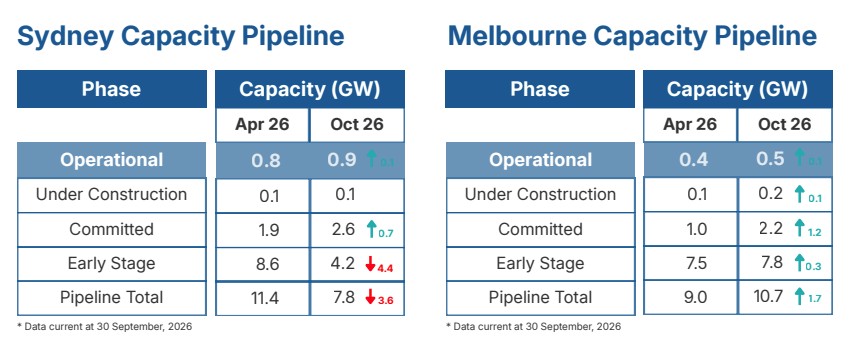
State comparisons show new proposals for Sydney data centres slowed dramatically in the past half year. Source: Data Centres Australia / DC Byte
Reflecting just how dramatically Australia’s demand has grown, the UK is weighing favourable treatment to reach the 6GW of AI data centre capacity it believes it needs by 2030 – only half again as large as the DCA’s forecast for Australia, despite the UK economy being over twice as large.
This level of demand has created hiccups, with Australian data centre aspirant Firmus last month shelving plans for an IPO to fund five new AI data centres – adding to financial uncertainty that, fuelled by inflation and power price concerns, has many fearing an economic bubble.
Dennett says industry operators resent being required to “wear all the risk for matters outside their control” but Energy Minister Chris Bowen recently outlined expectations that data centre operators to become more active participants in Australia’s power market.
That means they would be expected to not only build new solar, wind and other renewable power generation capacity but enable demand flexibility that can shunt some of that power into the National Electricity Market (NEM) when they produce more than they need.
Can data centres become a net positive for all Australians?
With many proposals already mothballed after protests, Sydney and Melbourne councils – fearing blowback as data centre power consumption explodes from 3 per cent of national supply to 13 per cent in a decade – have pushed for data centre moratoria until national data centre standards are finalised.
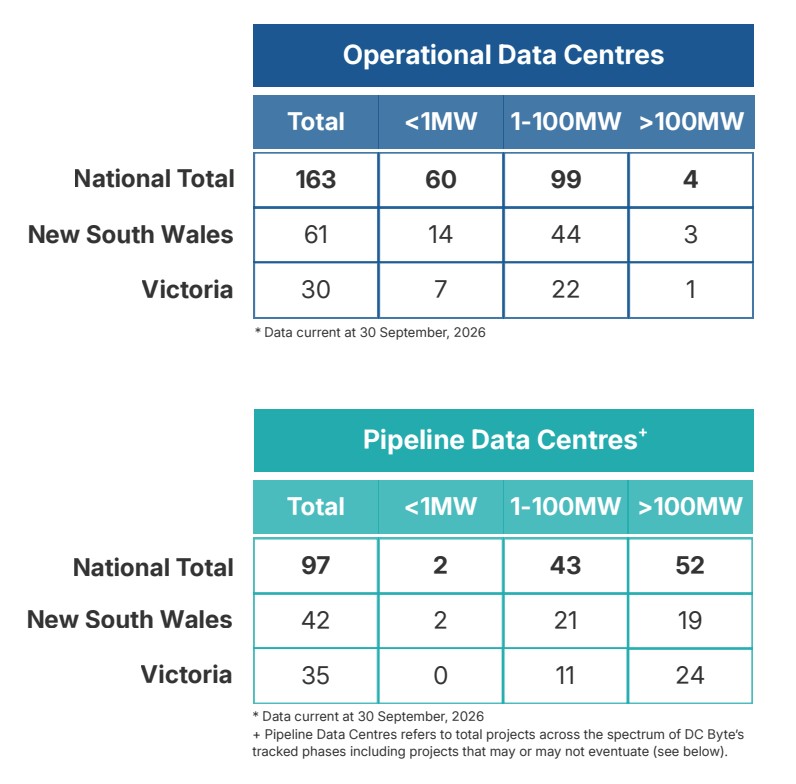
NSW still has the most planned data centres through 2030, but Victoria is emerging as the favoured destination for large-scale data facilities as power availability and changing state policies shape the fast-changing AI data centres market. Source: Data Centres Australia / DC Byte
Finding the right balance remains tricky, with Victoria Planning Minister Sonia Kilkenny said to be weighing over $5 billion in proposed data centres before a state election that will in part be a referendum on the Labor Government’s success managing data centre growth.
The benchmark for successful data centre policy will not be whether Australia’s lights stay on but in its net benefit to the community, notes RMIT University expert Dr Say Yen Teoh, who argues that “the question is no longer whether these facilities will be built, but on what terms.”
“Ensuring communities are not worse off,” he said, “is a relatively low bar… As Australia positions itself as an Asia-Pacific hub for AI infrastructure, policymakers should be asking a bigger question: what do communities deserve in return for hosting the facilities that power the AI economy?”