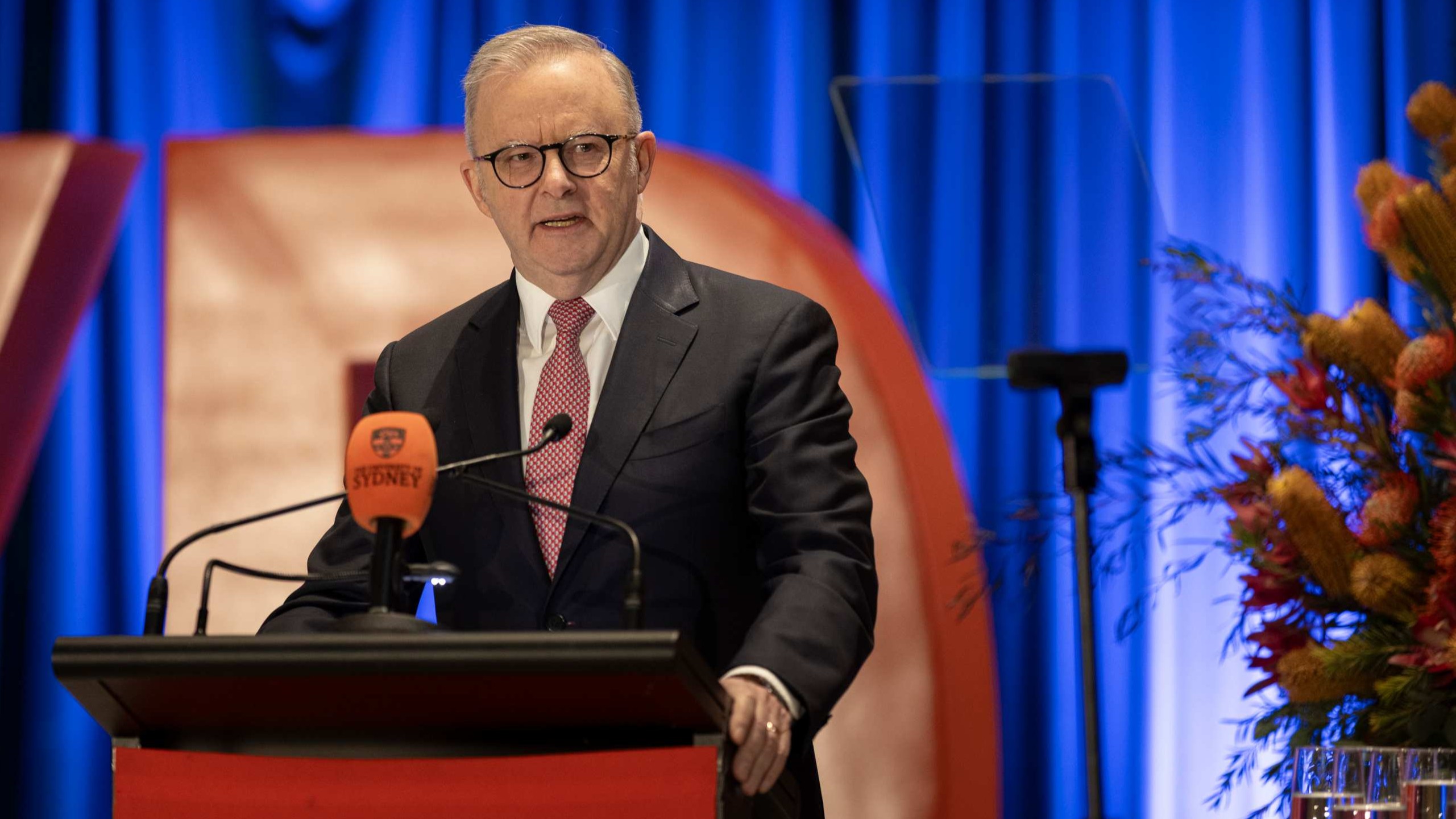

Data centres will face new rules on energy use and artificial intelligence firms will be told to compensate Australian creatives under a federal government plan to legislate national standards for AI, Prime Minister Anthony Albanese announced in a significant policy pivot on Wednesday.
The standards will be drafted by a newly founded Office of AI within the prime minister’s department, with legislation expected to be introduced to parliament in early 2027, Albanese said during a speech at the University of Sydney.
Amid “global instability”, Australia should use AI to become “more resilient and more sovereign”, said the prime minister, who warned against “subcontracting our national sovereignty and security to the control of foreign monopolies”.
“This is about building Australians’ confidence and trust in AI and our nation’s capacity to manage it,” Albanese said.
The prime minister added that the government is still “serious about attracting frontier AI investment to Australia” but wants AI to help create new jobs domestically – “and not replace them”.
“We want more Australian companies and global firms developing AI here,” he said.
Labor will consult states and territories on the changes at a National Cabinet meeting in August, Albanese said.
The government’s push to coordinate AI regulation nationally comes after it dumped plans in 2025 to introduce a dedicated AI Act like that in the European Union, and instead relied on existing laws and voluntary standards to manage the technology’s wide-ranging effects.
Albanese said it was “only natural that, up until now, our response has been issue-by-issue, sector by sector”, but the government had since decided to develop a coordinated national approach.
Professor Kimberlee Weatherall, co-director of the University of Sydney's Centre for AI, Trust, and Governance, said she was not surprised by the government’s policy shift.
“It’s clear that merely aspiration and voluntary standards aren’t doing a lot,” she told Information Age following the prime minister’s speech.
New rules promised on data centres, copyright
The government’s planned national standards on AI will include a mandatory framework for new data centres, the prime minister said.
Those rules are expected to be stronger than the series of voluntary data centre expectations the government released in March, and will define where new data centres can be built and the resources they can use.
“We will create a legal obligation for the next generation of large-scale data centres to underwrite new power supply,” Albanese said.
This would include pushing data centre owners to build renewable energy systems and “to put at least as much energy into our grid as they take out of it” so costs are not passed on to consumers or businesses, the prime minister added.
New data centres would be forced to “minimise their water use, maximise their energy efficiency, and pay for any additional water infrastructure that is required”, he said.
Australia “can set the terms” for AI’s expansion due to the country’s attractive land, energy, minerals, computing power, graduates and researchers, and stable legal and financial systems, the prime minister suggested.
Belinda Dennett, CEO of industry peak body Data Centres Australia, said, “The detail will matter as to whether new laws result in Australia attracting investment or deterring it.”
The government will consult with industry groups and its international trading partners “to design a framework for faster decision-making, better supporting infrastructure, and genuine community engagement”, Albanese said.
Labor’s planned laws will also “put in place the strongest possible protection” for Australian artists, writers, musicians, and journalists whose work is often used to train AI without their consent, Albanese said.
The government has ruled out creating a text and data mining exception to attract more AI investment in Australia, and the prime minister suggested the nation needs to “build the best possible solution for ourselves” to enable creatives to set a price for use of their work – but did not clarify what that solution might entail.
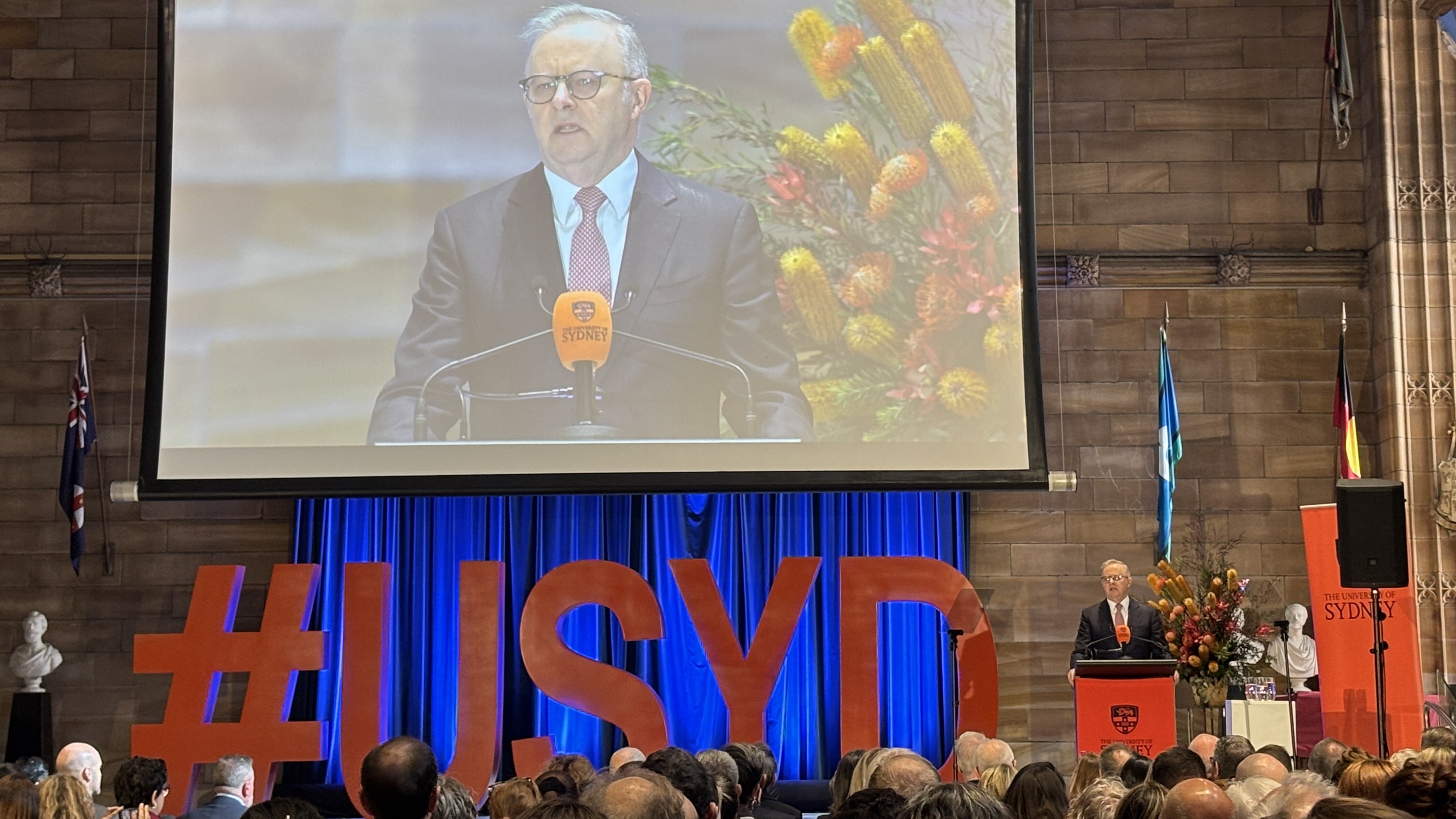
Anthony Albanese announces the government's plan to a room of AI researchers, journalists, and fellow politicians. Image: Tom Williams / Information Age
'The ambition is not defined enough’
Dr Sue Keay, director of the University of New South Wales (UNSW) AI Institute, said while she welcomed the prime minister’s announcements, she thought it was “very light on detail” when it came to possible public investments to build more AI domestically, and did not outline a clear AI strategy.
“I think the ambition is not defined enough, and if we followed the lead of other nations in having a strategy that we were aiming for, I would feel more comfortable,” she told Information Age.
“But if AI being part of [the PM’s department] actually means it can unlock some funds from Treasury, that would be a huge step forward.”
Professor Weatherall said while the prime minister’s push to encourage frontier AI companies to invest in Australia was “not necessarily a bad thing”, she also wanted “a bit more detail” on how Labor plans to build Australia’s AI capabilities.
The nation “needs to see investment in building local models, building local capability, connecting Australian data to Australian models and making that available, and investing in research compute and public interest compute”, she said.
“A lot of those things are kind of necessary to realise that goal of building in Australia, having control of our own destiny, building in the Australian interest – and the question is, ‘What’s the plan for all of that?’”
Cori Stewart, CEO of AI and robotics commercialisation centre ARM Hub, suggested local data centres should be directed to provide more affordable computation to local companies and researchers that are facing rising token prices from overseas vendors.
“It can all be turned off at the flick of a switch if we don’t create our own sovereign AI,” Stewart said.
AI not ‘a threat to good jobs’, Albanese says
The prime minister suggested Australia “should not treat AI as a threat to good jobs” and should instead “use it as an instrument to help create them”.
“That is the responsibility, the challenge and the opportunity facing our country,” he said.
“... We cannot settle for a short-term boom in capital expenditure and construction.”
Dr Keay from UNSW said while Albanese’s speech included “really positive messaging around jobs” – including a reference to a recent government report that found AI was not causing mass layoffs – she hears concerns from Australians about the technology's possible impacts on jobs, including fewer companies hiring recent graduates.
“Everyone’s worried about graduate recruitment and graduate jobs,” she said.
The Australian Computer Society (ACS), the publisher of Information Age, said it would welcome legislated standards for AI, including data centres, but also emphasised the importance of securing local jobs.
“Data centres that expand Australia's capacity are good for the economy and for Australia's strategic position in the Indo-Pacific,” ACS CEO Dr Prins Ralston said.
“But this infrastructure will only ever be as sovereign as the professional workforce that designs, operates, secures, and governs it.”