





Women are enjoying strong progression in technology careers but are still not getting the same level of influence in the workplace as their male counterparts, according to new research.
The ISACA Tech Workplace and Culture 2026 report, based on a survey of 1,025 tech professionals globally, shows several positives when it comes to gender diversity in tech, but many areas for improvement.
The report found that women are now getting salary increases and promotions consistently, and on par with men, but are considerably less likely to say they have proper authority and control across several key areas of a company’s operations.
Less than a third of the surveyed women in tech said they have sufficient authority over purchasing decisions at their organisation, compared to more than half of men.
When it comes to contributing to company strategy, two thirds of men said they had sufficient influence, compared to just over half of women.
This is also reflected in overall satisfaction levels at work, with 52 per cent of women saying they are satisfied with the culture at their employer, compared with 65 per cent of the surveyed men.
Moving beyond just counting roles
ISACA Oceania ambassador and Australian Computer Society (ACS) Fellow Jo Stewart-Rattray said the findings show career progression doesn’t necessarily translate into workplace influence.
“Women are reporting strong career momentum, yet they’re significantly less likely than men to feel they have sufficient authority over strategy, personnel, and purchasing decisions,” Stewart-Rattray told Information Age.
“We need to move beyond simply counting how many women are in the room and consider whether they have an equal voice in what happens there.”
Tech companies need to look not just at who is in higher-level roles, but at who is actually making the decisions, Stewart-Rattray said.
“Are women included in strategic discussions?
“Are their recommendations being heard and acted upon? Are they being given opportunities to lead significant projects and make decisions?
“These are the questions that will help us understand whether career progression is translating into meaningful influence," she said.
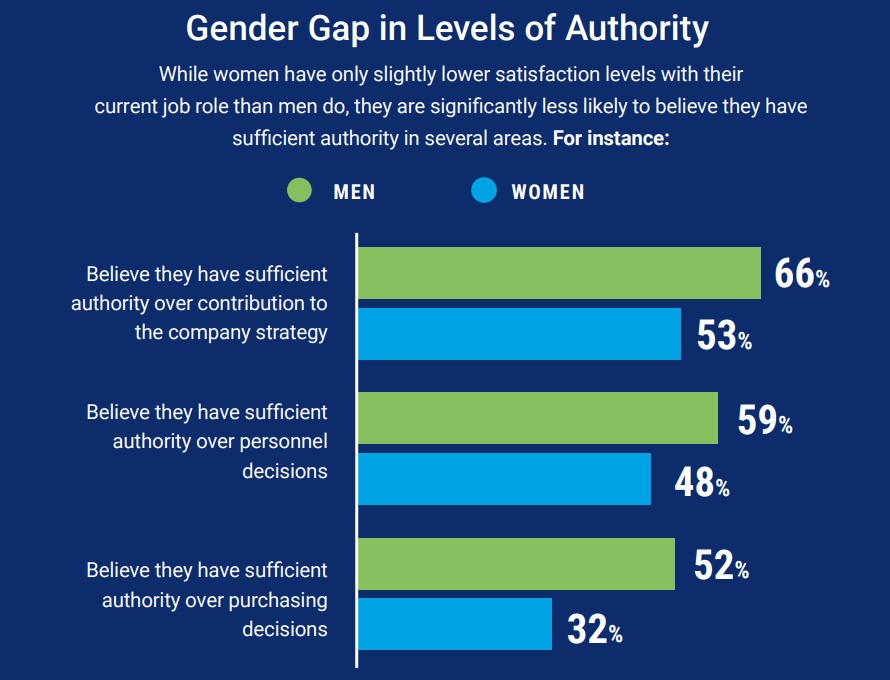
Chart: ISACA 'Tech Workplace and Culture 2026'
Women and men in tech are generally on par when it comes to promotions, pay increases, and career progression, the research found.
Nearly three quarters of the surveyed women had received a salary increase or promotion in the past two years, compared with 71 per cent of men.
Just under 70 per cent of women are satisfied with their career progression, compared to 73 per cent of men.
The report also found that women are, unsurprisingly, more likely to report facing barriers from the very beginning of their careers in tech.
Nearly one third of women reported encountering gender or diversity bias or stereotypes in their careers in tech, compared with just 4 per cent of men.
Half of the women surveyed said they believe pay inequality exists between men and women in tech, compared to a quarter of men.
More than a quarter of women in tech reported feelings of self-doubt and lack of confidence in their work, compared with just 14 per cent of men.
Recent data reported to the government revealed gender pay gaps had more than doubled at some tech firms including Canva and NextDC, and the local arm of Amazon Web Services (AWS).
This data looked at the differences in average earnings between men and women within a company, rather than comparing pay rates for men and women working in the same roles.
Looking to move
While the ISACA report found tech workers are generally happy in their current roles, nearly two thirds said they would think about changing jobs within the next two years, and 75 per cent said that retaining talent was a key challenge for their employer.
Those that were looking to change roles said this was mainly for better career prospects, higher compensation, and more interesting work.
Another report earlier this year revealed there are strong foundations in place when it comes to gender diversity, but there is still a lot of work to be done.
It revealed that women now make up nearly half of the wider Australian tech workforce, but still account for just 20 per cent of highly technical roles.
It found that this was due to structural issues such as workplace cultures, inflexible work practices, and the absence of proper leadership.
ACS is the publisher of Information Age.