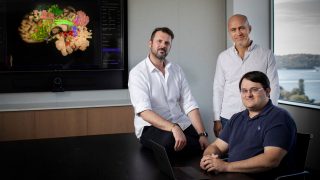

Australia has invested $54 million in Melbourne-born brain-computer interface company Synchron, the federal government’s National Reconstruction Fund Corporation (NRFC) announced on Thursday.
The company, which spun out of the University of Melbourne but is now headquartered in New York City, has completed a $305 million Series D funding round after previously receiving investments from the likes of tech billionaires Bill Gates and Jeff Bezos.
The NRFC said its equity stake in Synchron would help the company conduct final clinical trials and gain US regulatory approval for its minimally invasive Stentrode device, which does not require open-brain surgery and allows paralysed people to control digital interfaces with their thoughts.
The funding would also help Synchron establish a commercial hub and further clinical trials in Australia, the NRFC added.
The fund’s CEO, David Gall, said the NRFC was “proud to be investing in such groundbreaking Australian technology”.
“Investing in Synchron also helps to commercialise Australian innovation and technology, contributing to our sovereign medical capability and helping to create highly skilled jobs for Australians in the future,” he said.
Synchron co-founder and CEO, Tom Oxley, said the NRFC’s investment validated the company’s vision and “the pioneering Australian innovation that underpins our technology”.
“Most importantly, it brings us closer to delivering life-changing brain-computer interface devices to millions of people worldwide who are waiting for a solution,” he said.
Previous NRFC investments have gone to the likes of cloud computing firm Vault Cloud, AI medical startup Harrison.ai, and quantum technology company Quantum Brilliance.
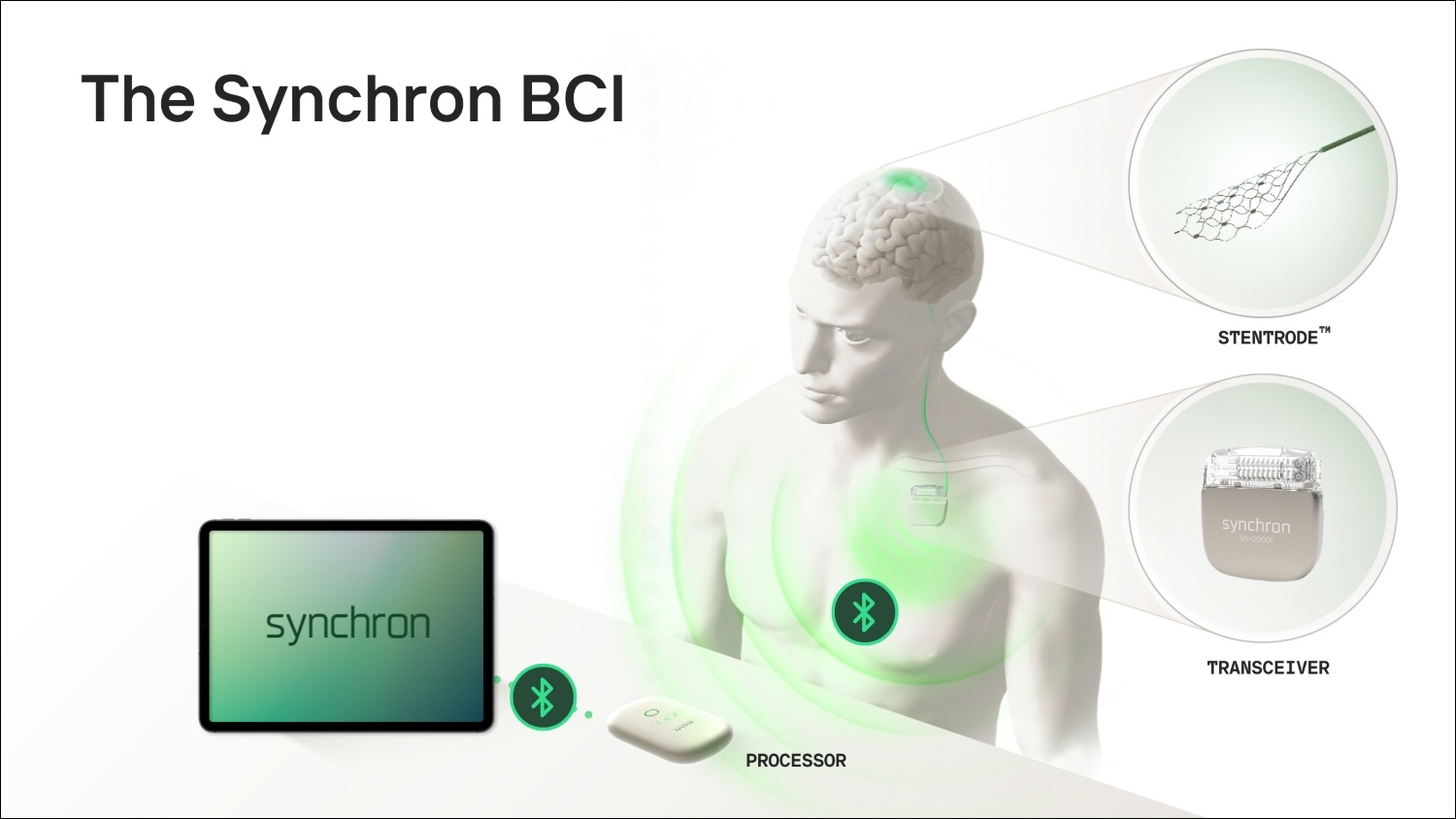
Synchron's brain-computer interface (BCI) reads neural signals through blood vessels in the brain. Image: Synchron / Supplied
Synchron developing ‘next-generation brain interface’
Now backed by around $528 million ($US345 million) in total funding, Oxley said Synchron was also developing “a next-generation brain interface that pushes the frontier of what’s possible”.
Synchron, which has an engineering hub in San Diego, said it also planned to expand its so-called NeuroAI division in New York City to train AI models “that learn from brain data to decode thought in real time”.
This work was part of the company’s goal of developing AI models which could understand human thought without any human input, it said.
To date, Synchron has implanted its existing Stentrode device in 10 patients with paralysis in Australia and the US.
“Implanted via a non-surgical catheter procedure, the device interfaces with the motor cortex through the blood vessels, recording and transmitting neural signals wirelessly to enable hands-free control of digital devices,” Synchron said.
The company has also collaborated with the likes of OpenAI, Amazon, and NVIDIA, and was the first brain-computer interface firm to integrate its technology with Apple’s to allow users to control iPhones, iPads, and Apple Vision Pro with their thoughts over Bluetooth.
Synchron faces competition from the likes of Elon Musk’s Neuralink, which has surgically implanted brain chips into patients and is developing an experimental device to restore people’s sight.
Neural data needs protection, Human Rights Commission says
Australians' neural data — that which is generated by their brains — should be protected under privacy laws, the nation's Human Rights Commission argued in an October report.
The commission suggested neurotechnology “must not be used to coerce, manipulate, or punish individuals for their thoughts”, and recommended 'neuromarketing' (the measurement of neural signals to better understand consumers or voters) be prohibited.
It also called for a “human rights by design” approach to neurotechnology development, and recommended the creation of a specialist agency “to protect consumers and establish effective safety standards to oversee consumer products”.
Australia’s Human Rights Commissioner, Dr Lorraine Finlay, said it was crucial that technological progress in neurotechnology did not come “at the expense of our most fundamental rights and freedoms”.
“It is about remembering that the power of neurotechnology lies not just in what it allows us to do, but in how we choose to use it,” she wrote.