



Google has strongly criticised Australia’s impending ban of under-16s holding social media accounts after its popular video streaming platform YouTube was added to the ban following a federal government backflip.
YouTube was expected to be exempt from the nation's social media age ban, set to begin on 10 December, after the legislation was first introduced by the Albanese government in November 2024.
The Commonwealth reversed its planned YouTube exception in July after competitors such as Meta, TikTok, and Snapchat complained to the government and Australia’s eSafety Commissioner Julie Inman Grant pushed for YouTube to be included in the ban.
Rachel Lord, the senior manager of public policy at Google and YouTube Australia, told a Senate committee on Monday that the government’s plan to ban social media accounts for under-16s "may be well-intentioned, but in practice risks unintended consequences”.
“The legislation will not only be extremely difficult to enforce, it also does not fulfill its promise of making kids safer online,” she said.
“… This law fundamentally misunderstands what YouTube is — it a video streaming platform that Australians use as a content library and learning resource — it is not social media.”
Lord argued under-16s who were forced to use YouTube in a logged out state would be less safe, as some safety features such as parental controls over child accounts would not be engaged.
She said it would be “a really poor safety outcome” if kids were forced to use online services while logged out or accessed platforms through their parents’ accounts, and argued the ban would be “taking away the ability of parents to make decisions about what’s right for them and their families”.
Lord also suggested the government’s backflip on YouTube’s exemption “sends a very confusing — and we would argue unfounded — signal to our user community and to parents about the safety of our service”.
The eSafety commissioner suggested to the committee that platforms were also against users viewing content in a logged out state “because they can’t monetise” those views.
Inman Grant told the committee she had told Google its YouTube Kids and Google Classroom platforms would likely be out of scope of Australia’s social media age ban.
She said Google had been given until 16 October to formally respond to her office’s preliminary view that YouTube should be included in the ban.
Google says it was originally told YouTube would be exempt from Australia's under-16s social media age ban. Image: Shutterstock
Google won't confirm legal challenge or Trump lobbying
Google wrote to Communications Minister Anika Wells in July to argue YouTube should be exempt from Australia’s social media age ban, and said it was considering its legal position should it not be exempted.
Since the exemption was overturned, The Guardian has reported that Google had used that letter to argue it may challenge the government in court over procedural fairness and the ban’s implications for political communication.
Google would not confirm on Monday whether it was planning a legal challenge against the government’s decision to remove YouTube’s exemption.
“I don’t have anything further I can share at this point in time,” Lord said in response to a question from Liberal Senator Sarah Henderson.
The company also would not say if it had been lobbying US President Donald Trump about YouTube’s inclusion in the ban ahead of Australian Prime Minister Anthony Albanese’s scheduled meeting with the president, set for next week.
Stefanee Lovett, Google’s director of government affairs and public policy in Australia, told the committee there were “a range of issues” Google’s Australian team were talking to US colleagues about, but did not specify what they were.
Lovett said her team had spoken with US staff “about a range of issues that we’re dealing with in Australia at the moment, so that they understand the position”.
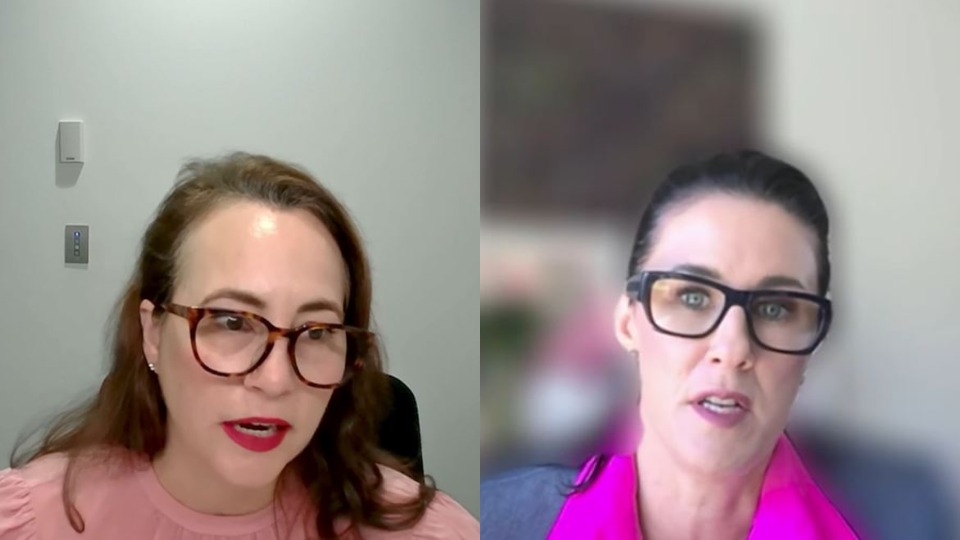
Google's Rachel Lord (left) and Stefanee Lovett (right) spoke virtually to a Senate committee on Monday. Images: Australian Parliament / YouTube
‘Not good enough’: TikTok, Meta, Snapchat dodge committee
Committee chair and Greens Senator Sarah Hanson-Young said TikTok, Meta, and Snapchat parent company Snap were all asked to attend Monday's hearing, but had refused.
“The Senate committee, we will be discussing what we do,” she said.
“I, for one, think that we should be using the powers of the Senate to subpoena their appearance.”
Henderson said it was “very disappointing” that Meta and TikTok did not agree to appear before the committee.
“This is a matter our committee takes very seriously — it’s simply not good enough,” she said.
Top officials from Meta, Snap, YouTube, and TikTok are meeting with the communications minister and eSafety commissioner this week.
Inman Grant said TikTok was not fighting its inclusion in Australia’s age ban, but suggested Meta would seek an exemption for WhatsApp as a messaging platform.
She added that OpenAI had been asked to self-assess whether its new social AI video platform Sora, which is yet to become available in Australia, should be included in the ban.
Microsoft attended Monday’s hearing and was asked whether its platforms LinkedIn or Xbox Live should be included in the under-16s age ban.
Elizabeth Thomas, a senior director of public policy at Microsoft, told the committee the company was “still evaluating the impact of the ban on our services”.
The federal government announced on Tuesday that a "national education campaign" for the social media age ban — including a radio spot, video advertisement and a "suite" of eSafety resources — would run from Sunday, 19 October.