

Australia "cannot meet" its needs for technology workers and skills without supporting skilled migration, science and technology industry bodies told a parliamentary inquiry on Friday.
The nation is experiencing significant problems attracting and retaining critical technology talent in areas such as artificial intelligence, cybersecurity, and energy, the parliamentary inquiry into the value of skilled migration heard.
Dr Kathy Nicholson, manager of the Australian Institute for Machine Learning and policy chair of industry body Science and Technology Australia, told the hearing that migrants in STEM (Science, Technology, Engineering, and Mathematics) are “essential to Australia’s productivity” amid “an acute shortage across the STEM workforce”.
This gap is increasing as Australia’s domestic STEM pipeline shows "real signs of strain”, suggested Nicholson, who referred to recent high school test results which returned Australia’s lowest maths scores on record.
“This combination – a shrinking domestic pipeline, and rising STEM demands from priorities like artificial intelligence, [defence partnership] AUKUS, cyber[security], quantum, and net zero – means Australia cannot meet its own workforce needs without migration," Nicholson said.
Slow and opaque visa processes are the top concern in attracting and retaining AI talent, she added, reflecting similar evidence heard by the committee in August.
“It takes me about 18 months to get a visa for one of these people," Nicholson said.
"That’s 18 months where in many cases they get offered other jobs in the meantime, and don’t end up coming [to Australia]."
Emeritus Professor Chennupati Jagadish, a Fellow of the Australian Academy of Science and a migrant himself, told the committee it is "very important" to attract, train, and retain skilled workers, "particularly in critical technology areas".
“I’ve lost many students to the UK, and Japan, and the US, because our visa processing took too long, and I’ve lost lots of postdoctoral fellows – again to other countries – because we have taken too long," he said.
Attracting and retaining technology and science talent has also been made more difficult by Australia's often lower tech salaries and lower investment in research and development (R&D) than other comparable nations, the committee heard.
Science and Technology Australia CEO Ryan Winn said, “We have amazing people who want to come to Australia and work here, but we have uncertainty about the speed of visas, the uncertainty of whether they can bring their families, and the uncertainty when they come here of the funding for their research."
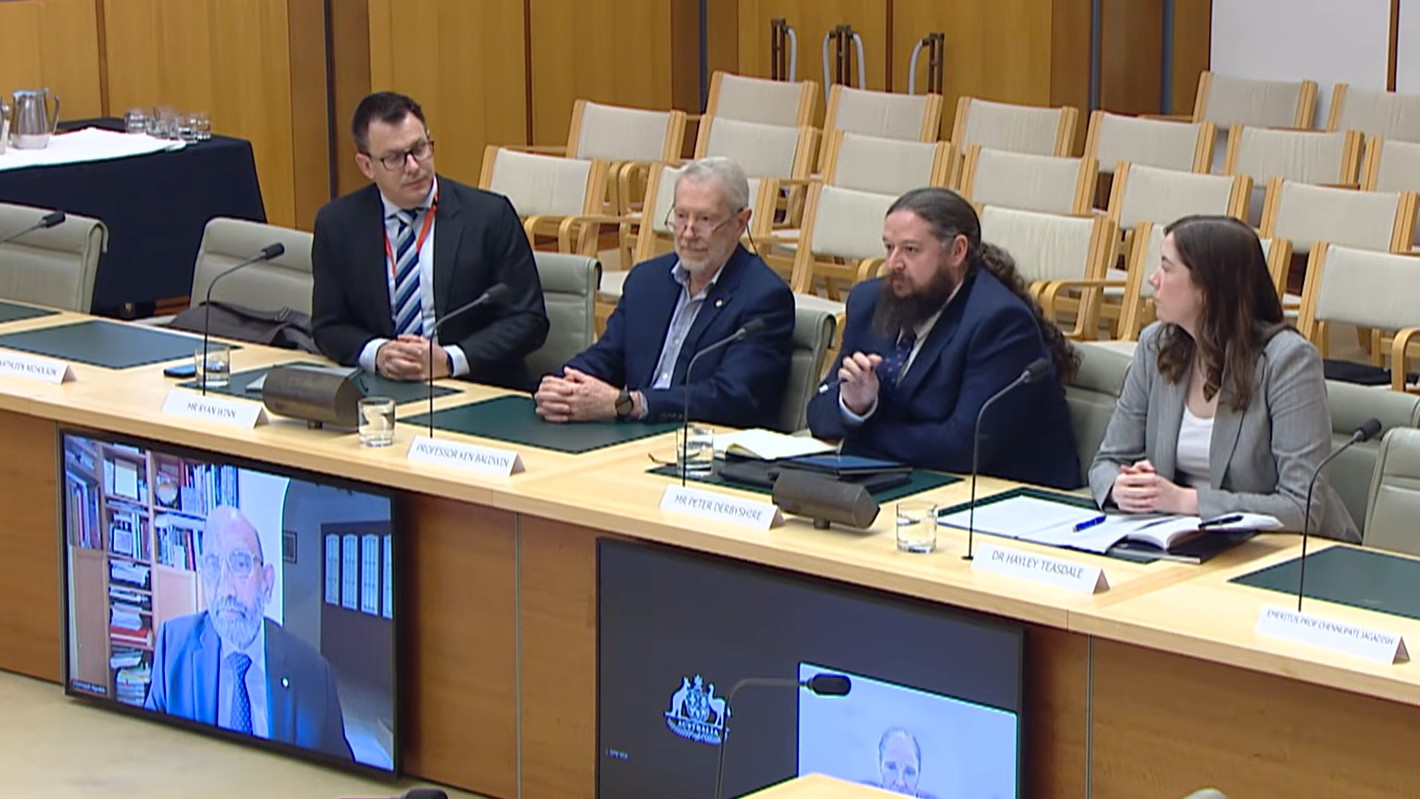
Representatives of science and technology industry bodies appear before a parliamentary committee on Friday. Image: Parliament of Australia / YouTube
Australia can't 'migrate its way out of this problem', inquiry hears
The Australian Academy of Technological Sciences and Engineering (ATSE) told the committee that while skilled migration is critical, so too is improving the skills of existing Australian workers.
ATSE's acting CEO, Peter Derbyshire, said, “Developing Australian talent is vital, and skilled migration should not be a replacement for this.
“Australia will not be able to migrate its way out of this problem, so for sectors like energy and AI we’ll need to redouble our efforts to produce a highly skilled workforce from Australian-trained students,” he said.
ATSE Fellow Professor Ken Baldwin added, “This is not just a skilled migration problem, this is a domestic education issue."
Derbyshire said that even with an improved focus on local skills, "the scale of the shortages more broadly across engineering and many other occupations" mean Australia still "won’t be able to meet the demand with domestic talent alone".
Baldwin added that he "cannot see" any critical advantage held by Australia to help it attract skilled STEM workers from overseas.
"We’ve got barriers like delays in visas, uncertainty in opportunity ... It is very difficult to understand given the salary rates and all the rest of it how we can attract people away from countries who really need these people as well in their domestic economy," he said.
“... We need a long-term plan that is holistic across government – not just the migration sector but in the education sector, in the skills training sectors, in the business sectors, and in the research sector so that Australian research can grow and attract these people as well.”
Winn from Science and Technology Australia also called for a “multi-pronged approach” supported by the federal government to support students, bring in high-end talent “so they don’t get poached before they arrive on our shores”, and to build skills domestically.
Business bodies reject One Nation migration proposal
Business industry bodies rejected a migration plan put forward by Pauline Hanson's political party One Nation on Monday, which would cut immigration by 750,000 places over three years, including large reductions in international student visas and no visas for families of students or skilled migrants.
Business Council of Australia CEO Bran Black said while his organisation agrees "the integrity and operation of the temporary migration system needs to be improved", it is "concerned" that One Nation’s proposal "risks holding back economic growth and worsening Australia’s skills shortages".
Innes Willox, CEO of Australian Industry Group, said One Nation's plan risks causing "severe economic harm" and painting Australia as "an insular nation".
"Preventing the partners of skilled migrants coming to Australia would mean many potential strong contributors to the Australian economy would not apply," he said.
"There is a global war for talent taking place and deliberately making it difficult for people with skills in demand to come here means that businesses and communities would undoubtedly suffer."
Australian Chamber of Commerce and Industry CEO Andrew McKellar said major cuts to migration would "would damage our economy, hit the budget, and weaken our capacity to provide services for, and lift, living standards for Australians".
“With many sectors of the Australian economy facing persistent skills shortages, major cuts to skilled migration are not supported by Australian business," he said.
"Migration has moved with Australia’s needs and today we need more skilled workers."