


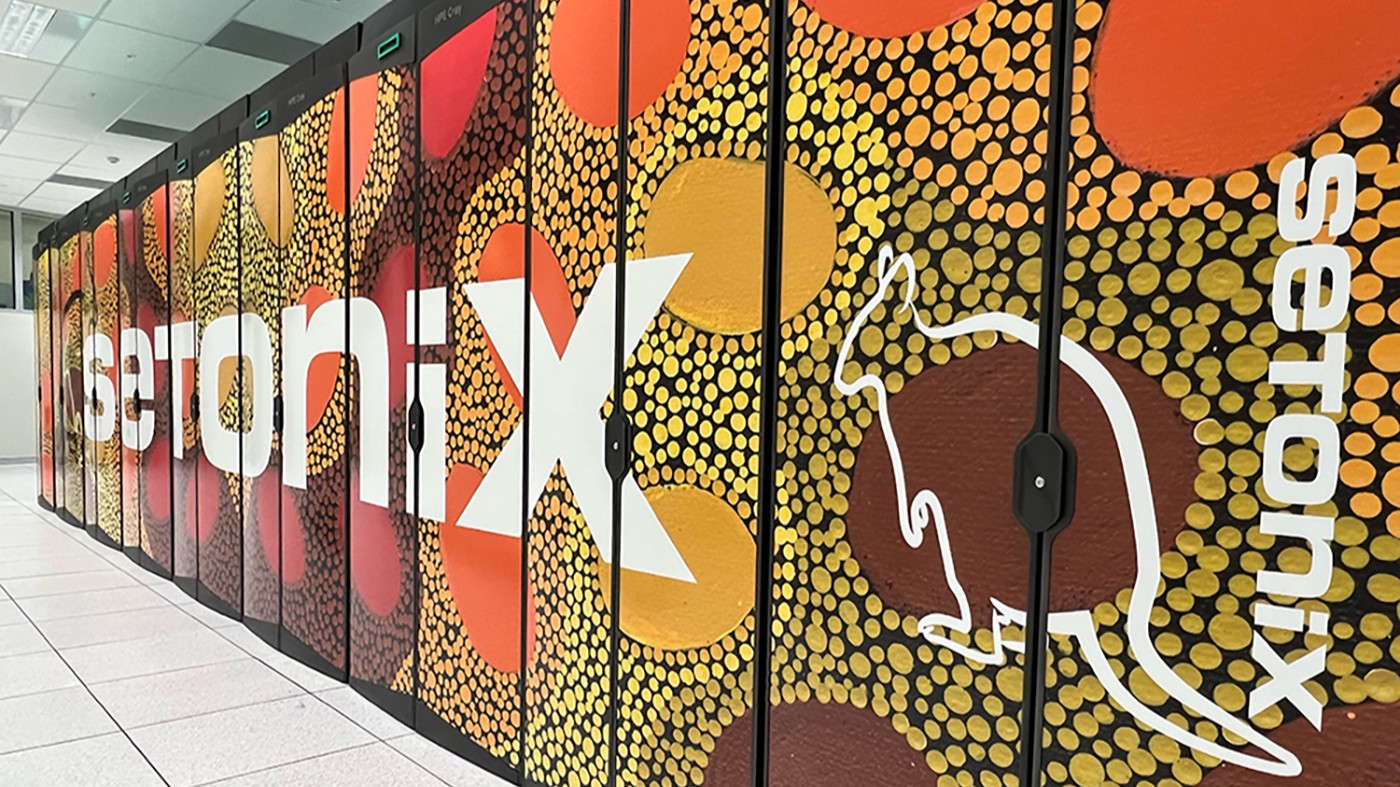

Australia's most powerful supercomputer Setonix could see "a winding down and a closure" if the nation's Pawsey Supercomputing Research Centre does not receive a significant funding boost for a replacement as technology costs skyrocket, a parliamentary inquiry has heard.
Located in Perth, Setonix came online in 2022 and is used by researchers and government bodies, with a current supported lifecycle up to 2028.
Pawsey CEO Mark Stickells said while the centre received $70 million from the federal government in 2018 to upgrade its systems – including $48 million to build Setonix – the supercomputer's future is a "critical decision that is before government", with funding for a replacement yet to be confirmed.
“We're right in the middle of a decision cycle that, if unmade, sees us move towards a winding down and a closure of this system," he told the joint select committee on artificial intelligence in Melbourne on Thursday.
Stickells suggested it would "have been better" for the government to have made its funding decision in 2025, and said 2027 would be "absolutely critical" because time would be needed to transition to any new system.
Stickells also suggested replacing Setonix would cost “four to five times” as much as it cost to build, largely due to “changes to the computing market” including rising costs.
In a joint written submission to the committee, Pawsey and fellow computing organisation National Computational Infrastructure (NCI) said “current funding levels are not sufficient”.
Both Pawsey's Setonix supercomputer and NCI's Gadi supercomputer "are now approaching major lifecycle decisions", they wrote.
"Increased prices for computing components caused by the AI boom mean that on current funding levels, the replacements for Gadi and Setonix will be smaller with less capacity,” they said.
“In short, existing funding levels will result in a lower-capacity replacement for Gadi and no replacement for Setonix at all.
"This is at a time when demand for capacity already exceeds supply, is growing rapidly due to AI, and public computing is central to Australia’s research and AI ambitions.”
Both NCI and Pawsey suggested demand for research compute in Australia has reached "approximately three times available capacity".
The Pawsey Centre is largely funded by the Department of Education under the National Collaborative Research Infrastructure Strategy (NCRIS).
The department would not confirm to Information Age whether the federal government intends to fund a replacement or major upgrade for Setonix to keep it operating beyond 2028.
A spokesperson said consultation is "ongoing" on an exposure draft for the 2026 National Research Infrastructure Roadmap, which "is developed every five years to help identify Australia’s research infrastructure needs, set priorities, and guide investment".
Australia 'very far behind' on research compute
Australia is "very far behind" other countries in government-funded supercomputing infrastructure – most notably in graphics processing units (GPUs) used in generative AI workloads – NCI director Andrew Rohl told the committee.
Government agencies such as the Bureau of Meteorology and Geoscience Australia have "plans for building AI models based on the data they hold", suggested Rohl, who said such organisations "don't have access to anywhere near enough GPUs to be able to do that work at a remotely affordable rate for a government department".
"Today we have 120 next-generation GPUs sitting in NCI," Rohl said.
"South Korea have just bought 8,500 [GPUs] for government ... for that research sector.
"... But Singapore only a few weeks ago opened their new centre with 1,500 GPUs.
"... And we have 120, so we're very far behind – so yes, some additional capability would be welcome."

Pawsey CEO Mark Stickells (left) and NCI director Andrew Rohl (right). Images: Supplied / Pawsey, NCI
Govt considers forcing hyperscalers to share compute
The federal government is considering whether a "compute reservation scheme" or a similar measure could be implemented under its planned AI and data centre standards.
This could force AI hyperscalers and data centre providers to reserve some compute capacity "for Australian research, innovation, and public-interest purposes", according to a consultation paper released in September.
Stickells from Pawsey suggested the government should not replace public computing investments with compute reservation arrangements, and instead suggested Australia would need both.
"We think that it's an important complement to bringing the private investment into this space to help support this market," he said.
"But the fundamental need for public investment – and public support so that we can govern and secure and maintain this in the national interest and and serve communities rather than just customers – is the thrust of our presentation here."
Stickells said he was also concerned that solely relying on compute reservation arrangements with hyperscalers "may not" support improving training and skills in Australia.
"If it wasn't supporting carefully the skilled jobs, the control and management of the data environments that we may need to manage with sensitivity and with sovereignty – those sorts of conditions are important considerations," he said.
In an email to Prime Minister Anthony Albanese on Monday, the joint select committee on AI recommended the government implement a compute reservation scheme for local researchers and government agencies.
The committee also recommended the government "continue to invest in public interest compute directly, through programs like the National Collaborative Research Infrastructure Strategy (NCRIS)".