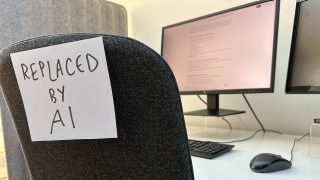

Companies that cut jobs in the rush to adopt artificial intelligence may soon find themselves hiring some of those workers back, in an AI ‘recruitment correction’.
New research has found that almost one in three US and Canadian companies that eliminated roles primarily because of AI later rehired for the same or similar positions – a trend that could eventually reach Australia.
The findings suggest some employers may have underestimated how much human expertise is still needed to oversee AI systems, manage relationships and make decisions that require context and judgement.
That could have significant implications for Australian companies, which have also begun cutting technology jobs while pointing to AI as one of the reasons.
Nearly 4,500 Australian tech workers were laid off in the first three months of this year, with AI attributed as a reason for every one of the cuts, according to analysis published earlier this year.
The new research, from global talent solutions and business consulting firm Robert Half, focuses on North America but identifies the region as a “bellwether” for the Australian employment market.
It found that just under one in three US and Canadian hiring managers who had axed a role primarily because of AI later rehired for the same or a similar position.
The most common reasons were that AI required more human oversight and quality control than expected, while businesses also found they still needed relationship management skills and institutional knowledge.
AI needs human expertise
For Australian employers, the findings could signal a shift away from broad assumptions about what AI can replace and towards a more nuanced assessment of where the technology adds value.
Nicole Gorton, director at recruiter Robert Half, told Information Age businesses could see renewed demand for roles involving judgement, stakeholder management, quality control, risk and contextual decision-making.
“For Australian employers, the biggest impact may be a shift from broad assumptions about what AI can replace towards a more considered assessment of where technology adds value and where human capability remains critical,” she said.
“We could see renewed demand for roles where judgement, stakeholder management, quality control, risk and contextual decision-making are essential.
“In some cases, employers may find that reducing headcount too quickly creates capability gaps that only become apparent once AI tools are embedded into day-to-day operations. “That could lead to rehiring for similar roles, but often with redesigned responsibilities that combine technical capability with stronger oversight, communication and decision-making skills.”
Rethinking AI job cuts
Gorton said companies should be careful about treating AI adoption primarily as a cost-cutting exercise.
“The priority should be workforce planning, whereby companies identify which tasks can genuinely be automated, where human oversight remains necessary, and which skills will become more valuable as AI adoption increases,” she said.
She also warned that cutting staff can mean losing knowledge that is difficult to replace.
“Employers should also think carefully before allowing critical knowledge to leave the business.
“This is because institutional knowledge, client relationships and technical context can be difficult and costly to rebuild.
“Retaining and upskilling existing employees to work in tandem with new technology may prove more effective than removing roles and having to recruit those capabilities back into the organisation later.”
Gorton said any Australian correction in AI-driven job cuts was likely to emerge gradually as organisations moved from experimenting with AI to integrating it into their operations.
“We would expect the earliest signs to appear among organisations that moved quickly to restructure,” she said.
“As businesses measure productivity, quality, risk and customer outcomes over time, some may find they need to rebuild capabilities they had previously reduced.”
Companies already reversing AI cuts
There are already examples of Australian and international companies reconsidering job cuts made as part of their AI strategies.
Some Australian and global companies have already been forced to rehire for positions they axed due to the embrace of AI.
Commonwealth Bank last year reversed its decision to cut 45 customer service jobs after deciding to use of AI instead, saying this had been an “error”.
A Swedish fintech also rehired some customer service staff that it had initially replaced with AI chatbots after the company realised its customers still wanted access to human support.
IBM has similarly rehired some workers after cutting 8,000 workers to implement automation in 2023.
The tech giant found that its AI bots were unable to perform many of the tasks that required empathy or subjectivity and rehired some workers to cover these gaps.
Australian tech giant Wisetech announced in February that it would be axing around 2,000 jobs during a two-year restructure as part of a “deep AI transformation”.
But the broader Australian labour market has not yet experienced the mass displacement that some predictions about AI have warned of.
A government report released in July found there was “no evidence to date of broad labour market upheaval” in Australia as a result of AI.
The report did, however, find that growth in jobs more exposed to potential automation from AI had begun to slow since the launch of generative AI tools.