

The international boom in artificial intelligence and data centres is contributing to ongoing inflation in the Australian economy, the Reserve Bank said on Tuesday after raising interest rates to a 15-year high.
The RBA board unanimously decided to raise its cash rate target by 25 basis points to 4.6 per cent, as it attempts to slow down inflation.
While rising prices are largely being driven by conflict in the Middle East and a lack of capacity in the Australian economy, an increasingly substantial factor is global investment in generative AI and associated data centres, the RBA said in a statement explaining its rates decision.
"AI-related demand is driving rapid growth in global prices for technology-related goods," the central bank said.
RBA Governor Michele Bullock added that the AI investment boom "has driven significant price rises for some inputs within the AI supply chain, including software costs and some commodity prices".
"These costs are now beginning to flow through to the prices faced by businesses and consumers," she told a press conference.
"The AI boom is also adding to demand in the Australian economy, at a time when we already have capacity pressures."
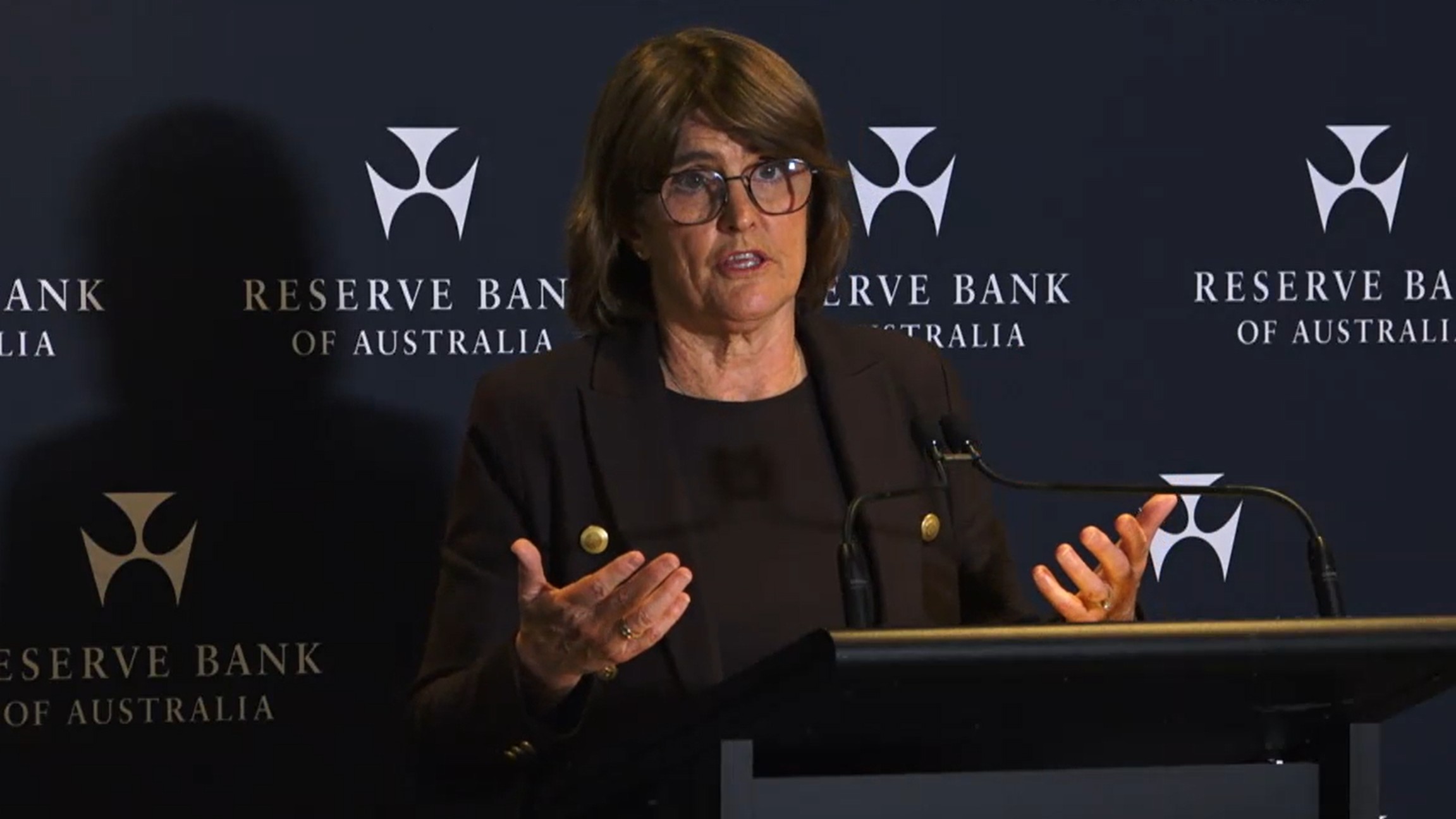
RBA Governor Michele Bullock says AI-related demand, such as data centre construction, is helping fuel higher prices. Image: RBA
Finance academic Professor Angel Zhong from RMIT University told Information Age the fact the RBA specifically called out AI "tells us it has moved from a theoretical risk to something showing up in the data, and it is the one pressure that looks likely to build rather than fade".
Bullock said "risks are building" in AI, and suggested the RBA expects inflationary pressures to continue for longer than previously expected.
Treasurer Jim Chalmers acknowledged "the impact of AI-related demand on global prices for technology-related goods" following the RBA's decision, and said inflation "is higher than we would like and the conflict in the Middle East is making inflation linger for longer".
Australian data centre funding hits $35 billion
Bullock said construction, including of data centres, is "an area we know is under pressure – that's where demand is actually above supply".
"Building data centres – the need for tradies and materials – that is actually impacting [inflation]," she said.
Professor Zhong said, "The world's biggest tech companies are spending enormous sums on data centres, and they all want the same things at the same time: advanced chips, memory, servers, electricity, and the construction workers and engineers to put it all together.
"When demand for scarce things jumps faster than supply can catch up, prices rise."
There has been "rapid growth" in the amount of funding raised by Australian data centre companies in recent years, according to RBA research released in September.
An RBA analyst estimated Australian data centre companies had raised at least $35 billion so far in 2026 – a 46 per cent increase on the $24 billion they raised across all of 2025.
Between 2020 and 2024, the annual average funding raised was only $4.6 billion per year, the research found.
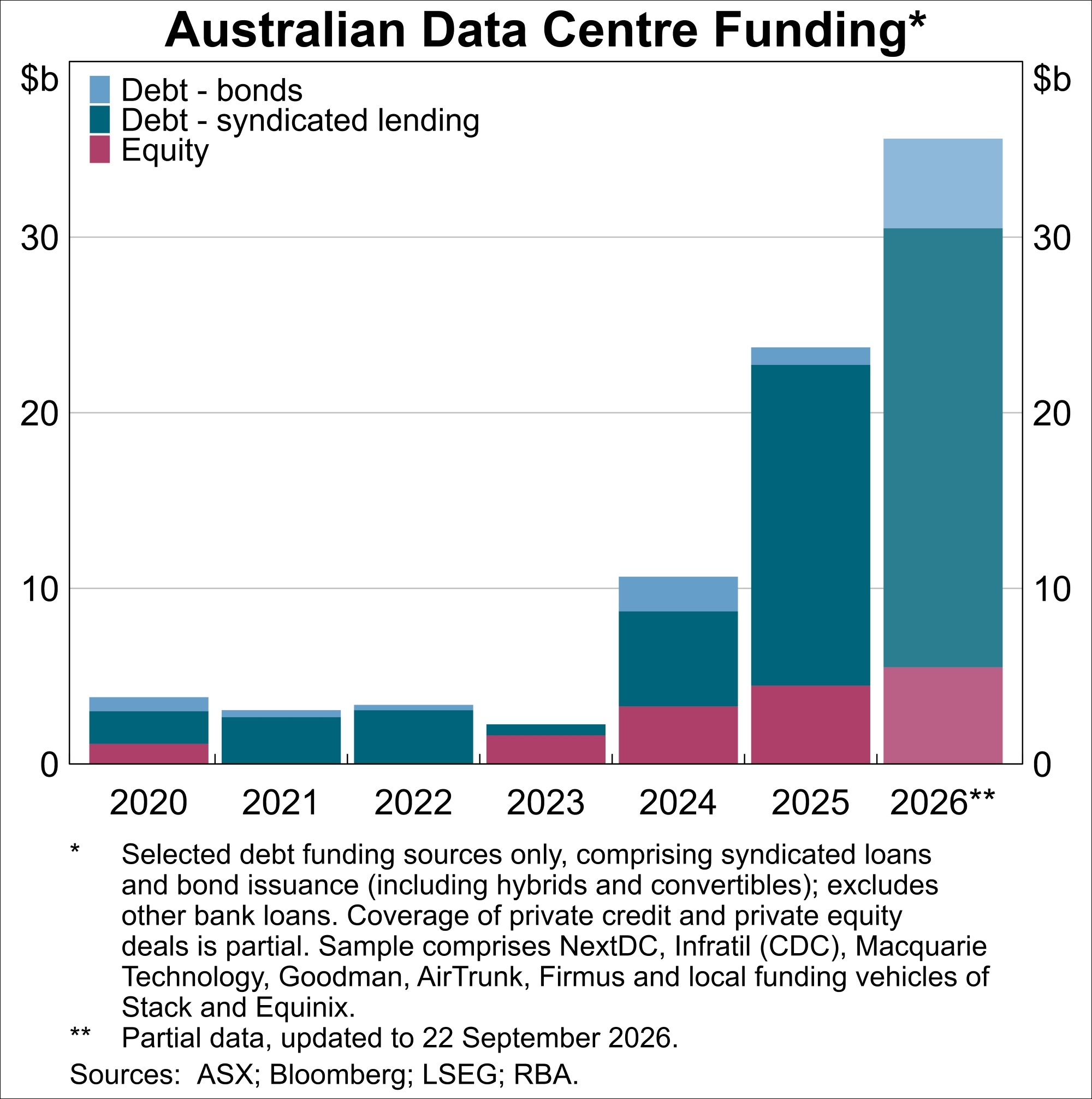
Chart: Reserve Bank of Australia
Bullock said the RBA is also "not alarmed, but alert" to changes in bond markets, which are seeing "increasing demand" for funding from governments and so-called AI hyperscalers – large multinationals such as Google, Microsoft, and Amazon.
Overseas, rising AI investments in some of Australia's major trading partners has "outweighed the adverse effects of the Middle East conflict" and supported "stronger than expected growth", the RBA said in its statement.
Australia misses out on much of this growth because it is "mostly a buyer in the AI supply chain, not a seller", Professor Zhong said.
"The economies getting a growth boost are the ones that make the chips, memory and hardware, such as Taiwan, South Korea and the United States," she said.
"They are selling into a boom at rising prices."
While Australia does get "some benefit through demand for critical minerals and energy", data centre construction "adds to demand in an economy that is already at capacity", Professor Zhong added.
Australian consumers face rising tech prices
As AI and data centres contribute to inflation by increasing the demand and reducing the supply of specialised electronics, processors, memory chips, and workers, Australians are facing higher prices for consumer devices.
Companies including Apple, Google, and Samsung have all recently increased the starting prices of most of their latest smartphones, and some other devices.
Annual headline inflation jumped from 3.5 per cent in July to 4 per cent in August, the Australian Bureau of Statistics (ABS) confirmed on Wednesday.
Rising prices in housing construction and fuel were the two largest contributors to annual inflation, according to the ABS.
The bureau's latest quarterly data showed the price of 'games, toys, and hobbies' – a category which includes video games and consoles, as well as more tradition toys and board games – rose 12.7 per cent over the past 12 months.
This was partly due to "price increases in memory and storage components being passed on to consumers", the ABS said.
Interestingly, 'Telecommunication equipment and services', which includes smartphones, smart watches, and phone and internet plans, rose by only 1.3 per cent.
While Assistant Treasurer Daniel Mulino suggested to ABC News on Tuesday that rising technology costs were "a shorter-term measure", Bullock suggested the issue would persist in the short-to-medium term.

Australians are facing higher prices for consumer devices, as AI contributes to greater demand and lower supply of key electronic parts. Image: Shutterstock
AI and the productivity problem
Despite some politicians and business leaders hoping the diffusion of AI through Australia's economy will improve the country's low productivity, Bullock said on Tuesday that while she sees that as a possibility, RBA economists "don't know" when that will happen.
"Let's hope we get there," she said.
Bullock said earlier in September that while many of her colleagues in other central banks see AI as "the great white hope to improve productivity", she believes authorities typically agree "there are very few signs yet that AI is actually influencing the supply side of the economy".
We are still in "the early stages of the AI productivity boom", she suggested during an event held by the Committee for Economic Development of Australia (CEDA).
The AI boom has been inflationary because it increases demand, while "the productivity benefits that could eventually lower costs haven't arrived yet", Professor Zhong said.
"We are paying for the AI boom now, through higher prices and higher interest rates, while the payoff is uncertain and some years away," she said.
"That's an uncomfortable position for households already stretched by four rate rises this year."