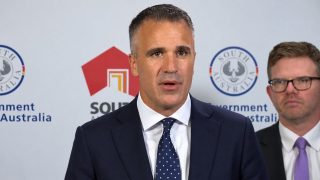

Having a uni degree will no longer expedite access to migrant visa queues, Minister for Home Affairs Tony Burke has said in releasing a long-awaited migration policy overhaul that will crack down on temporary visas and stop overseas students bringing family to Australia.
The changes, which Burke said in a National Press Club speech have been in development for much of the year in consultation with industry, include an updated Ministerial Direction 119 that will treat applicants with experience in critical areas as if they had a university degree.
Adjustments to the visa points system are intended to allow particular industries – construction, in particular – to designate in-demand skills that, he explained, “will have an uplift so that they will be viewed as though they were a higher level of education.”
Named critical areas include healthcare, construction, education, law enforcement, defence, resources, agriculture, aquaculture and fishing – but ICT related areas did not make the list, suggesting the new changes will do little to relieve problems attracting technology talent.
The measures include a focus on undergraduate overseas students, who will be barred from attaching family members to their visas – with Burke noting that “we will no longer be adding to the stock of students automatically being able to bring family members over.”
They also crack down on ‘visa hopping’, where migrants who should have left the country prolong their stay, often for many years, manipulate the system by repeatedly applying for visas in other categories.
“There are individuals who would never meet the qualifications to be able to become a permanent resident,” Burke said, noting that 80 per cent of the government’s visa caseload stems from unsuccessful asylum applicants trying to game the system.
“They effectively jump from visa to visa,” he said, “and use the appeals process to stay here as long as possible until it eventually becomes absurd to not just let them stay.”
Ballot system
Burke’s announcement came as newly released ABS figures showed net overseas migration (NOM) had fallen to 292,000 in the year to March, down 47 per cent from its 2023 peak – with Burke noting the new policies target NOM of 245,000 this year, and 225,000 in 2027-28.
Those figures are well above the 130,000 cap of the “radical reset” recently floated by One Nation and backed by the IPA, but Burke cautioned against arbitrary cuts – noting that “drastic cuts, wherever you make them, hurt the economy in every part, in every area.”
Burke also flagged a sharper focus on working holiday makers and backpackers – crucial in agricultural sectors – with a new ballot system that will cut the number of year-two backpackers from 57,000 to 45,000, and third-year recipients from 31,000 to 5,000.
The new policies have also been framed through the lens of the housing shortage, which Burke said “is not caused by immigration” but by changing demographics in which the average number of residents per household has dropped steadily, from 2.9 to 2.5.
“Every time we get a 0.1 change in the number of people per household,” Burke said, “we have to find an additional 450,000 homes…. immigration needs to be part of the solution, and we need immigration to soften enough that housing has a chance to catch up.”
“What we need to make sure of is anything that we do to temper migration needs to take account of the economic cost,” he said, “and anyone who wants to pretend there's only an economic cost in the regions does not understand the Australian economy.”
Industry welcomes change, urges caution
Peak groups in many industries have been crying out for reform as challenges in sourcing and keeping staff bite, with slow visa processing and a lack of access to suitable candidates challenging employers in tech and other industries.
The Australian Chamber of Commerce and Industry (ACCI) for one, released a new policy paper this week as CEO Andrew McKellar warned against “economy damaging cuts” and urged policymakers to “ensure migration policy settings are designed from what Australia needs up, not to chase an arbitrary NOM figure.”
The Business Council of Australia (BCA) welcomed the migration reforms “to restore integrity to the migration system” but has concerns about restrictions on working holiday visa holders and warned Ministerial Direction 119 “has made it harder to bring in skilled workers.”
The newly announced changes “will not fully resolve this issue,” CEO Bran Black said, urging for migration policy to deliver “what our economy genuinely needs…. Slower pathways affect workers across the board, wherever the shortage is.”
The Migration Institute of Australia (MIA) said it is “broadly supportive” of the policy changes, while small-business advocate the Council of Small Business Organisations Australia (COSBOA) CEO Sky Cappuccio noted that “there are small businesses looking for skilled people who don’t fit neatly into those priority areas.”
And Australian Industry Group (AiG) chief executive Innes Willox urged the government “to end the current migration pause as soon as possible because it is clearly hurting the capacity of business across the board to meet and bid for contracts and deliver for customers.”
Willox welcomed the closure of the visa jumping loophole but warned that backpacker restrictions “will create significant stress in regional areas” and said businesses “will reasonably expect” faster visa processing times for skilled migration pathways.
“We can’t afford migration to become a political race to the bottom,” he said, adding that “it is critical that demand signals remain a key part of our migration system, to ensure it aligns to our pressing and profound skills needs.”