



A new Tesla Roadster used rocket and vacuum technology to briefly drive upside down, fly, and flip through the air on Friday, when Elon Musk’s electric vehicle company unveiled the long-delayed redesign of its second-generation sportscar.
While a ‘Rocket’ version of the next Roadster is not approved for use on public roads and will only be available by “invite only”, Tesla said, a 'Performance’ version of the two-seater with no rocket thrusters and a 'Thrust’ version with only thrusters in the rear are said to enter production in 2028.
Availability of the new Roadster “is subject to each region's legal requirements and applicable laws", the company said – and the vehicle will only be available in left-hand drive, so Australians appear likely to miss out.
The redesigned Roadster debuted at an event in the US state of Texas, where it was also shown using its cold-gas thrusters to accelerate to 60 miles per hour (almost 100 kilometres per hour) in less than one second.
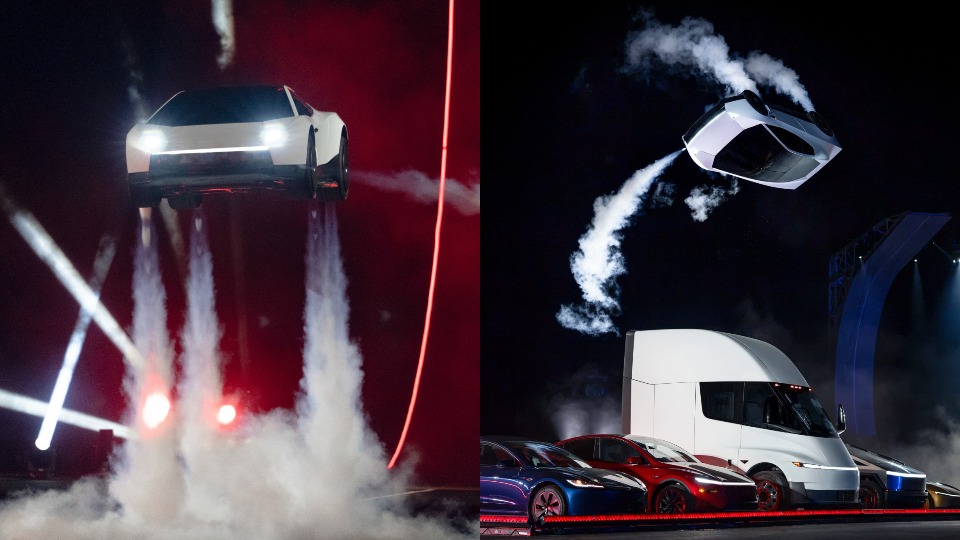
In the first demonstration at the Roadster’s launch, the ‘Rocket’ version of the vehicle – with no humans inside – drove up a ramped wall and stuck to it as it turned almost completely upside down, before slowly reversing back down to the ground.
Moments later, the car again drove up the same wall and briefly drove upside down before driving off a ramp and into the air, before using its thrusters to flip in the air, control its fall, and land relatively smoothly.
“Flying cars are real, Tesla’s vice president of vehicle engineering, Lars Moravy, told onlookers as the car came to a rolling stop.
“To do that, we have a fan suction system on the bottom of the car that can pull up to 2 Gs [of force], in order to make the car go upside down – and then we borrowed some technology from SpaceX to do the rest,” he said.
“This car really sucks,” CEO Musk added jokingly.
'Not necessarily a safety-optimised car’
In a third demonstration, the new ‘Rocket’ Roadster used its thrusters to launch into the air and flip 360 degrees while it moved forward and cleared a lineup of Tesla’s other vehicles, before landing.
Musk said the car refills its pressurised air tanks by itself, and does not need special propellants, but Tesla is yet to confirm the exact production specifications.
“It can basically fly like a rocket,” he said.
Musk suggested the new Roadster was “not necessarily legal in all jurisdictions” and is “not necessarily a safety-optimised car”, but argued its technologies will help it break records on the track.
“You might say, ‘How often do you want to stick upside down in a car?’
“Maybe not that often,” he said.
“But it actually has this benefit on the track, or just driving, where the downforce of the car means you can corner incredibly well ... because the car sticks to the ground so hard.
“... It’s gonna crush every track record that has ever existed,” he claimed.
The eventual production version of the Roadster would have a top speed faster than 370 km/h, Moravy added.
Hefty deposits, but no guarantees
Tesla has not confirmed final pricing for the second-generation Roadster, but has begun taking deposits of $US50,000 ($72,000) for its ‘Performance’ variant and $US250,000 ($360,000) for its race-focused ‘Thrust’ variant.
However, the company has not guaranteed when, or if, they will be delivered to customers.
The second-generation Roadster, which was previously unveiled in a different concept design in 2017 and originally set to start production in 2020, has been delayed several times.
While the new Roadster completed its stunts autonomously and with no human inside on Friday, Musk said the vehicle would not be autonomous and would be Tesla’s “only manual-driven car”.
“If you’re going to have only one manually-driven car, let’s take it to the limits – and way past the limits,” he said.
Tesla has increasingly integrated autonomous self-driving technology into its vehicles, but discontinued its Model S and Model X cars earlier this year as Musk sought to repurpose manufacturing lines to build its autonomous humanoid robot, Optimus.