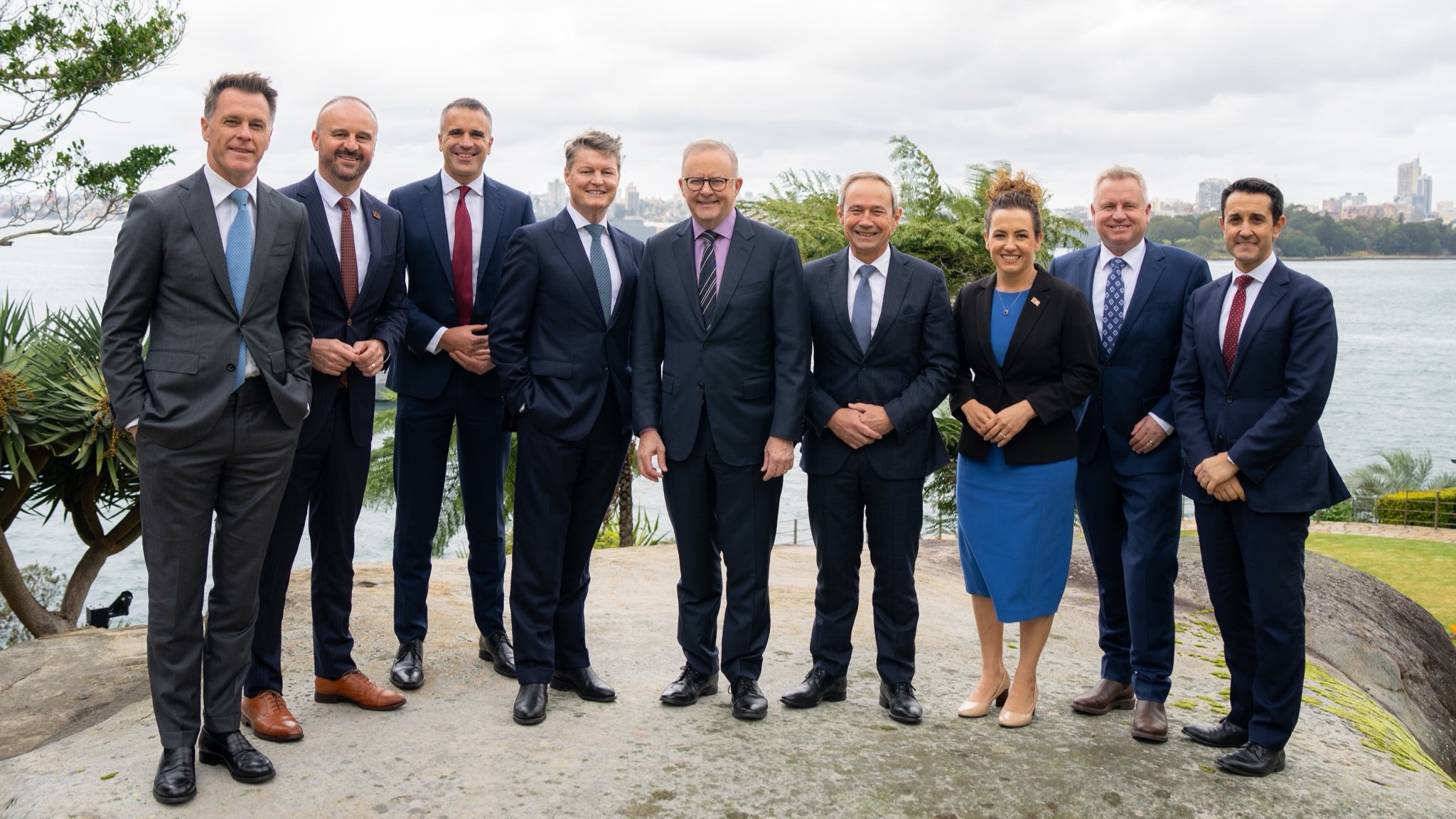

The federal government’s plan for national data centre energy rules will not force Queensland and the Northern Territory to mandate the use of renewable energy, after Prime Minister Anthony Albanese appeared to give up ground during what he called a “constructive” national cabinet meeting on Wednesday.
The federal government wants data centres to use renewable energy (backed by gas), to generate more electricity than they pull from the grid, and to follow water usage restrictions, amid public concern over their environmental impacts.
Both Queensland and the Northern Territory have resisted the government’s plan to legislate renewables-centric standards in 2027, as they want the right to allow data centre projects to use electricity generated from fossil fuels like coal, oil, and gas.
National cabinet achieved “buy-in on Australia’s national AI laws”, Albanese said in a press conference following Wednesday’s meeting with state and territory leaders, but added that he recognised “different states have different issues”.
“We want to make sure that in attracting investment, we don't have eight different systems operating around the country,” he said.
“That's why we came to a common position, which recognises that all states aren't exactly the same, and that was accommodated in the way that we normally do – in a flexible way – and that will enable us to move forward, and that will be consistent when we deliver the legislation.”
Queensland premier David Crisafulli told the press conference, “We believe that we can control our data sovereignty, protect the rights of local communities, and enable that energy mix to bring those data centres on.”
NT chief minister Lia Finocchiaro said on social media that while her government agrees with “a nationally consistent approach when it comes to water, location, and data security and sovereignty”, it is pleased that “the territory has been recognised as having different energy needs”.
The NT’s electricity system is publicly owned, while the Queensland government also owns much of the heavy infrastructure in its own system.
Opposition energy spokesperson, Dan Tehan, argued Albanese had “clearly been rolled” over his government’s proposed data centre energy rules, while Greens Senator Sarah Hanson-Young suggested Labor had “opened the door to more gas, more pollution and a fossil fuel free-for-all".
The prime minister announced in July that the government plans to legislate rules on data centre energy usage in early 2027 as part of national AI standards, which are also expected to cover copyright issues.
Federal Labor released a list of expectations for data centre developments in March, which it said would be used to prioritise proposals that used renewable energy and avoided putting pressure on power prices.
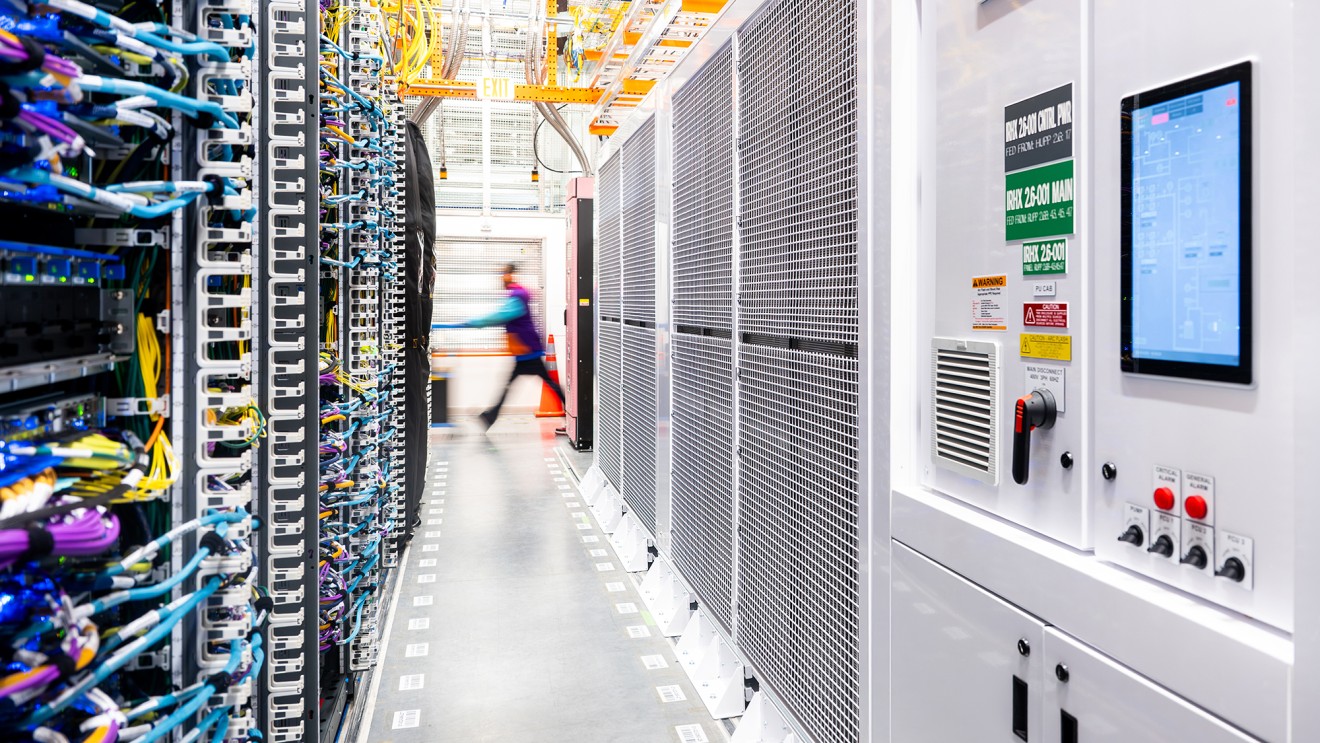
There are more than 200 data centres now operating in Australia. Image: Amazon
‘We should choose the energy mix, not a minister in Canberra’
Ahead of Wednesday’s national cabinet meeting, Crisafulli said Queensland would not support rules requiring data centres to source power exclusively from renewables, and said energy sources should be technology neutral.
“We should choose the energy mix, not a minister in Canberra who is driven by ideology,” he said in state parliament on Tuesday, arguing that Queensland has “an abundance of opportunity” with gas, coal-fired power, and renewables.
Finocchiaro said on Tuesday that the NT government rejected federal “attempts to override the territory's ability to make its own decisions on energy and investment”.
“Territorians hate nothing more than being dictated to by Canberra,” she said.
That sentiment was echoed by federal opposition leader Angus Taylor, who suggested to ABC News ahead of national cabinet that if Labor’s plan was not technology neutral, it would “raise the cost of energy for all Australians”.
A report released on Wednesday and commissioned by Data Centres Australia, the peak body for local data centre developers and operators, suggested Australia “is best positioned to deliver the AI compute sustainably” in the Asia-Pacific region.
“With large global technology companies facing growing pressure to meet Scope 2 [carbon emission] commitments, Australia is one of the few markets in the region able to credibly supply low-emissions compute at scale within this decade,” it found.
Data centre electricity usage expected to skyrocket
Electricity use by data centres in Australia’s National Electricity Market (NEM) grid – which excludes Western Australia and the Northern Territory – is expected to see a sevenfold increase over the next 10 years, the Australian Energy Market Operator (AEMO) forecast on Tuesday.
If correct, that would see data centres move from using about 3 per cent of the grid’s capacity today to around 13 per cent by 2036, AEMO said – or around the same total amount of power currently used by all homes in New South Wales and Victoria combined.
AEMO previously forecast that data centres would not consume that much power until sometime after 2050, but confirmed it is seeing “rapid growth in data centres, driven by increased AI adoption and cloud services”.
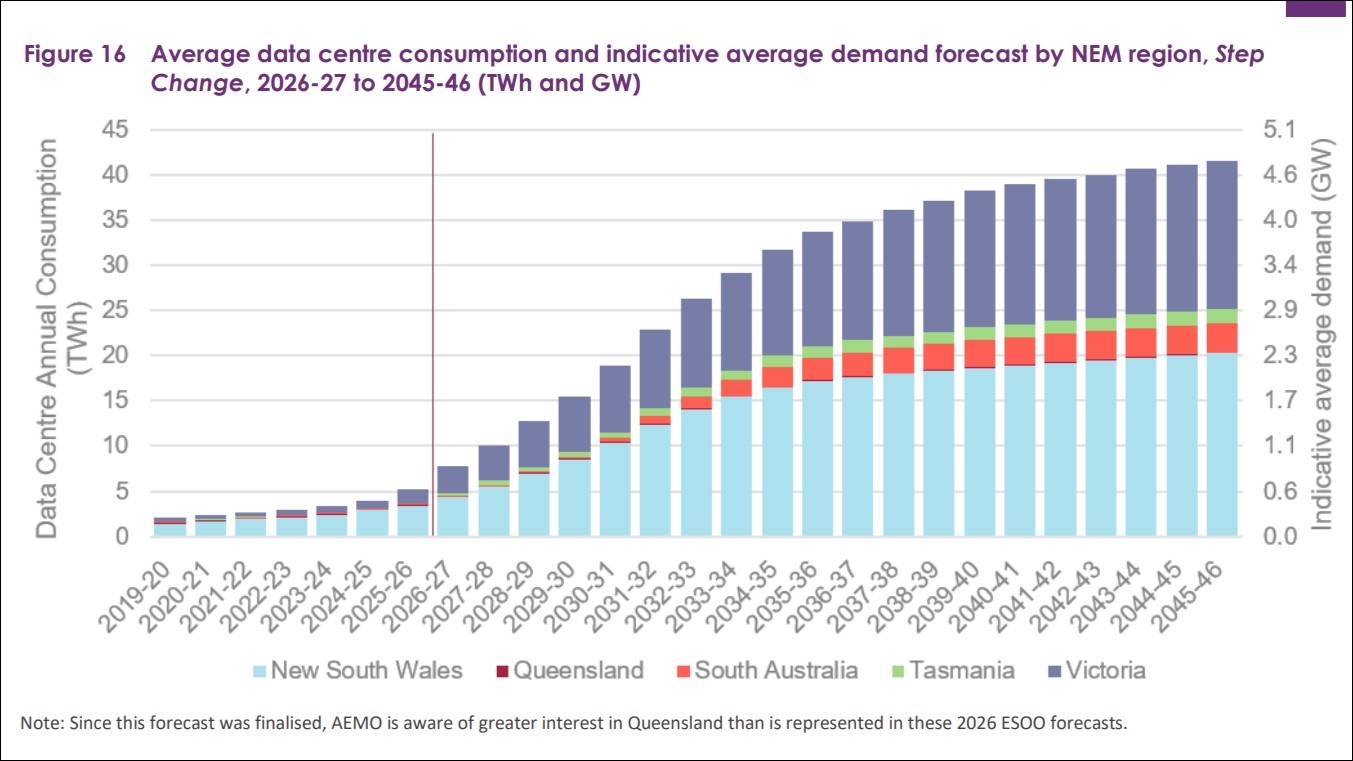
Chart: AEMO '2026 Electricity Statement of Opportunities'
While many data centres have a maximum power capacity in the hundreds of megawatts (MW), a planned $5 billion AirTrunk data centre in Western Sydney could be the first in Australia to surpass a 1-gigawatt (GW) capacity, and has raised concerns from local residents and schools.
American AI company Anthropic, which develops the Claude AI models, allegedly hoped “to locate up to 5GW of AI training capacity in NSW”, according to state government emails reported on by ABC News.
Australia currently has around 1.6 GW of total data centre capacity, according to analysts at DC Byte.
Since signing a memorandum of understanding with the Australian government in April, Anthropic has opened job listings for several Sydney-based data centre-focused positions, including an energy lead to “secure power capacity and accelerate energy delivery for our rapidly expanding AI compute footprint across the region”.
Major competitor OpenAI, which owns ChatGPT, is expected to be the first primary customer of a $7 billion NextDC AI data centre facility to also be built in Western Sydney.
There are currently 225 data centre projects "in various stages of the connection process" in the National Electricity Market, according to AEMO.
Despite the escalating proliferation of data centres, around a third of new projects proposed in the National Electricity Market have been cancelled over the past year, according to the market operator.
Google reportedly paused plans for a $20 billion AI and data centre hub in Australia in 2025, but the likes of Amazon and Microsoft have publicly announced plans to invest billions more dollars into local data centres in the coming years.