
Australian internet users are being blocked from some of the world’s most-visited pornography websites after their owner restricted access in protest over new age assurance rules which come into effect on Monday.
Canadian company Aylo, which owns numerous porn websites including Pornhub, YouPorn, and RedTube, blocked Australian visitors to RedTube, YouPorn, and Tube8 on Friday, and said it was “not currently accepting new account registrations” from Australia.
Aylo’s most popular site Pornhub is the most-visited pornographic site in the world, and has begun showing only non-explicit content to Australian users who are not signed in.
Pornhub is the 15th most-visited website in Australia and 25th globally, according to the latest data from Similarweb.
Aylo has previously taken similar action in the United Kingdom and France, as well as in some jurisdictions in the United States.
Age assurance technologies such as facial age estimation or credit card checks are already used by major social media platforms under Australia’s under-16s social media ban, but they are not always accurate and can sometimes be circumvented.
The country's new online safety rules are part of so-called ‘Phase 2’ codes which were co-developed with Australian technology industry associations and registered by eSafety in September 2025 – six months before they were to take effect.
Under the new rules, relevant websites must conduct risk assessments and take steps to comply with the codes, or face potential fines in the tens of millions of dollars.
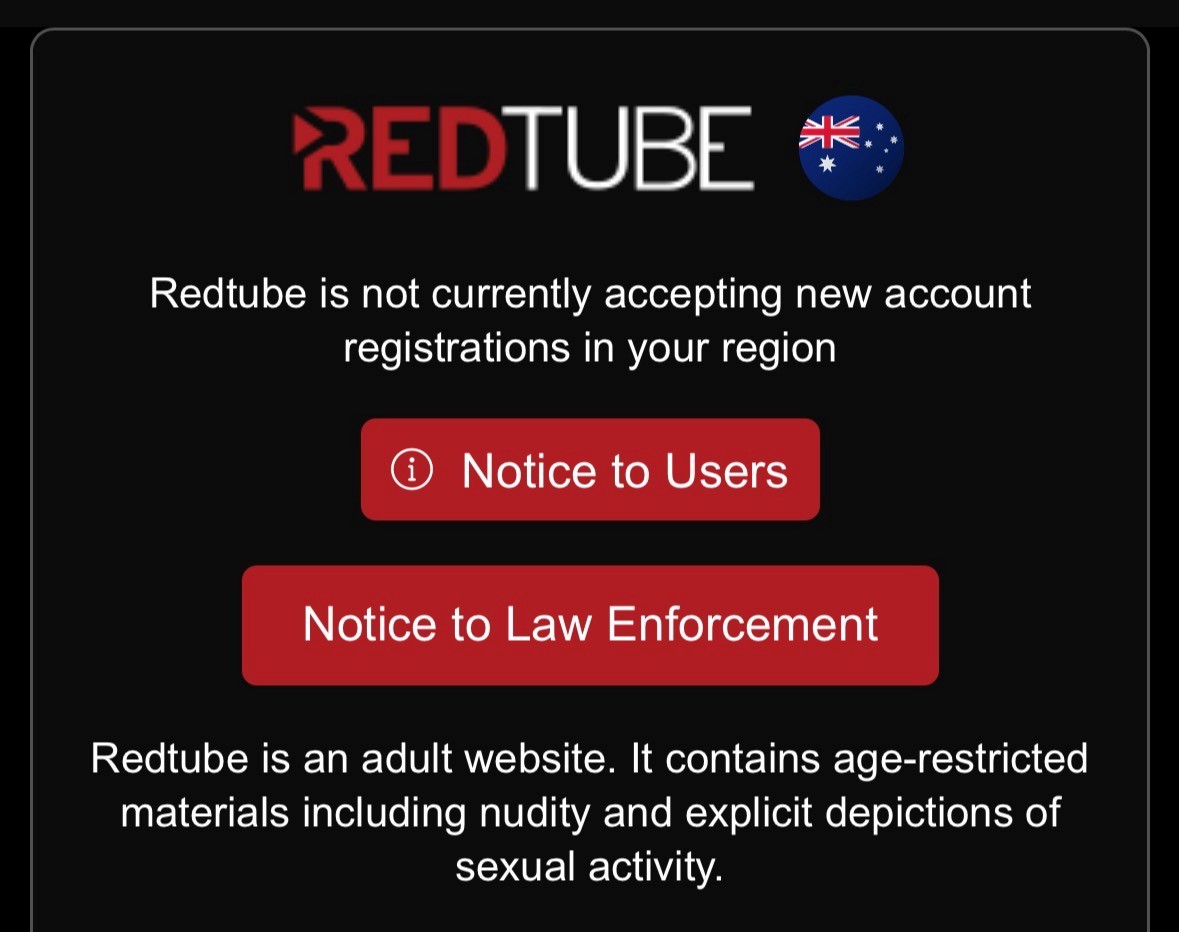
Image: RedTube
Clicking ‘I am 18’ now ‘no longer sufficient’
While the office of Australia’s eSafety Commissioner Julie Inman Grant has argued the new rules are not unprecedented due to similar regulations in the UK, France, Germany, and parts of the US, it is the first time Australians will need to provide biometric data or proof of their age to access pornography online.
“Clicking a button that says ‘I am 18 years or older’ is no longer sufficient,” eSafety said.
The government agency has noted that some online services “may allow one-off age checks that apply across future sessions or across connected services”, but others may ask for age checks every time they are accessed.
“While the codes will provide stronger protections for children, they also require services to give all Australians information, tools and options to limit their exposure to this sort of content,” eSafety said.
Inman Grant said she would “take enforcement action where there is systemic non-compliance", and a breach of a direction to comply with a code could result in penalties of up to $49.5 million per breach.
“No piece of regulation will eliminate all risks and harms all at once, but these codes create meaningful protections for children across the tech ecosystem,” Inman Grant said.
“… The codes also ease the burden on parents, carers and schools, ensuring the online environment aligns more closely with offline protections and they complement other recent reforms, including the social media minimum age obligation.
“But make no mistake, where we see failures or foot-dragging, we will hold companies to account.”
The new industry codes were put in place “to ensure children are having age-appropriate experiences and not being exposed to potentially harmful content too early”, Inman Grant added.
“These industry-developed codes shift that responsibility back where it belongs – onto the companies designing these digital platforms and profiting from their users – and will give children back a little more of their childhoods,” she said.
Australia's adult entertainment association Eros was contacted for comment.
Australia's eSafety Commissioner says age assurance rules will better protect children online. Image: Shutterstock
Aylo has argued ‘irresponsible porn sites’ still easy to access
The United Kingdom introduced similar rules within its Online Safety Act which took effect in July 2025 and mandated age assurance for sites with pornographic content, including through credit card checks and facial age estimations.
Aylo claimed in October 2025 that Pornhub’s UK traffic had dropped by 77 per cent following the changes.
The company announced in January 2026 that it would block UK visitors to its sites who had not already registered an account or had their age verified.
Aylo said it would no longer participate in what it called a “failed system”, which it argued had “not achieved its intended goal of protecting minors”.
The company has also voiced concerns over the privacy of age assurance systems, which are typically run by third-party providers and have already been embroiled in data breaches.
Aylo’s vice president of brand and community, Alex Kekesi, said in January that the firm was concerned “thousands of irresponsible porn sites will still be easy to access” despite the UK’s new rules.
“We believe this framework in practice has diverted traffic to darker, unregulated corners of the internet, and has also jeopardised the privacy and personal data of UK citizens,” she said.
“… Based on our data and experience, effective enforcement is not possible, circumvention is rampant, privacy is compromised, and new, unregulated sites quickly fill any gaps left by responsible operators.”
Aylo has advocated for age assurance systems to be integrated at the operating system level of consumer devices – an argument which has also been made by numerous social media firms.
The company did not respond to requests for comment about Australia.
Australia’s age assurance checks aren’t just for porn
Aside from porn, Australia's latest online safety codes also apply to websites and online services which allow users to view or share high‑impact violence, suicide, self‑harm, and disordered‑eating content.
Generative AI services and chatbots which have the highest risk of exposing children to pornography or harmful material must also implement age assurance checks under the new rules – as do providers of video games which are rated R18+.
Similar age assurance technologies are also being mandated by eSafety for internet search engines such as Google or Microsoft’s Bing, which must implement age assurance checks for logged-in users in Australia by 27 June 2026.
Users who are not logged in to accounts with search engine providers such as Google or Microsoft should expect pornographic and violent or harmful content to be blurred or hidden by default under those new rules.
Signed-in users who are found to be aged under 18 by age assurance checks are expected to have safety tools such as ‘safe search’ functions set at their highest levels by default, to filter out such content.
App stores must also implement age assurance by 9 September 2026, before allowing users to download apps rated 18+, but Apple began implementing age checks for its Australia’s App Store in February.