
Educational authorities are warning that the competitiveness of Australia’s universities has been “undermined” after an unexpectedly large visa application fee increase left foreign students paying hundreds of dollars more than they were just months ago.
Although application fees regularly jump by a few per cent each fiscal year to keep pace with inflation, on 1 July prices increased by 25 per cent across the board – leaving most prospective foreign students paying $2,500 to apply for subclass 500 student visas.
Fees for skills in demand visas (subclass 482) increased from $3,210 to $4,015 while Skilled Independent (189), Skills Nominated (190) and Employer Nomination Scheme (186) visa application fees rose by over $1,200 – from $4,910 to $6,140.
The price of employer sponsored Skills in Demand visas, which prioritise applicants with skills in high priority areas, increased by $805, to $4,015.
And the Temporary Graduate visa, which authorises graduates to stay in Australia while they secure work, doubled in price on 1 March – from $2,300 to $4,600 – and has now increased to $5,750, up $3,450 (150 per cent) in four months.
The price changes “blindsided” the student migration industry, with Edupi Migration CEO Justin Browne calling the latest adjustments “a genuine surprise… for a sector used to incremental, predictable indexation.”
The new fees are “a significant new cost for applicants, sponsoring employers and families already deep into the migration process,” Browne said, advising employers with sponsorship obligations to review budgeting for planned visa nominations.
Sending the wrong message?
The fee changes merited little mention by government ministers, but educational officials are concerned that they will make Australian institutions less appealing for foreign students weighing the relative benefits and costs of study in several countries.
Singapore, by contrast, charges a processing fee of just $33 (S$30); Germany $124 (€75); Canada $152 (C$150); the United States $267 (US$185); New Zealand $615 (NZ$750); and the UK $944 (£490).
One ranking found Australia to be the second most expensive country overall to study in, with students facing a $32,785 (€19,896) first-year commitment that ranked just behind Switzerland and well above a host of European and Asian destinations.
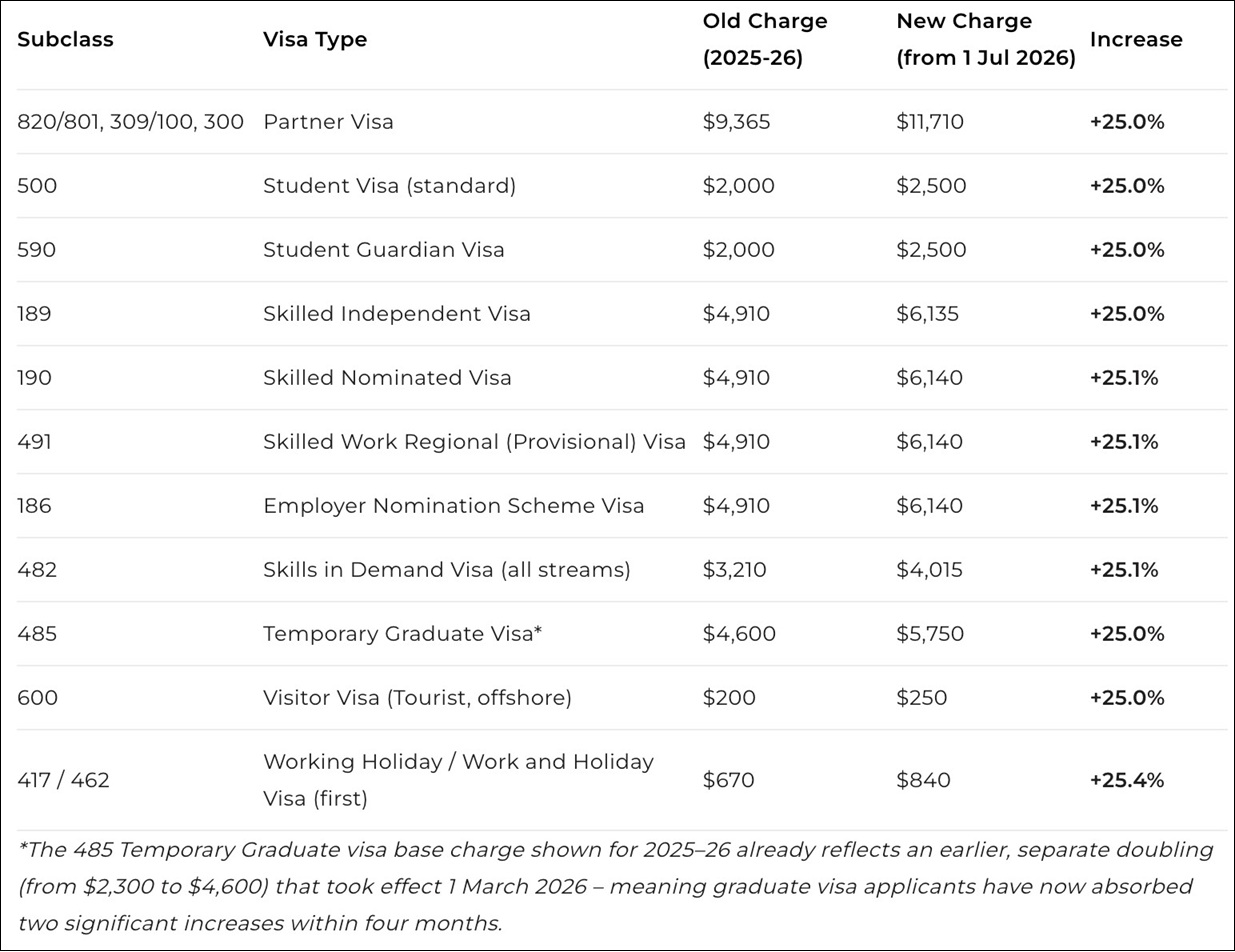
Critics worry the July 1 price increases will dissuade foreign students from choosing Australia as the place to build their careers. Source: Edupi Migration
Although Australia’s recent decision to maintain the number of overseas students at 295,000 sent “an important signal” about the value of international students, Group of Eight (Go8) chief executive Vicki Thomson said, price rises send a different message.
“That positive signal is diluted when students are simultaneously being asked to pay the highest visa charges in the world,” she said, adding that “cost matters, particularly for the talented students Australia is seeking to attract.”
“International students are much more than just an export industry,” Thomson added, but “a core part of Australia’s future skilled workforce, particularly in areas of shortage like health, engineering and advanced technologies.”
Plugging the skills gaps
Those key areas of skills shortage remain bugbears for the government, which has been working to balance universities’ enthusiasm for profitable foreign students with concerns about their impact, with measures such as requiring housing guarantees.
The changes come on a background of significant reform designed to make university and TAFE courses more industry relevant – with NSW, for one, committing $2.8 billion and the federal government investing $12.6 billion to overhaul vocational training.
Australia isn’t the only country fighting to reconcile ongoing feverish demand for its educational institutions with the need to shape their course delivery to match changing workforce expectations.
Countries around the world have been tightening means testing amidst surging rejections of visa applications by students for whom the fees are non-refundable.
Canadian authorities, for example, refused 62 per cent of study permit applications last year alone – up from 52 per cent in 2024 and 40 per cent in earlier years – while Australian student visa refusals reached a 21-year high of 32.5 per cent in February.
The US, for its part, overhauled its H-1B visa system on 1 April to crack down on deceptive hiring practices even as new rules in the One Big Beautiful Bill Act (OBBB) capped federal student loans to steer students to towards careers with higher incomes.
Other countries, by contrast, see increasing refusals as an opportunity, with Germany, South Korea, France, Malaysia and other countries jockeying for valuable foreign students.
New Zealand recently laid out a plan to boost international student numbers by 35,000 and introduced favourable visas for Indian students that the country sees as crucial to replenishing its workforce with high-level skills.
“Increasing upfront costs,” Go8’s Thomson said, “will disproportionately deter the very students Australia most needs: high-ability postgraduate students who go on to fill critical roles and strengthen Australia’s research capability.
“Visa settings should reinforce that objective, not work against it.”