
Australian startups and researchers will soon have access to Europe’s $155 billion innovation program, with Industry Minister Tim Ayres calling for an “all hands on deck” approach to build industrial resilience in the face of global shockwaves.
This “generational task” for a joined industrial, research and science policy system will help to strengthen Australia’s economic resilience, and requires the input of governments at all levels, the private sector, workers, employers, scientists, researchers and investors, Ayres said.
Ayres was named new industry minister in May last year following the federal election, taking over from Ed Husic who was ousted from the role due to faction powerplays.
On the Horizon
The Commonwealth already invests $15 billion into research and development, and Ayres said his role is to make sure Australia is getting the most out of this.
It was announced this week that Australia would soon begin negotiations to join the European Union’s $155 billion Horizon Europe R&D initiative.
This will mean Australian startups and researchers will have access to the funding pool – the largest in the world for research – from early next year.
“Universities are essential institutions and the people in them are driving the national effort – pushing breakthroughs in low-emissions technology, artificial intelligence, productivity in agriculture, new therapeutics that mitigate cancer and the foundational research and the humanities and social sciences that will shape a better future,” Ayres said.
“Horizon Europe is about opening a pool of global talent with trusted partners to deepen local knowledge and lift Australian capability in fields like critical technologies, defence and clean energy.”
‘The world is being remade’
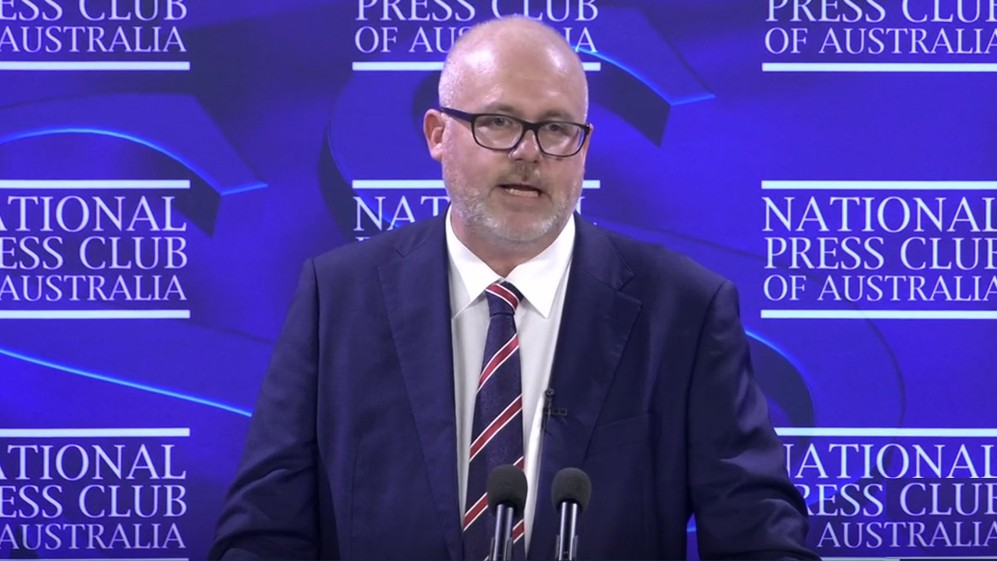
In his address at the National Press Club in Canberra, Ayres set out his vision for Australia’s industry policy and said his role is to “marshal our best and brightest to deliver long-run opportunities for working Australians”.
“The world is being remade around us – rules and norms are in flux,” Ayres said in the speech.
“We don’t have time to stand around admiring problems.
“We must make Australia stronger, smarter, safer – and more resilient to the shocks that keep coming. There’s no time for silos.
“This is a time for public service and deliberate, constructive Australian nationalism.”
In the face of economic shockwaves from global wars, industrial policy needs to be seen as security policy, Ayres argued.
“Times are tough, and budget processes are tough – but this is the Albanese government’s mission: to stop the drift and replace it with discipline and determination to deliver at a critical juncture in Australia’s history,” he said.
“These times require deep thinking, heavy lifting and coordinated effort to achieve national priorities.”
Setting expectations
Ayres also earlier this week unveiled new ‘expectations’ for data centre operators looking to build new facilities or expand in Australia, requiring them to align with national interests and ensure energy efficiency.
The expectations have been criticised by industry groups for omitting on-site data centres, and by environmental groups for not being binding requirements.
Ayres defended the expectations.
“There’s always debate when you announce a new policy framework, particularly in an area that is contested,” he said.
“But overwhelmingly the response from industry has been very positive, as has the response from the states and territories.
“What the sector is looking for is to understand what it takes to get government support for these projects.
“I’m very confident it will provide the right framework for Australia to make sure that data centre investment underpins national economic resilience and development of our electricity grid.”
The minister added the federal government was not looking to directly invest in any data centre projects or provide tax breaks.
“I don’t think with digital infrastructure the answer here is the Commonwealth government providing incentives – Australia is incentive enough already,” Ayres said.