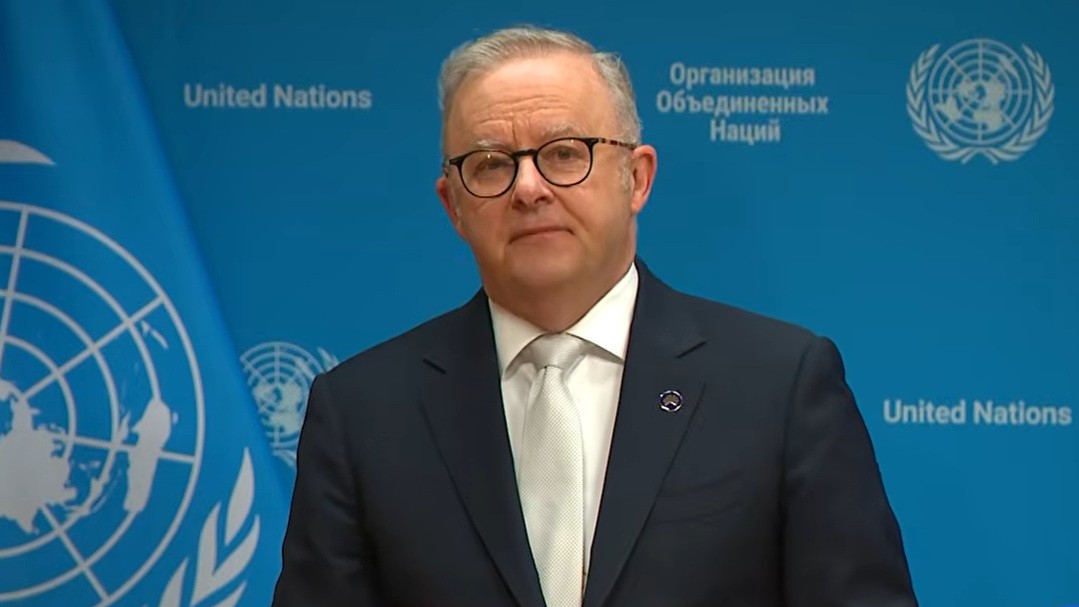

Australia has joined a group of global middle powers in urgently calling for stronger safeguards around AI to make sure the technology remains “under human control”.
Prime Minister Anthony Albanese joined world leaders from Finland, Norway, Canada, Singapore and the European Commission in signing a joint statement warning that AI development could be moving faster than governments’ ability to manage its risks.
“The rapid development of frontier AI models poses serious risks to safety and security if not appropriately managed,” the statement says.
“To realise AI’s potential, industry, governments and society must act now. AI must remain under human direction, oversight and control. It must be developed and used in line with international law.”
The leaders said current efforts to contain the risks of AI were not keeping pace with its development.
Albanese is in the US meeting some of the world’s biggest technology companies and promoting Australia’s online safety policies, while also making the case for Australia to secure a seat on the United Nations Security Council.
The UN General Assembly will meet later this week, with AI expected to be a major topic of discussion.
Australia has made online safety and regulation of big technology companies a key policy focus, with its social media age ban at the centre of its efforts.
The government recently unveiled draft legislation for a Digital Duty of Care, which would allow Australians to opt out of algorithmic social media feeds.
It would also require social media companies to “protect children from harmful content, including content that promotes eating disorders, misogynistic content, pornography and content that glorifies crime”.
The government is also developing legislation aimed at addressing the risks posed by artificial intelligence.
Albanese goes to Apple
Albanese met with Apple executive chair Tim Cook, the former CEO of the tech giant, at its headquarters in California
Speaking after the meeting, Albanese said that Cook had acknowledged Australia’s policies on social media to be “world leading”, and that Apple had worked to “support Australia’s online safety laws”.
“It was a proud moment today, I’ve got to say, when the head of a major company that has changed the world, like Tim Cook from Apple, recognises the leadership that Australia has shown,” Albanese told the media after the meeting.
“One of the things that I’m not sure has been recognised fully in Australia is just the way that Australia is seen to have led the world when it comes to protecting children from some of the negative consequences of access to social media and new technology.”
We all have a responsibility to make the online world safer for our kids.
— Anthony Albanese (@AlboMP) September 19, 2026
It’s a belief @tim_cook and I share.
Today at Apple HQ, we spoke about what we’re doing to protect children from online harm and the work ahead. pic.twitter.com/A9Ofg6S7RA
Albanese was also given a demonstration of Apple’s latest tools for parents, including features that allow them to manage the content children can access on their phones, who they can communicate with and when they can use apps.
“Walking through Apple Park today and seeing these new safety features in action proves that when we draw a line in the sand, tech companies will step up,” Albanese said in a statement.
“Tim Cook and Apple are showing that the industry can, and must, compete on safety credentials, not just convenience.”
Making the case at the UN
After the Apple visit, Albanese travelled to New York to make Australia’s case for a seat on the UN Security Council.
He said that middle-sized nations like Australia need to have more of a say shaping the global response to AI and other emerging challenges.
Albanese has also called for the US and China to agree to a global pact on AI, similar to a nuclear non-proliferation treaty, with rules designed to ensure humans “remain in control”.
The comments come after US President Donald Trump said that he had no interest in adopting a cautious approach towards AI.
“Whoever wins AI, wins,” Trump said.
“We’re the most sophisticated country in the world, and frankly, I want to keep it that way.”
The comments came as a number of leading AI executives called for a slowdown in the development of the technology and stronger guardrails.
Australia’s Digital Duty of Care is also expected to feature in discussions at the UN General Assembly.
“We’ll continue to advocate, and I’m sure that it will be a centre of discussion this week,” Albanese said.
“This week, the fact that there is such a focus on technology and its impact on the way that society operates says a lot about where we are, and that reflects the concerns of the community as we go forward.”
The push for stronger AI safeguards comes as the Australian Government also looks to the technology to deliver economic gains.
Treasurer Jim Chalmers released the 2026 Intergenerational Report on Monday, with significant expectations that AI will boost productivity.
Chalmers described AI as the “biggest economic transformation of our lifetime”.
“The rise and adoption of AI is likely to support the achievement of Treasury’s long-term labour productivity growth assumption over time,” the report said.
“As a medium-sized economy, Australia’s productivity performance will depend on adopting innovation, supporting investment, developing skills and delivering regulatory reforms that improve the efficient operation of the economy.”