

The Australian government’s industry department is no longer measuring its performance towards a federal Labor goal of 1.2 million workers in technology-related jobs by 2030, as a sector slowdown continues.
The Department of Industry, Science, and Resources (DISR) briefly noted it had “ceased” the tech jobs performance measure in its latest Corporate Plan, released on Friday.
The 1.2 million worker target was set by industry group Tech Council of Australia (TCA) and adopted by Labor in 2022, but was the only performance measure not met by DISR in its latest annual report.
DISR declined to comment on its decision to remove the performance measure or whether the goal has been formally dropped by the government, but Information Age understands the department is looking into new performance measures aligned with Labor’s goals on artificial intelligence.
A TCA spokesperson said, “The number of technology jobs across the Australian economy is affected by many factors outside the Department’s control.
“DISR has therefore removed this as a departmental performance measure, so that its performance framework focuses on outcomes the department can more directly influence.”
Australia 'will not reach’ jobs target by 2030
Documents released by DISR in July under freedom of information laws showed Australia had around 999,000 technology-related jobs in February 2026, with their quarterly growth more than double that of the wider economy.
“Despite the recent increases, the department is projecting that total technology-related jobs will not reach the 1.2 million target by 2030,” DISR noted at the time.
The department estimated that Australia will be around 71,000 jobs below the target by 2030, unless recent growth somehow continues.
DISR previously said in October 2025 that Australia was “not on track” to meet the government’s goal.
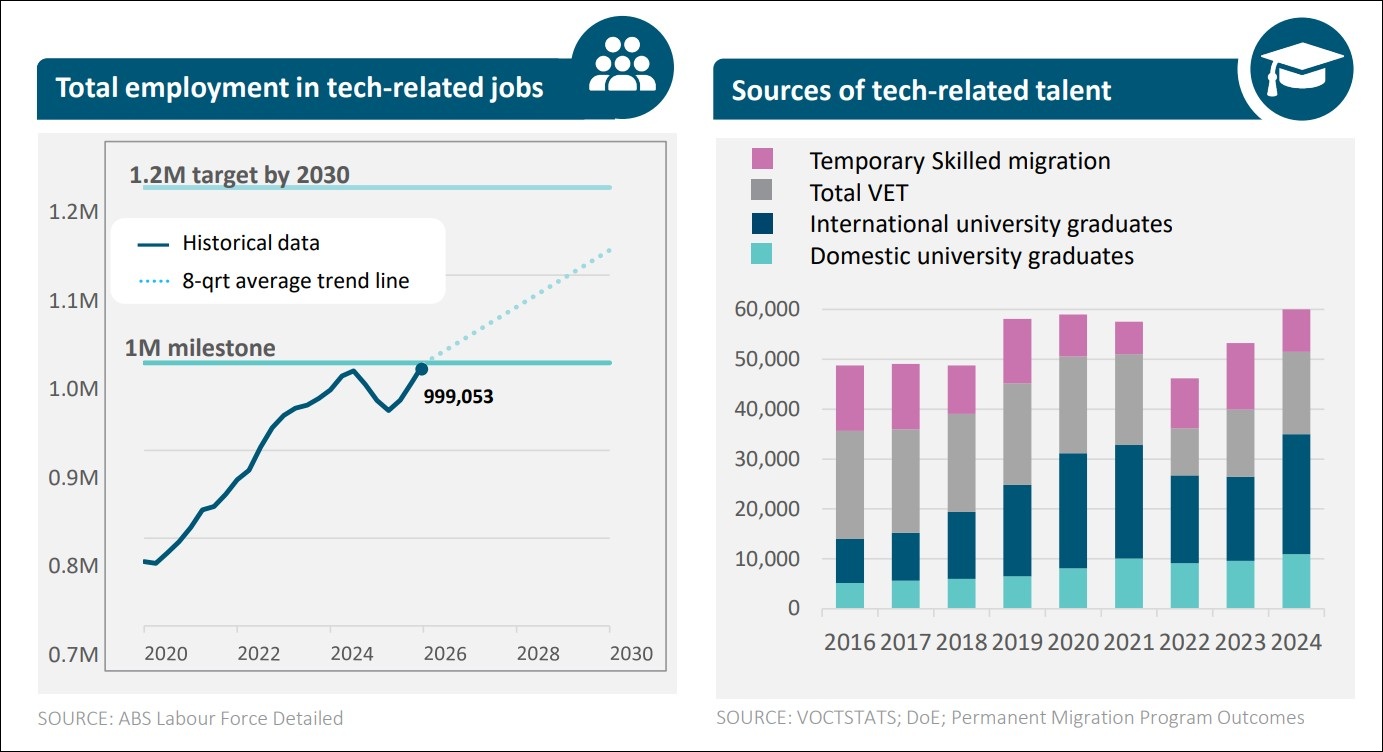
Australia has almost 1 million technology workers, according to government data to February 2026. Image: DISR FOI document
The Australian Computer Society (ACS), which represents local tech workers, has held a target of 1.3 million tech-related workers by 2030 as recently as May 2026.
But the society’s latest Australia’s Digital Pulse report, released in August, found Australia's technology workforce shrunk for the very first time in 2025 to around 967,000 workers, amid a slowdown in some ICT sales, trades, and administration roles.
As the government comes under pressure over migration, ACS’s operations director Betsy Gregg told a parliamentary committee on migration in August that visa processing time for migrants “is slowing down actively in IT”, leading Australia to lose some skilled technology workers.
AI and economic uncertainty ‘likely to be playing a role’
Documents released by DISR in July included briefs sent to the Minister for Industry and Innovation, Tim Ayres, and the Assistant Minister for Science, Technology, and the Digital Economy, Andrew Charlton, which noted declines in Australian tech jobs in 2024 and 2025 “were in line with global reductions in technology jobs”.
But they also said factors such as business evaluations of AI, “post-pandemic corrections”, and “economic uncertainty and geopolitical considerations” were also “likely to be playing a role in general technology hiring declines”.
A government report released in July found "no evidence to date of broad labour market upheaval” in Australia caused by generative AI, despite some local companies hiring fewer entry-level workers while using more AI tools.
The rising use of AI has also been cited as a factor in recent job cuts by the likes of the Commonwealth Bank, Microsoft, Officeworks, WiseTech, Telstra, Afterpay, and Atlassian.
Educational authorities raised concerns in July over unexpectedly large visa application fee increases for foreign students, given many end up working in technology-related jobs.
ACS is the publisher of Information Age.